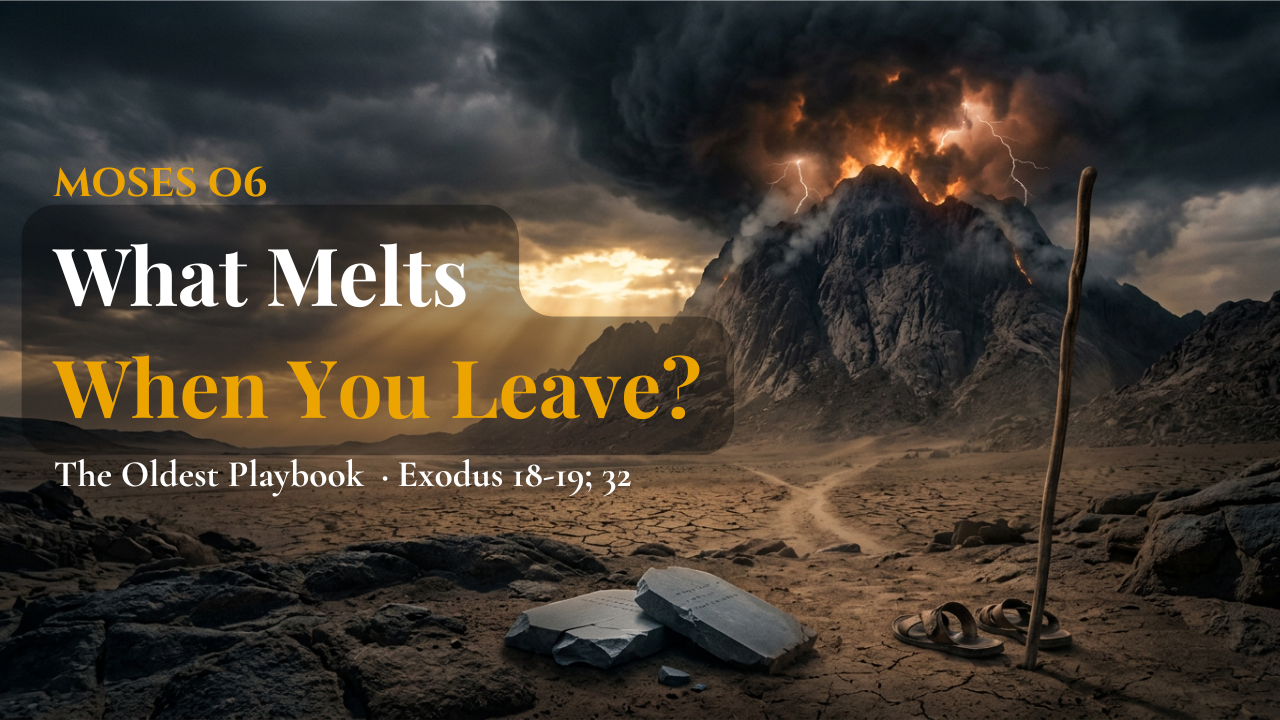
Moses 06: What Melts When You Leave
Exodus 18, 19, and 32 | The Oldest Playbook

Let me ask you the scariest question a builder can be asked.
If you disappeared for forty days — no phone, no email, completely gone from your company — what would you come back to?
I'm not asking whether the lights would stay on. I mean the culture. The standards you think you set. The mission you assume everyone bought into. If you vanished tomorrow and walked back through the door on day forty-one, would it all still be there? Or would you find something you don't recognize, and spend the next six months rehashing things you thought were settled?
Hold onto that question. Three thousand years ago, the book of Exodus ran that exact experiment. The result was brutal — and useful enough to be worth the entire finale of this series.
Where we've been
For five weeks we've run Moses as a case study — not as a religious figure, but as a founder and builder. Whether you're religious doesn't matter for the decoding; we take the text seriously as the author wrote it. If you don't believe it, put it down. But if you're going to engage it — fairy tale, fiction, or nonfiction — engage it for what it is.
What Moses executed was one of the most operationally demanding projects in recorded history: extracting an enslaved nation out from under the era's dominant superpower. Along the way we learned that Pharaoh and Moses are two different species of leader, and the difference is one question — who's your boss? Pharaoh's boss was Pharaoh. Moses had someone above him.
At the Red Sea, the insight wasn't the miracle. It was that the Israelites were bait, cornered on purpose to draw the Egyptian army in, so credit would land where credit was due. But the miracle still required a concert: Moses lifts the staff, the people walk into a seabed with their livestock. Everybody acts while the miracle is happening. You are never acting alone.
Then the wilderness, where God feeds a nation that had spent four hundred and thirty years in slavery and knew how to farm, fight, and govern exactly nothing. He doesn't give them a warehouse. He gives them manna, daily (Exodus 16). Take only what you need; take more and it spoils. Double portion before the Sabbath, so rest is built into the rhythm. That's not a food delivery. That's an operating system being installed on a population that had never run one.
All of that was horizontal. Survival. The grind. Tonight we go vertical — Moses climbs a mountain.
The whole thing in one line
You have to be willing to go up the mountain — to step out of the day-to-day and work on the thing instead of in it. But you can only go up safely if what you've built below can stand without you.
That turns on something a lot of founders get wrong. Most founders think they're building a product and the purpose of the business is to sell it. That's level-one thinking — and it's fair at zero-to-one, when you're just building a gadget you want someone to buy.
But the product you're actually building is the company itself. The company is the product that produces all the other products. And the culture is that product's operating system: how leadership talks to staff, how you go to market, what your meeting cadence is, whether the town halls actually happen. Those are the features you ship. So when I say work on the product instead of in it, I mean the big P. The company.
Three moves.
Move one: stop being the bottleneck
Before Moses climbs anything, Exodus 18 gives us an almost comic domestic scene.
His father-in-law Jethro — a Midianite priest, an outsider — comes to visit. I imagine Moses pretty pleased with himself: Hey, Dad, come see what I'm running. You didn't make a mistake giving me your daughter.
What Jethro sees is Moses sitting from morning to night with a line of hundreds, maybe thousands, waiting to have their disputes settled. One man, the ultimate arbiter of everything. And Jethro doesn't flatter him:
"What you are doing is not good. You will surely wear yourselves out, both you and these people. The work is too heavy for you; you are not able to do it alone." (Exodus 18:17–18)
Founders — this is you. Many of you. Everything routes through you. Every decision, every approval, every can you just take a quick look at this?
Here's the trap: it feels important. It feels good to be needed. Nothing moves without me.
That feeling is a lie. What feels like importance is a ceiling. You've become the bottleneck, and the entire mission now squeezes through one throat. A mission that can only move as fast as one exhausted human being isn't a mission anymore — it's already stopped growing. You just don't feel it yet. You will.
So Jethro hands him an org chart (Exodus 18:21). Appoint capable people. Officials over thousands, hundreds, fifties, tens. Let them judge the small stuff. Only the genuinely hard cases come up to you. They will share the burden with you.
Two things I want to pull out of this.
One: the hardest thing you will ever do is scale yourself. I like the rise of the solopreneur — nothing wrong with it. But if you want to take a business past twenty million, you generally need people. AI helps. People help more. And the only way through is accepting that delegation is not losing control. Delegation is the only way the things you care about survive you. You are one finite person with twenty-four hours. Every task you refuse to hand off is a task you're betting will never matter more than your ego's need to be the one who does it.
Two (and this is the one I want to press on): look at who's giving the advice.
The greatest leader in the story takes his single most important operational lesson from an outsider. A man from a different tribe with a different religion.
I'll admit something. When my father or someone close to me gives me advice, I get agitated — I don't fully know why. And when feedback comes from outside my industry, I'll receive it politely, but somewhere in the back of my mind I'm thinking: what do they know about this sector? What do they know about what I'm building?
Moses could have done exactly that. Respectfully, Dad, you don't understand our situation. This is different. You're not in the arena. In today's language: write him off as a boomer. Out of touch. Doesn't get it.
He didn't. The most powerful man in the story heard a hard truth from an unlikely source and changed his entire operating model the next day.
Teachability is an elite trait.
I mean that as an investor. There is nothing scarier to put money into than a founder who isn't teachable — except a founder who performs teachability. Investors aren't idiots; we catch it. This isn't intelligence and it isn't charisma. It's the ability to receive a correction that stings, from someone who by all rights shouldn't be the one teaching you.
Every founder who flames out has something back down the road that wasn't working, a Jethro who showed up, and a moment where they didn't listen. The truth is the truth regardless of who's holding it. And it may be a mercy when it comes from outside — because when it finally comes from inside, it arrives a lot less gently.
One quiet detail before we climb: notice Jethro's promotion criteria. Capable, yes — but also trustworthy, God-fearing, hating dishonest gain.
Buffett makes a version of this point: between a smart person and an honest one, never hire the smart one who isn't honest. Character, not just competence. When you build your layer of leaders, the question isn't only can they do the job — almost anyone can be taught the job. It's who are they when nobody is watching? You're handing these people your authority. You do not want to learn the hard way how much havoc a person without character can do with it.
Move two: give them an identity, not just instructions
Now Moses climbs. Exodus 19. Sinai.
This is the moment the rules arrive — the Ten Commandments, the whole legal framework. But watch the sequencing. Before a single commandment, God says:
"You have seen how I carried you on eagles' wings and brought you to myself... you will be my treasured possession... a kingdom of priests and a holy nation." (Exodus 19:4–6)
Identity before law. Purpose before policy. Who you are before what you do.
This is one of the most important sequencing lessons in the playbook, and almost every organization runs it backwards. We lead with rules. Handbooks. Process. Here's how we do things. Systems matter — we spent a whole week on manna to prove it. But then we wonder why nobody's inspired.
Nobody ever ran through a desert for a policy. People run through deserts for an identity.
You are a kingdom of priests. That's not a rule, that's a mission statement — three thousand years before the phrase existed. Before He tells them a single thing to do, He tells them who they are, and everything asked of them afterward hangs off that.
Here's why it matters for what's coming. Rules require enforcement — a cop, a manager, a founder in the room. Identity doesn't. Identity is what runs a person from the inside when there's nobody left to check. If all you've given your people is instructions, then the moment you leave, the instructions leave with you. If you've given them a real identity — this is who we are, this is what we don't do, this is what we're for — it's self-executing. It holds in the dark.
Notice the staging, too. Thunder. Lightning. A thick cloud swallowing the mountain. A trumpet blast so loud the people tremble. Fire, and the ground shaking. And the instruction to consecrate themselves — to treat this as holy, not to come strolling casually up the mountain like it's nothing.
For a room of builders and skeptics, I know that reads strange. But the principle underneath is real whether or not you share the faith: some things have to be treated as sacred or they will not survive contact with a culture that treats everything as casual. The mission is not a shrug. The standard is not negotiable. There are lines you don't cross. If everything in your company is a shrug, nothing is holy — and there's nothing solid to hold when it shakes.
Reverence, it turns out, is load-bearing.
Spoiler: they couldn't hold it.
Move three: absence is the test
Moses is up there a long time. Forty days. And what's he doing? Receiving the law and the design for the tabernacle — the plan for how God will dwell permanently in the middle of these people. He is literally up the mountain drawing blueprints for the institution meant to outlast everyone.
And while the founder is up on the mountain designing the permanent thing, the thing melts.
Down at the base, the people panic. The entire tragedy is in one sentence:
"As for this Moses, the man who brought us up out of Egypt, we don't know what has happened to him." (Exodus 32:1)
This Moses. The man who brought us up.
Do you hear it? They credited the man. Not the mission, not God — the man. Their entire sense of security was attached to a face, and the second the face was gone the identity evaporated and they reverted to who they'd been.
So they go to Aaron. Not to God — to the next man they can see. Make us a god.
And Aaron does it. This is the part that still puzzles me. The Aaron who stood beside Moses through every plague, the mouthpiece who made Pharaoh tremble — that Aaron melts the gold, makes a calf, builds an altar, and announces a festival. The leader left holding the line doesn't hold it. He leads the collapse.
What melts when you leave the room is the truest measure of what you actually built.
They trusted Moses, not the mission. So when Moses vanished there was nothing underneath. He hadn't built a people who knew who they were. He'd built a following — and a following is just a personality cult with better PR.
I see this on LinkedIn constantly, people obsessed with follower counts. Fine, but it's a vanity metric; stop posting and they unfollow. The real question is whether you're using the platform to give people an identity, something deeper to move toward. Do that and it isn't a following anymore. That's true of your staff and your customers alike.
You'd think the calf was the low point. It gets worse. Moses comes down, sees it, and confronts Aaron: What did these people do to you, that you led them into this? And Aaron delivers what I promise you is the worst leadership excuse ever recorded:
"They gave me the gold, and I threw it into the fire, and out came this calf." (Exodus 32:24)
Out came this calf. It just happened. The furnace did it. They handed me gold, I put it in the fire, and — whoop — a calf.
Watch how passive he goes. Not my fault. The people are what they are, you know how they are. It's almost funny. But every one of us has an Aaron inside. The metrics miss, the culture turns toxic, the project fails, the timing was wrong, the team got hurt — and we go passive. We narrate. We blame the furnace.
Aaron is the anti-Jethro. Jethro is the outsider with no formal stake who took responsibility for making the leader better — and it takes real courage to deliver that kind of feedback. Aaron is the insider, the anointed one, the second-in-command, who under pressure abdicates and refuses to own wreckage he personally made.
Two models, one story. When you hand someone authority, the crisis tells you which one you gave it to. That's the whole test of leadership — not what people do when things are going well, but what they say when it's melted down and you're standing there asking who's responsible. Which means a practical warning for anyone with reports: it is easy to like the person who speaks well and pleases you. Build the ability to read people past the words they say. Without it, you're just being played.
One more thing about Aaron, because it took me years to see it. What happened at that mountain looks sudden. It wasn't. Nobody melts in one day. The man who threw the gold in the fire had been making small, quiet choices for twenty years — every time he told the crowd what it wanted to hear instead of what was true, every time he let something slide, every time he picked being liked over being right.
The calf didn't create Aaron's character. Neither did the pressure. It revealed it. Character is the compound interest of a thousand invisible choices, and the crisis is just the statement arriving in the mail.
And here's the detail that haunts me. Aaron was the eloquent one. Remember why he was there at all: at the burning bush Moses said I can't do this, I stammer — so Aaron was given to him as a mouthpiece. The polished front man, the one who could work a room. Moses was the guy who could barely finish a sentence.
When the final pressure came, the stammerer had the spine and the orator folded.
Let that recalibrate how you read talent. The most articulate person in the room is not automatically the most solid, and sometimes the polish is precisely the problem. We meet someone who speaks beautifully, likes what we like, moves like we move, and we read that as capability. The person who stammers, who doesn't share your philosophy, who doesn't even like the same food, may be carrying the better character. It's worth the effort to look past your own biases.
Think of Abraham and Lot (Genesis 13). Same family, same journey, same God — until the fork. Lot lifted his eyes, chose the well-watered plain by sight, and drifted one reasonable-looking step at a time toward Sodom. Aaron and Moses walked the same road for twenty years, and then a moment arrived that revealed — quietly at first, then very loudly — that they were standing in completely different places.
Discerning character takes time, and experience makes you faster at it. Don't rush it. If this is your first company and you hire the wrong people, that's survivable. Just stay teachable.
The summit: refusing the clean cap table
So what does Moses do?
He's furious. He throws down the tablets and shatters them — and understand what those were. Forty days of work with God Himself. Your magnum opus, burned in front of everyone. Then he burns the calf, grinds it to powder, and makes them drink it (Exodus 32:20). There are real, hard consequences that day, and I'm not going to sand that down. Leadership that never confronts is just cowardice with a nicer vocabulary.
And then he climbs back up the mountain — for the very people who betrayed everything. The ones who complained against him in the wilderness, who romanticized Egypt, who melted the moment he was gone.
But you have to understand what God offers him first, because it's the ultimate temptation:
"Now leave me alone... that I may destroy them. Then I will make you into a great nation." (Exodus 32:10)
Translate it. You have a company. A billionaire you respect comes to you and says: your people, I don't want any of them. Here's five hundred million. Forget the company. You're what I want.
That's the clean cap table. Ditch the broken team, I'll build you a better one. Walk away from the failing company with your reputation fully intact and start fresh with a dream roster. Every leader gets offered some version of this — sometimes from the outside, more often from yourself at 2am.
Moses says no.
He doesn't argue that the people are great; they're not, and he knows it. He grounds his case in the promise and in God's own name. And then he lays himself down:
"But now, please forgive their sin — but if not, then blot me out of the book you have written." (Exodus 32:32)
Take my name out of the book. Take me instead of them.
Take my name off the cap table. Take me instead.
That's a leader. And I wonder how many of us would do it — how many founders would put themselves in front of the people who work for them like that.
That's the summit. That's what this whole series has been climbing toward. The measure of a leader is not the size of the crowd that follows him across the Red Sea. It's whether, when the whole thing has melted into a golden calf and you are being handed a clean exit, you climb back up the mountain, put your name on the line, and say: put it on me.
The land he never entered
One last turn, and I don't want you to miss it.
Moses does all of this. Survives the wilderness. Builds the leadership layer. Casts the identity. Stands in the gap and refuses the exit.
And he never sets foot in the promised land. He dies outside of it. Everything he built, he built for a destination he would never personally enjoy.
Remember Joshua — the young man who made his debut two weeks ago, fighting the battle in the wilderness while Moses held the staff up? He's the one who walks the next generation in. That was the entire point of the mountain, the delegating, the identity, the leaders raised in the trenches: so that when Moses was gone — not for forty days, but forever — the thing didn't merely survive. It advanced into a future he would never see.
That's the last and hardest thing the oldest playbook asks of builders. Not just: can you build something that runs when you step out of the room? But: can you build something that outlives you entirely? Can you pour yourself into people who'll carry it into a promised land you'll only ever see from a distance?
The best leaders plant trees whose shade they'll never sit in. They train the Joshuas. They build for the generation after the next, and they make peace with handing off the baton before the finish line. Because the glory was never theirs, and the finish line was never the point.
The inheritance was.
Take this into your week
Five questions from tonight. Answer them honestly — nobody's watching:
- The forty-day question. If you vanished for forty days, what specifically breaks first? Name it. That's your bottleneck, and it's probably you.
- Where's your Jethro? Who has told you something true and unwelcome in the last ninety days? If nobody has, that's not because things are going well.
- Identity or instructions? If you asked five people on your team who you are as a company — not what you sell, who you are — would you get five versions of the same answer, or five different ones?
- What's sacred here? Name the two or three lines your company does not cross, even when it costs you. If you can't name them, they don't exist.
- Aaron or Jethro? For each leader you've handed authority to: in the last real crisis, did they own it or narrate it?
The book has been sitting there for three thousand years, waiting for a generation of builders honest enough to read it — not as a relic, but as the deepest field manual on leadership ever written.
Go build something that doesn't need you. And be the kind of leader who'd stand in front of it anyway.
Put it on me.

The Oldest Playbook Newsletter
Join the newsletter to receive the latest updates in your inbox.