Daniel 02: Your God, Their God, the King of Heaven
Daniel 2, 3, and 4

The written version of the second Daniel Concert, for everyone who couldn't tune in. Three chapters, three protagonists, and one very stubborn king.
Last week we spent an entire Concert on lunch.
Some of you came back anyway. That's either loyalty or low expectations, and I'll take both.
Quick recap. In chapter one, a teenager gets deported, renamed, and enrolled in the empire's leadership program. The one thing he refuses is the menu. Vegetables and water, three years, nobody watching. I told you that decision was the whole book.
Tonight I have to prove it.
Chapter one ended with a promotion and a compliment. Ten times better than every advisor in the empire. On LinkedIn, that's where the post ends.
Chapter two opens with a death sentence.
That's the real sequence of a founder's life. Excellence, recognized. Then, almost immediately, a crisis you didn't cause and can't control. And the temptation is to read the second thing as a verdict on the first. It isn't. Watch what it actually is.
The Scripture
This Concert covers three full chapters. The key verses:
- Daniel 2:1-49. The king's dream, the impossible demand, and Daniel's answer. Key verses: 2:5-6, 2:10-11, 2:24, 2:47.
- Daniel 3:1-30. The golden image and the furnace. Key verses: 3:12, 3:16-18, 3:28.
- Daniel 4:1-37. The tree, the warning, and the fall. Key verses: 4:4, 4:27, 4:29-31, 4:34, 4:37.
The Short Version
- When a crisis lands that you didn't cause, ask for time. Everybody else argued about feasibility. Daniel asked for a deadline.
- Win, then spare the people who lost. His first move with the answer was to save the guild that failed.
- Watch one phrase change. The king goes from "your God," to "their God," to "the King of heaven."
- Delay is not acquittal. Between the warning and the fall, there was a year of nothing. It felt like a pardon.
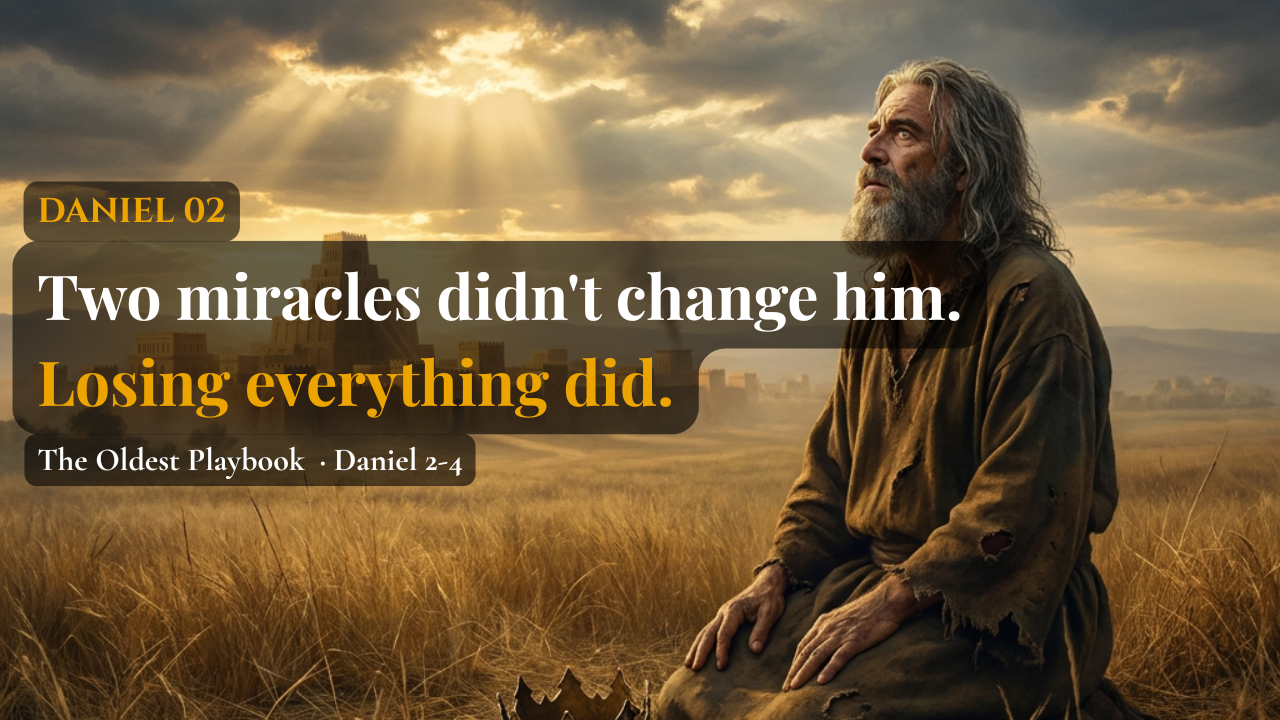
- Admiration is cheap. Two miracles didn't convert the king. Losing everything did.
Act One: The Impossible RFP (Daniel 2)
The king has a dream and can't sleep. So he calls in the entire professional class: magicians, enchanters, sorcerers, Chaldeans. Every consultant in Babylon.
Then he makes his demand. Tell me the dream. And then tell me what it means.
Not "interpret the dream I describe." Tell me what I dreamed. Fail, and you'll be torn limb from limb and your houses turned into rubble (2:5). Succeed, and you get gifts, rewards, and great honor (2:6).
Founders, you've answered this RFP. The client won't share the brief. The client will absolutely grade your answer. The upside is a logo on your website. The downside is your company.
Now listen to the guild's response, because it's the most honest thing anyone says in this chapter: "There is not a man on earth who can meet the king's demand... no one can show it to the king except the gods, whose dwelling is not with flesh" (2:10-11).
Translation: that's out of scope.
And here's the thing. They're right. It is impossible. They aren't lazy and they aren't lying. They're about to be executed for accuracy.
Then verse thirteen. The decree goes out, and the soldiers go looking for Daniel and his friends to kill them too. Daniel wasn't in the room. Nobody asked him. He didn't get the meeting, the brief, or the invitation. He just got the death sentence.
You'll be on lists you were never invited to. The decision that ends your company can be made in a room you don't have a badge for. We see it now with wars, supply chains, and inflation. You weren't in the room, and the consequences landed on you anyway.
So what does Daniel do? Verse fourteen says he replied "with prudence and discretion." He doesn't panic. He doesn't protest. He asks a question. Why is the decree so urgent? Then he goes to the king and asks for time.
Everybody else argued about feasibility. Daniel asked for a deadline. In an impossible, life-or-death demand, the one move nobody made was asking for more time. It was available the whole time.
Then he does the thing from chapter one. He goes home and gets the same three friends, the ones who ate vegetables with him. Now they pray together. That's not a coincidence. It's a compounding effect. In Revelation 5:8, prayers are kept in golden bowls. Collected, then poured out. I think chapter two is a bowl tipping over.
The answer comes in a vision that night. One night. Not three years. God waited until the deadline, like the rest of us.
And before Daniel tells a single person, he stops and blesses God. Verse twenty. He celebrates before he gets paid. That's a man whose security doesn't come from the outcome.
Now the verse that shows you who he actually is. Verse twenty-four. He goes to the officer in charge of the executions and says: "Do not destroy the wise men of Babylon."
Sit with that. The first thing Daniel does with the answer is save the guild that failed. The astrologers and sorcerers. People whose entire profession he doesn't believe in. People who didn't call him into the room and who would've watched him die. He held a decree that would've cleared out every competitor in Babylon, and he spent his win on them.
When you finally get leverage, what you do for people who have none is the whole test. Most of us spend our first big win on quietly settling scores.
Then he refuses the credit. "Not because of any wisdom that I have more than all the living" (2:30). The chapter ends with the most powerful man on earth face down in front of a foreign kid.
And the king says it: "Truly, your God is God of gods and Lord of kings" (2:47).
Your God. Circle that. Hold onto it.
Act Two: The Room You're Not In (Daniel 3)
Chapter three, verse one. The king builds an image of gold, sixty cubits high and six wide. About ninety feet tall and nine feet wide.
Remember what he was just told. "You are the head of gold." One piece of a statue made of four metals, and the whole statue gets smashed. He heard "you're the head of gold" and built a statue that's gold all the way down.
That's a man who took one piece of positive feedback and turned it into a capital expenditure. Tell a founder his deck is good and he'll raise a round he doesn't need. Also, ninety feet by nine? That's not a statue. It's a flagpole with a face.
Then the herald announces the rule. When you hear the horn, flute, lyre, and the entire band, fall down and worship. (The chapter lists that whole orchestra four separate times. Somebody in Babylon was very proud of that procurement.)
Then the accusation. The same wise men Daniel just saved step forward and go after his friends. Verse twelve: "These men, O king, pay no attention to you."
Notice the charge. Not "they're theologically wrong." They don't respect you. The complaint is rarely the complaint. It's usually about attention.
And notice who wasn't targeted. Daniel. He's next to the king. Untouchable. So they go after the next best thing, his friends. Daniel isn't in this chapter at all. Not once.
Here's why that matters, founders. The test of leadership isn't whether you'd walk into a fire. You'd love that story. The test is whether your people make the same decision in a building you're not in.
Here's their answer, and it's the hinge of the whole night:
"Our God whom we serve is able to deliver us from the burning fiery furnace... But if not, be it known to you, O king, that we will not serve your gods" (3:17-18).
But if not.
Three words that separate conviction from forecasting. Most of what we call conviction is a prediction with moral vocabulary. "I'm holding the line because I believe it works out." That's a bet wearing a nice suit. "But if not" is conviction that doesn't depend on the outcome. It's the only kind that survives a real furnace, a real down round, a real no.
And remember who's saying it. The same guys who asked for vegetables. Nobody goes from zero to furnace. The furnace is what the vegetables compound into.
Then the king throws a tantrum. Seven times hotter than normal, so hot the guards who carry the three men die. And what burns? The rope. Then the king looks in and sees four men walking around, unbound, unharmed. Christian scholars have argued for centuries about who the fourth is. Many say Jesus. Others disagree. The Bible clearly says there's a fourth man. And when they walk out, they don't even smell like smoke.
And the king says: "Blessed be the God of Shadrach, Meshach, and Abednego" (3:28).
Their God. Not "your God" anymore. Their God. He's amazed. He's thankful. And he's still standing at a safe distance.
Then he issues a decree that anyone who speaks against this God gets torn limb from limb. He wrote a policy instead of changing his life. Every company that answers a values failure with a values statement is doing Daniel 3:29.
Act Three: Twelve Months (Daniel 4)
Chapter four is strange, and almost nobody points it out. It's written in the first person. By the king. It's a royal proclamation to all peoples and nations, and inside it, he describes his own collapse. Daniel probably slotted it in because Nebuchadnezzar is finally coming around.
Verse four. "I, Nebuchadnezzar, was at ease in my house and prospering in my palace."
That's the most dangerous sentence a founder can say. Not in crisis. Not under attack. Just comfortable. The most tragic things tend to happen when things are calm, because the calm never lasts. That's when you can hear a pin drop.
He has another dream. Calls the magicians. They fail again. Daniel gets called last. They phoned the guy who's been right twice, last. That's procurement.
The dream is a tree. It reaches the heavens, visible from anywhere on earth. It shelters animals and feeds everyone. And a voice says: cut it down.
Notice the tree is not evil. This isn't a wicked business. It's a good business with a man underneath it who's started to believe he grew it himself.
Verse nineteen. Daniel is dismayed. He takes no pleasure in this. "My lord, may the dream be for those who hate you." If you have someone in your life who tells you hard things and hates doing it, protect that person. The ones who enjoy it aren't brave. They're just enjoying themselves.
Then the prescription, 4:27: "Break off your sins by practicing righteousness, and your iniquities by showing mercy to the oppressed, that there may perhaps be a lengthening of your prosperity."
Notice what he prescribes. The cure for a proud king isn't more religion. It's how he treats the people beneath him. Look at your org chart. That's your spiritual life.
Now the crux of the night. Two verses, back to back, and if you blink you'll miss it.
Verse 28: "All this came upon King Nebuchadnezzar."
Verse 29: "At the end of twelve months, he was walking on the roof of the royal palace of Babylon."
Twelve months.
Between the warning and the consequence, there was a year. Think about what a year of nothing does to a man. Week one, I guarantee he changed something. Month two, nothing happened. Month four, still king. Month eight, the warning became an anecdote. Month eleven, it's a story he tells at dinner about the time his advisor got dramatic. It's a New Year's resolution. Good for a few months, then back to who he was.
Delay is not acquittal. The gap between the warning and the consequence is the only window you get, and it always feels like a pardon.
That's why companies die slowly, then all at once. Nobody ignores an obvious cliff. We ignore a quiet warning followed by twelve good months. The churned customer who never complained. The co-founder who said it once, calmly, and never brought it up again. The burn rate you were definitely going to fix.
Then verse thirty. Twelve months in, on the roof, looking at the skyline:
"Is not this great Babylon, which I have built by my mighty power as a royal residence and for the glory of my majesty?"
Count the pronouns. I built. My power. My majesty. That's the most founder sentence in Scripture. Every one of us has said it. Usually not on a roof. Usually on a podcast.
Verse thirty-one: "While the words were still in the king's mouth." Not next year. Not tomorrow morning. Mid-sentence.
Then he loses his mind. Seven periods of time. The man who built Babylon eats grass in its shadow. I'm not making a joke about that part.
And then verse thirty-four: "At the end of the days I, Nebuchadnezzar, lifted my eyes to heaven, and my reason returned to me."
His reason returned when he looked up. Not before.
Whose God?
So here's the sentence I told you to listen for.
Chapter two, verse forty-seven: "Your God is God of gods."
Chapter three, verse twenty-eight: "Blessed be the God of Shadrach, Meshach, and Abednego." Their God.
Chapter four, verse thirty-seven, the last words he ever speaks in Scripture: "Now I, Nebuchadnezzar, praise and extol and honor the King of heaven... and those who walk in pride he is able to humble."
No "your." No "their." He finally stopped standing next to it.
Look at what it took. An impossible dream read aloud to him. Four men in a furnace and not a hair singed. Neither one converted him. What finally got him was losing the one thing he thought he built.
You can't be argued into a conviction you've only ever admired.
Every one of us has a "your God" relationship with something we know is true. We've watched it work in someone else. Their discipline. Their patience. Their honesty about their own numbers. We call it inspiring. We read the biography. We share the clip. Then we turn around and forget.
Admiration is the cheapest emotion available to a founder. It costs nothing and feels like growth.
I know this personally. I knew the wisdom of the Bible. I'd seen what mattered. I'd heard all the inspirational stories. It wasn't real until 2019, when I got into a car accident on a business trip and was flat on my back, unable to move. That was my Nebuchadnezzar moment. Before that, I was hustling for show, and my authenticity wasn't there. After it, I understood what actually matters.
I hope you're wiser than Nebuchadnezzar. I hope you're smarter than I was. I hope you don't need the field or a bed you can't get out of to learn what the Concert already told you.
The Question
Somebody has already told you the truth about your company, your marriage, your body, or your pace. And nothing has happened yet.
So here's my question for you.
What are you eleven months into?
The Oldest Playbook is where we decode the Bible, the oldest playbook there is, through the lens of a founder. Next week, the final Daniel Concert: a party, a hand writing on a wall, and the lions, finally. See you at the next Concert.

The Oldest Playbook Newsletter
Join the newsletter to receive the latest updates in your inbox.