Daniel 01: The Line Was Drawn at Lunch
Daniel 1:1-21

Missed the live Concert? This is the full written version. Read it with coffee. Or vegetables. You'll get the joke in a minute.
Ask a room full of people what they remember about Daniel and you'll hear one word.
Lions.
Nobody says lunch. Nobody says vegetables. The lions have a Sunday school poster, a felt board, and probably a plush toy. Lunch has a footnote.
Here's my claim this week: lunch is the whole book.
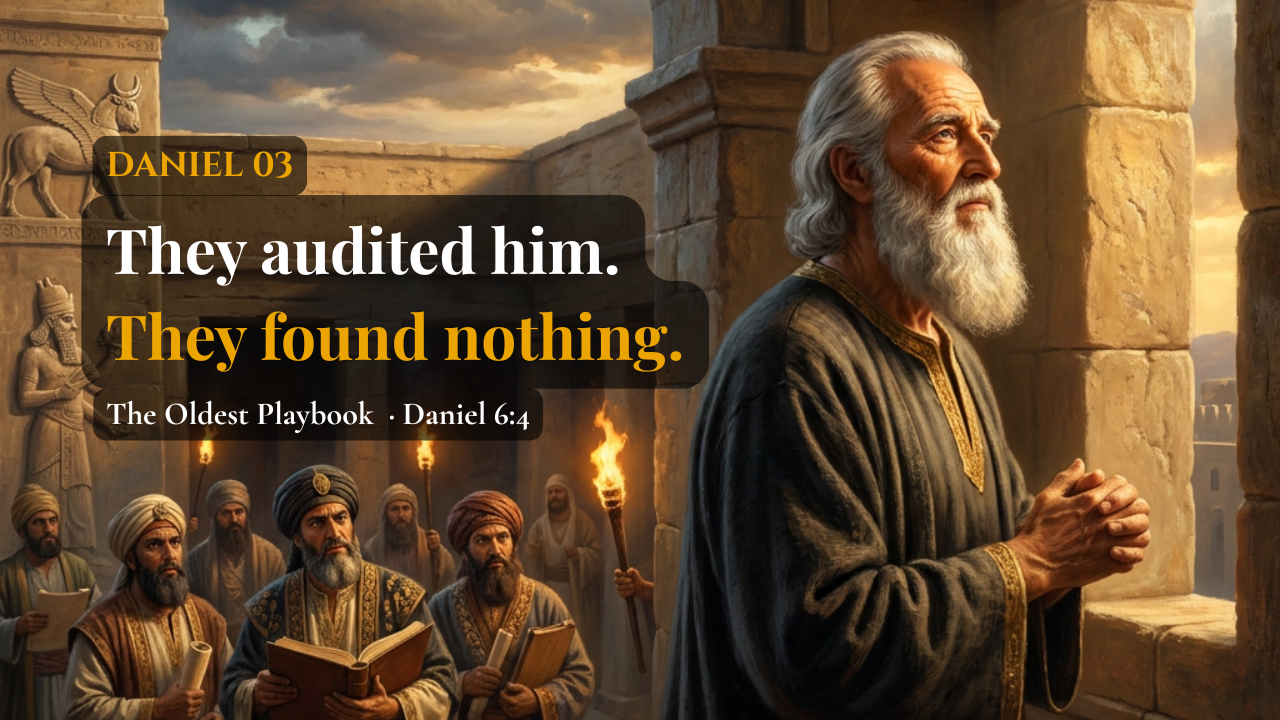
Chapter six, the lion's den, is not a heroic moment. It's a rerun. When the trap is finally set, the text says Daniel went home, opened his windows toward Jerusalem, and prayed three times a day "as he had done previously" (Daniel 6:10). As he had done previously. The lions were a Tuesday.
The decision that saved Daniel at eighty got made when he was fifteen. Over food.
So this week we start at chapter one. Because I've raised a lot of money and spent twenty years around founders, and the thing I've gotten wrong most often about people is this: I judged them by their chapter six. I never asked about their chapter one.
The Short Version
If you only have ninety seconds, here's the Concert:
- Daniel is kidnapped at about fifteen, renamed, and enrolled in the empire's elite leadership program. He says yes to almost all of it.
- He draws exactly one line: the king's food and wine (1:8). The king's table was a term sheet. Every meal was a signature.
- Nobody was watching. That's the test. Your real values are your defaults when no one is in the room.
- The ten-day test was the demo. The three years was the company.
- Your edge doesn't come from what you consume. It comes from what you decline.
Now the long version. It's better. It has jokes.
Who This Book Is For
Quick map first. Daniel is two books stapled together. Chapters 1 to 6 are stories: a guy inside a foreign government, dreams, promotions, politics, a furnace, some lions. Chapters 7 to 12 go completely off the rails. Beasts, horns, numbers, visions. Entire conferences exist to argue about that half.
We're staying in the stories. This is a series about characters as case studies, and chapters 1 to 6 are Daniel's biography. Chapters 7 to 12 are his philosophy and visions. I'm not ignoring them. They deserve their own study. But we're decoding the Bible for founders, and founders learn from people.
One more thing. Daniel is roughly eighty years old when the book's events wrap up. We meet him as a kid. The man who wrote this outlived an entire empire and walked into the next one.
And this book isn't only for immigrants or the children of immigrants. It's for the third culture founder.
What's that? Someone who operates between two cultures and belongs completely to neither. So they build a third space where they're finally at home. Culture goes beyond country, language, and skin color. It can be industries. Maybe you're deep in fashion and deep in technology, and you don't fully belong in either. You innovate in the overlap. I've spent the last five years finding and investing in these founders, and Daniel is their patron saint.
The Talent Pipeline (Daniel 1:1-5)
Verse one. Nebuchadnezzar takes Jerusalem, and he grabs two things.
First, the treasure. The gold cups from the temple go into the treasury of his own god. Remember those cups. They come back next week and they end a dynasty. Chapter one loads the gun.
Second, the kids.
Not all of them. He hands his HR chief a spec, and it reads like a job description you've written yourself: royal family and nobility, no physical defect, good-looking, quick to learn, well-informed, able to serve in the palace.
That's a talent pipeline. Babylon's real weapon was never the chariots or the siege engines. Anybody can break a wall. Babylon's genius was the intake process. You don't kill the elite kids of the country you just conquered. You enroll them. Three years of language, literature, room and board, and a personalized meal plan from the king's own kitchen. Best university on the planet, full ride, job waiting at the end.
The most aggressive acqui-hire in ancient history.
Now slow down, because this is where "diaspora" gets flattened. This is not a founder moving to San Francisco for the market. It's not your parents choosing a better life for you. It's not even Esther, who was born into Persia and was already part of it.
Daniel is first generation, and he did not choose this. He's a teenager. Someone moved him nine hundred miles. Hostage as a service.
The closest modern parallel I can find is Korea under Japanese occupation. The brightest kids got selected, sent to the imperial universities, and given the best education in Asia at the time. Some were then conscripted into the war of the empire that flattened their homeland.
And here's the part I can't shake. The rage in that situation isn't only aimed at the empire. It's aimed at your own leaders. The ones who lost. The ones who made the bad deals and got everyone into this.
Some of you know exactly what that feels like. The competitor didn't kill your company. Your co-founder did. Your investors did. The people whose whole job was to protect the building.
A teenager in that spot goes one of two ways.
Kid number one says: my country is gone, and its leadership sold me out. Look at the size of this new empire. The library, the army, the budget. My old identity has no market value. It couldn't protect me. I'll take the new power, get excellent at it, and live well.
I want to be fair to that kid. He's not a villain. He's grieving and doing math. He's every immigrant child who was ever told to lose the accent.
Kid number two says: this is real power, and this power is dark. I can't live inside it like it's nothing. But I can't get out either. I'm here. So what do I do with one life inside a system I didn't choose and can't beat?
Daniel is kid number two. That's chapter one. It's also the founding question of every third culture person reading this.
The Rebrand (Daniel 1:6-7)
So they run the integration.
New names. Daniel means "God is my judge." He becomes Belteshazzar, a name that points to Bel, a Babylonian god. His three friends, Hananiah, Mishael, and Azariah, become Shadrach, Meshach, and Abednego. Every Hebrew name had God in it. Every new name has a Babylonian god in it.
If you've been through an acquisition, you know this. New email address, new title, new deck, and someone from comms explaining why your name is now aligned with the parent company's values.
Here's what surprised me. Daniel doesn't fight it.
He answers to Belteshazzar for seventy years. He learns the language. He studies the literature, including the astrology and the dream manuals. He shows up to class and he's very good at the job. He isn't a separatist. He isn't building a compound. He assimilates on almost everything.
I've watched a lot of immigrant kids fight over a name. I understand it. I'm not mocking it. Names matter. But Daniel doesn't pick that fight.
So when a man who says yes to nearly everything finally says no, write down where he drew the line.
The Line Is at the Table (Daniel 1:8)
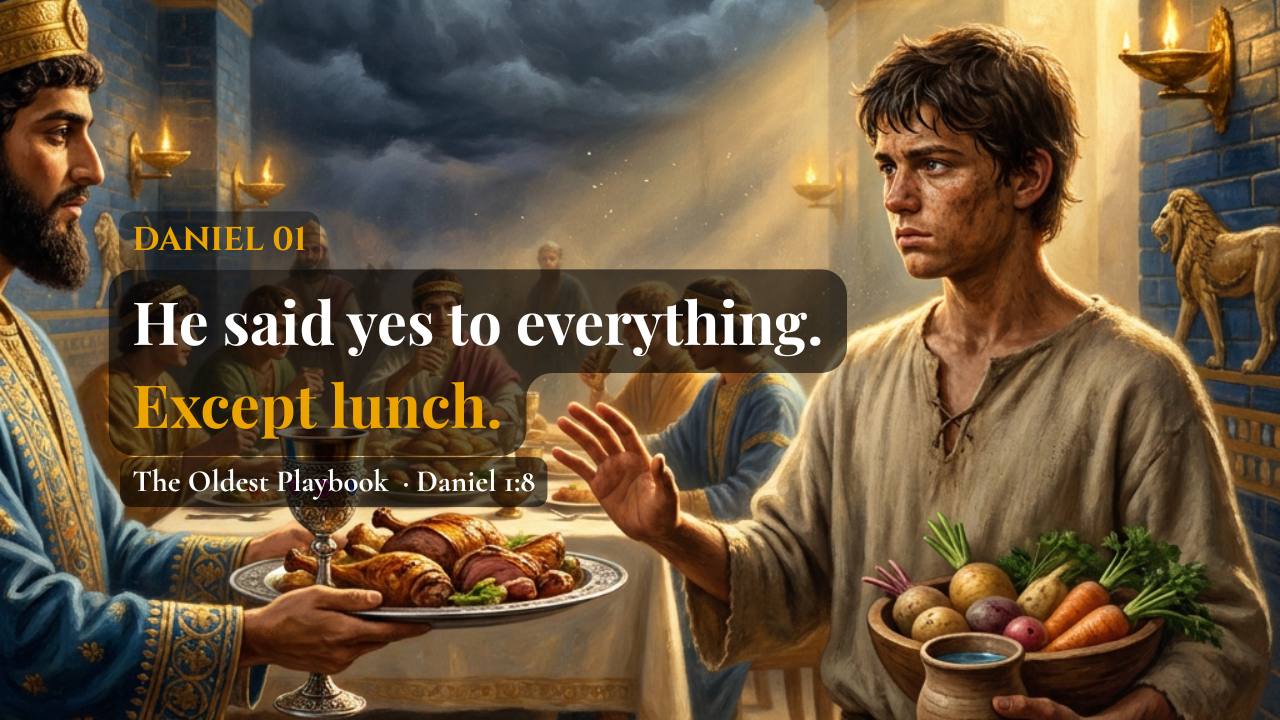
"But Daniel resolved that he would not defile himself with the king's food, or with the wine that he drank."
Out of the entire list, the kidnapping, the name, the curriculum, the career, he picks the menu. This is the most millennial act of resistance in the Bible. He went plant-based on the empire's expense account.
For years I thought that was a strange hill to die on. Then it clicked.
Sleeping, eating, and the other thing your body does whether or not anyone is looking. That's your baseline. I learned this flat on my back after a car accident in Shanghai in 2019. When you can't do anything, you do three things: you eat, you sleep, and you do the other thing. Everything else got stripped away. What was left was my defaults.
And in Daniel's world, eating at the king's table wasn't catering. It was covenant. You eat the king's food, you belong to the king. Every meal was a signature on his term sheet, three times a day.
So this was never about calories. Daniel is saying: you can have my address, my schedule, my language, my name, my résumé. You cannot have my body's default.
Now the uncomfortable part. Nobody was watching.
His parents were gone. His teachers were gone. The temple was rubble. There was no youth pastor in Babylon and no small group. The surveillance that used to keep him accountable was gone. That's what exile does.
And that is exactly when your real operating system shows up.
The founder version: your values are not the words on your website. Your values are what you do at eleven at night when nobody is in the room. Culture is what happens when you're not there.
Here's the question I asked the room, and I'll ask you. When no one is watching, who are you? Do you like that person? What do you do in the first two hours after you wake up? Doom scroll? Stay in bed feeling sorry for yourself? Or lace up and run two miles? For a long time, that window told me exactly who I was in that season of my life.
And yes, I love food. I split my time between Ho Chi Minh City, Jeju Island, and California. Saying no to the food in any of those places is a spiritual discipline. Daniel gave up Michelin-level catering for vegetables and water. He's a stronger man than I am.
Conviction With a Proposal (Daniel 1:9-14)
Watch this next part, because it's where Daniel stops being a Sunday school poster and becomes an operator.
He goes to the chief official, and the official says: I fear the king. He assigned your food. If you look worse than the other young men, "you would endanger my head with the king" (1:10).
That's not a policy objection. That's a man telling Daniel his conviction could get him killed. Founders, you've been here. You know what you want is right, and the person whose permission you need has everything to lose if you're wrong.
Look at what Daniel does. He doesn't martyr himself. He doesn't give a speech. He doesn't start a movement.
He runs a pilot.
Give us ten days. Vegetables and water. Then compare us to the young men who eat the king's food, and deal with us according to what you see (1:12). Ten days, one metric, a control group, and a rollback plan.
Daniel invented the two-week sprint. He's the first product manager in Scripture.
And notice verse nine, which comes first: "God gave Daniel favor and compassion in the sight of the chief of the eunuchs." Before Daniel says a word, God has already moved the counterparty. So do the work. Design the test. And remember the yes was never really your negotiating.
One more lesson here, and I'd say it to every founder. We hate confrontation now. We text before we call, because calling feels rude. Stop. Ask. Reach out. The worst answer is "I'm busy." Best case, you find out God already did the work on the other side. Either way, without action there's no information coming back.
The Demo and the Company (Daniel 1:15-20)
Here's where I changed my mind on rereading.
I always read it as ten days of vegetables, a miracle, and then everybody quietly goes back to the good food. It sounded like grace. But look again. Verse sixteen says the steward kept taking away the royal food. And the training program was three years long (1:5, 1:18).
The vegetables were not a ten-day stunt. They were the whole degree. Three years. Every meal. While the rest of the cohort ate from the king's kitchen.
Ten days is your demo. Three years is your company.
Everybody wants the ten-day result. The screenshot. The vindication. But God runs a three-year cohort. And nobody applauds you on day four hundred for eating the same thing you ate on day three hundred ninety-nine.
This is why I'm building Quintstone as permanent capital. The horizon is twenty to thirty years, and we're aiming at businesses that should still be around in a hundred. It's easy to make that sound exciting on a slide. Nobody tells you the compounding curve is flat for a very long time, and you have to keep eating vegetables through the flat part.
Then comes the receipt. Verse seventeen: "God gave them learning and skill in all literature and wisdom, and Daniel had understanding in all visions and dreams." Verse twenty: in every matter the king asked them about, he found them ten times better than all the magicians and enchanters in his kingdom.
Ten times better. Not on the elite meal plan. On vegetables and water.
Your edge isn't in what you consume. It's in what you're willing to do without.
The Quiet Last Verse (Daniel 1:21)
The chapter ends on a sentence you'll skim: "And Daniel was there until the first year of King Cyrus."
That's roughly seventy years. Four kings. Two empires. The empire that deported him fell, and Daniel was still on the org chart. He outlasted the acquirer.
And when the lions finally came at eighty, he didn't have to go find courage. He had been building it since he was fifteen.
Then there's the last thing. Daniel never went home. He lived his whole youth, career, and old age in a foreign land. He spoke both languages. He ate his own food. He served an empire that didn't believe in his God, faithfully and at a high level. And he prayed toward a city with broken walls, torn down by the people he worked for.
If you're a third culture founder, hear this: bridges get stepped on from both sides. That's what makes them bridges. It's lonely to innovate between two worlds because your world has fewer citizens. Your in-between isn't a bug to fix. It's the job description. And it's been happening for thousands of years. Daniel was there first.
The Question
If I get one takeaway across, it's this.
What's on your table right now that nobody is watching you eat?
I don't mean food. I mean the daily thing. The small habit or repeated choice that quietly shapes who you'll be in twenty years. Those tiny, repeated, invisible decisions are the subatomic particles of a life. Pay attention to them.
And if I could choose a second name in the Bible, I'd stay David. But Daniel would be my second choice.
The Oldest Playbook is where we decode the Bible, the oldest playbook there is, through the lens of a founder. Next week: Daniel 2, 3, and 4. A death sentence, a furnace, and a king who loses his mind. See you at the next Concert.

The Oldest Playbook Newsletter
Join the newsletter to receive the latest updates in your inbox.