Daniel 03: The Audit
Daniel 5:1-31 and Daniel 6:1-28

The written version of the final Daniel Concert. Two kings, two audits, one party that went badly, and some lions.
Nobody likes an audit.
The IRS. Your board. A CFO who messages you at eleven at night asking where a number came from. Somebody opens the books, pulls your history, and wants to know what's going on. Everything you've done catches up with you.
Here's what nobody tells you. The scariest audit isn't the one somebody else runs. It's the one that happens in your conscience.
That's the theme of this last Concert on Daniel. I call it The Audit.
The Scripture
- Daniel 5:1-31. Belshazzar's feast and the writing on the wall. Key verses: 5:1-4, 5:25-28, 5:30.
- Daniel 6:1-28. Daniel in the lions' den. Key verses: 6:3-5, 6:10, 6:16, 6:22-24.
The Short Version
- Nothing about Belshazzar's ending was sudden. Companies that implode overnight have been rotting for years.
- Daniel's audit found nothing. His enemies pulled the Persian version of an FBI file and came back with one charge: he loves his God too much.
- Daniel didn't rise to the occasion. He fell back on his habits. After sixty-plus years of practice, the lions were just a Tuesday.
- Two practical rules. Build the boring, repeated, private discipline now. And watch what you sign when you're flattered.
Where We Left Off
Quick recap for anyone joining late.
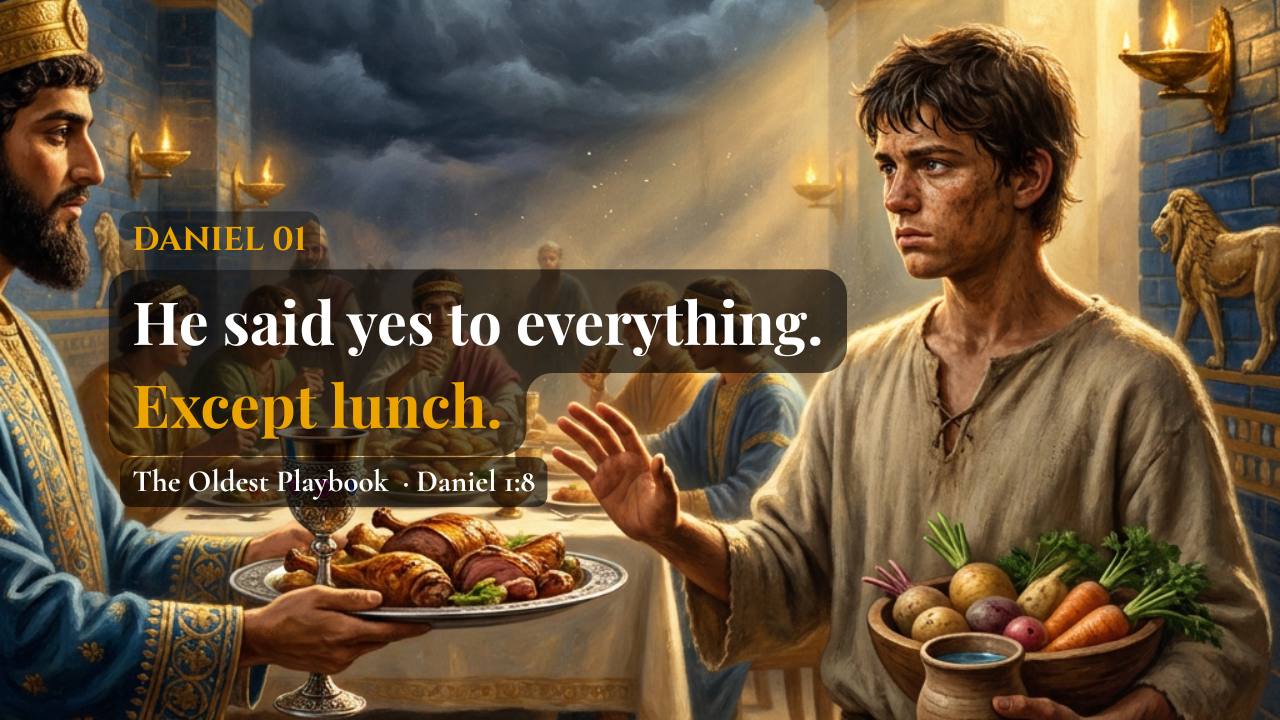
In part one, Daniel is a hostage teenager, deported from Jerusalem to Babylon, and he draws his one line at the king's buffet. Vegetables and water.
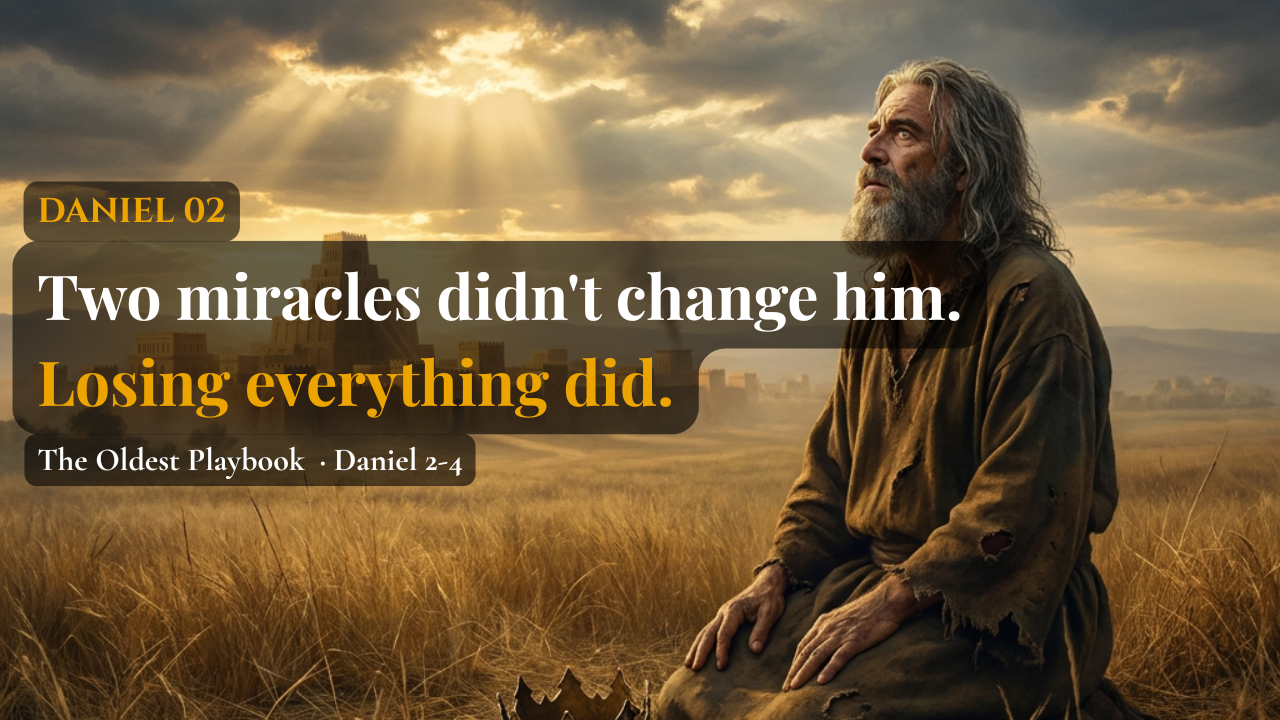
In part two, three of his friends walk into a furnace and walk out unburned. And Nebuchadnezzar loses his mind for twelve months, comes back, and finally gives glory to the God of heaven. Not only the Hebrews saw God's power. The Babylonian king did.
Today we finish. Two stories. Belshazzar's party, which gave us the phrase "the writing on the wall." And the most famous scene in the book, the lions.
Story One: The Party (Daniel 5)
Belshazzar is Nebuchadnezzar's royal descendant. The text calls him his "son," which in that world covers a lot of family tree. He's the king now, and he's throwing a party.
This man loves a party. He has advisors, his wives, his concubines, a thousand nobles. He's drinking, and he's arrogant. So, to flex in front of his posse, he sends for the gold and silver cups his grandfather took from the temple in Jerusalem. Remember those? We met them in chapter one, verse two. They were dedicated to God.
And Belshazzar and his guests drink from them, and toast the gods of gold and silver.
Translate that to the boardroom. That's raiding the restricted account set aside for something sacred, like LP capital, and using it to buy a Ferrari.
Mid-toast, a hand appears. Fingers of a human hand, writing on the plaster wall. The king's face goes pale. Verse six says his knees knocked together. That's the most honest description of fear in the Bible.
He calls every wise man in the kingdom. None can read it. Then the queen walks in and says: there's a man in your kingdom, your grandfather trusted him, the Spirit of the holy gods is in him. Send for Daniel.
Daniel comes, and he reads it. Mene, Mene, Tekel, Parsin. Numbered. Numbered. Weighed. Divided. And verse twenty-seven is the audit line: "You have been weighed in the balances and found wanting."
You will die tonight.
Here's the strangest part. The king keeps his promise. He clothes Daniel in purple, puts a gold chain on his neck, and makes him third in the kingdom. To a man who just told him he's dead. I don't know what to make of that. Maybe he didn't believe it. Maybe he just wanted to keep his word in front of everyone watching.
Verse thirty. "That very night Belshazzar the Chaldean king was killed."
Now here's the founder version. Nothing about Belshazzar's ending was sudden.
Picture a WeWork-era founder party, vodka shots and all. It looks like a sudden fall. It isn't. Every company that implodes overnight has been getting there for years. The weight piles up quietly, and the people closest to it are the last to notice, because they're so busy partying.
So ask yourself how you steward what isn't fully yours. Capital. Trust. A title. When you think nobody is reading the ledger, that's when the ledger is being written.
And here's the lie I want to kill. People believe the honest ones lose. That you have to fake it till you make it. That you game the system and lie your way to the top, and that's just how the game works.
That's false. It's the oldest wisdom in the world, and it's false. Audits ask whether you were trustworthy with the money. If you can't be trusted with a hundred dollars, nobody will trust you with a hundred million. And the belief that you're untouchable because you've raised X amount of dollars is the biggest mistake you can make.
An audit isn't the enemy. It's a pulse check, an X-ray on the health of your company and of you as a CEO. Welcome the audit. Don't let it destroy you. Be accountable from day one, because everything compounds.
Story Two: The Lions (Daniel 6)
New empire. The Medo-Persians are in charge, and Belshazzar's out. The new king is Darius, and he's a very good operator.
Look at what he builds. He sets up 120 regional administrators (satraps) and puts three supervisors over them. Daniel is one of the three. This is an admin guy who knows how to build systems that run.
Notice something else. Darius is also a foreigner ruling over a foreign people. Just like Daniel, he isn't native to Babylon. And I think that's what made him a good king. Like every other third culture person, he had to adapt locally. Darius looked at skill. He didn't look at bloodline or nationality. If you produced, you got promoted. Verse three says Daniel distinguished himself above all the others because "an excellent spirit was in him," and the king planned to set him over the whole kingdom.
If you've ever built something as a first-gen kid with no legacy network, you know how rare that is. Most systems default to pedigree. In Silicon Valley, say "Stanford" and the room leans in. Darius defaulted to results.
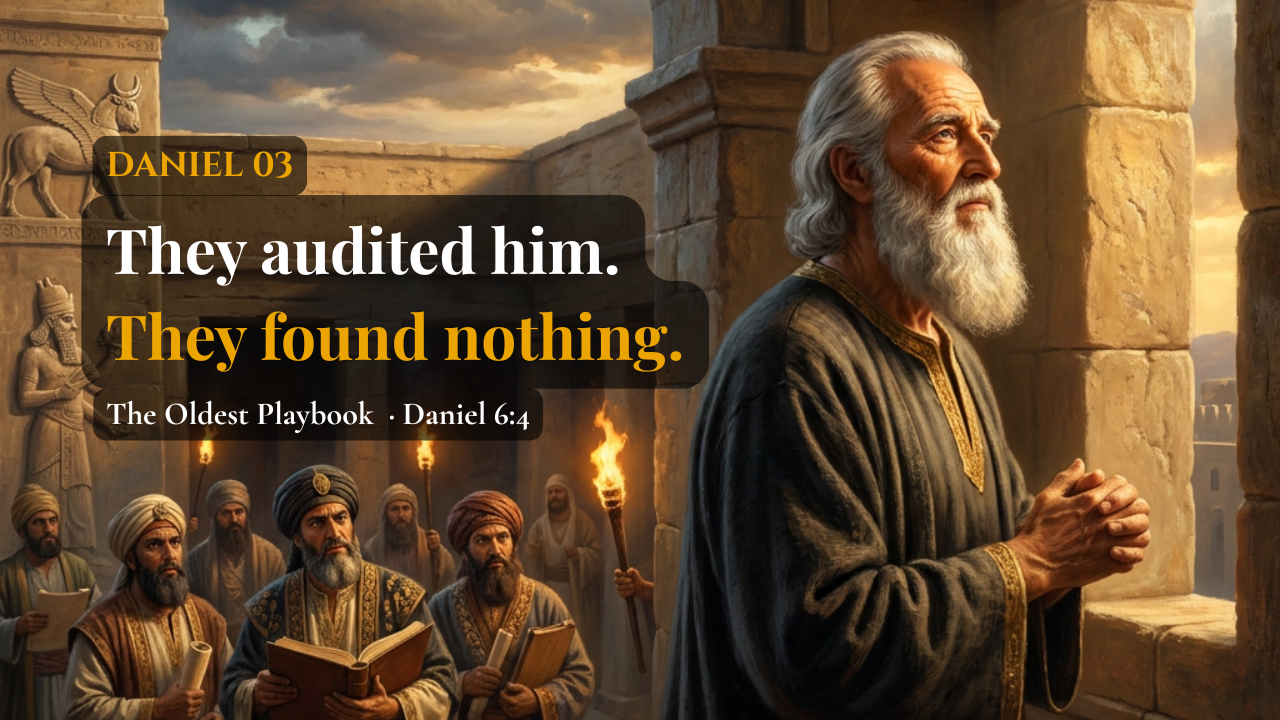
So of course the other 121 executives get jealous. And they set out to bring him down. What do they do? They pull the ancient Persian equivalent of an FBI file. They look at everything.
And they find nothing.
No embezzlement. No corruption. No shortcuts. No skeletons. He's been faithful for decades, and the file is empty.
So verse five, and this is one of the best lines in Scripture: "We shall not find any ground for complaint against this Daniel unless we find it against him with regard to the law of his God."
I wish my enemies would say that about me. I wish anyone who tried to entrap me had to come to that conclusion. There's nothing on David, except that he really loves his God.
So they get creative. They go to Darius and suggest a thirty-day law: for a month, everyone prays to the king and nobody else. It's flattery, and the king eats it up. And under Persian law, once a decree is signed, even the king can't take it back.
That's exactly the trap. Darius realizes what he's done. He remembers Daniel. He's troubled. He can't undo it.
Daniel hears about the decree. And what does he do?
He doesn't make a scene. He goes home, opens the window toward Jerusalem, gets down on his knees, and prays. Three times a day. Verse ten adds: "as he had done previously."
The men who set the trap catch him doing it in the open. They report him. And the king, who truly loves Daniel, has no choice. He doesn't eat. He doesn't sleep. As Daniel goes in, he says, "May your God, whom you serve continually, deliver you!" (6:16).
And God shuts the lions' mouths. Next morning, Darius runs to the den. "Daniel, servant of the living God, has your God been able to deliver you?" And Daniel answers. Alive.
Then Darius does something brutal. The men who accused Daniel are thrown to the lions, along with their wives and children, and the lions crush their bones before they hit the floor (6:24). It's ugly and it's in the text.
Three Observations
One. A strange detail. When Daniel is thrown into the den, the text mentions only Daniel. When his accusers are thrown in, it's them and their families. You have to wonder: where's Daniel's family? The text doesn't say. Some scholars guess he may have been a eunuch, taken as a boy. That's speculation. I found it sad to think about.
Two. His courage wasn't a spike. It was a habit. Look at how Daniel behaves in the crisis. He isn't summoning some heroic reserve of faith. He isn't panicking. He's running the exact program he's run for decades. Probably around sixty years of it.
You don't rise to the occasion. You fall back to whatever you've been practicing.
If your habits only hold when nobody's watching and nothing's at stake, they were never load-bearing in the first place. Daniel was so strong in danger because he'd practiced this same habit through years of peace.
Three. Two books, two kings, two audits. One failed, one passed. Belshazzar took what was sacred and toasted with it. Daniel stewarded what he was handed. When the audit came for both, the ledger caught up with one of them.
The executives who framed Daniel walked into the trap they built. The whole thing feels almost too neat for a story, and it's in the Bible anyway.
So What Do We Do?
Trouble will come. Whether you live like Belshazzar or like Daniel, trouble comes. Everyone gets some kind of tragedy. The question is what habits and what honesty you've built up until that moment. When the audit arrives, what will it find?
Maybe it comes from your board. Maybe from a regulator. Maybe from your own life under pressure. But there's always that moment when the incentives say cut the corner and nobody's watching, and a voice in your head tells you what's right. I've never met a person who doesn't have that voice. Listen to it. Even when it's costly.
Character compounds. That's how you become the founder investors want to back. They may not notice it on day one. They will notice it on day one thousand.
Two practical things, and then I'll stop.
1. Build the boring, repeated, private discipline now, before you need it in public.
Whatever your version of the window open three times a day is, that's what shows up in trouble. Not the idea of it. The habit. You can't manufacture integrity overnight, and you can't decide to be trustworthy the week the trouble starts. Everyone's had a boss who was a nasty person, and they didn't get far. Be the leader people don't love because they have to, but because your integrity earned it.
2. Watch what you sign when you're flattered.
Belshazzar got drunk on his own glory and grabbed something sacred without a thought. Darius got flattered by a room of executives telling him he was a god, and signed something irrevocable. Flattery right before the signature is where things go wrong. So when it's hitting you in the face, that's the moment to slow down and read the fine print.
That's a Wrap on Daniel
Three Concerts. Here's the arc.
In Daniel 1, the decision that shaped everything happened at lunch, when nobody was watching.
In Daniel 2-4, a king went from "your God" to "their God" to "the King of heaven," and a year of quiet nearly fooled him.
In Daniel 5-6, two audits, one failed and one passed, and the man who passed had been preparing for it for sixty years.
Next up: Job. Perhaps the oldest book in the Bible. Bring questions.
And one favor. I want to hear from you. Write me at david@oldestplaybook.com and tell me three things: what's going well, what could go better, and what decisions you're facing. I'll pray for you. And it helps me prepare these Concerts for the people actually reading them.
If you're a founder grinding through fundraising, sales, or a build that feels like Groundhog Day, know that's part of the journey. And you don't have to walk it alone. Founder Chapel is a place to walk with other founders. It can be lonely out there. Come check it out.
Here's the question I'll leave you with.
When your audit comes, what will it find?
The Oldest Playbook is where we decode the Bible, the oldest playbook there is, through the lens of a founder. See you at the next Concert.

The Oldest Playbook Newsletter
Join the newsletter to receive the latest updates in your inbox.