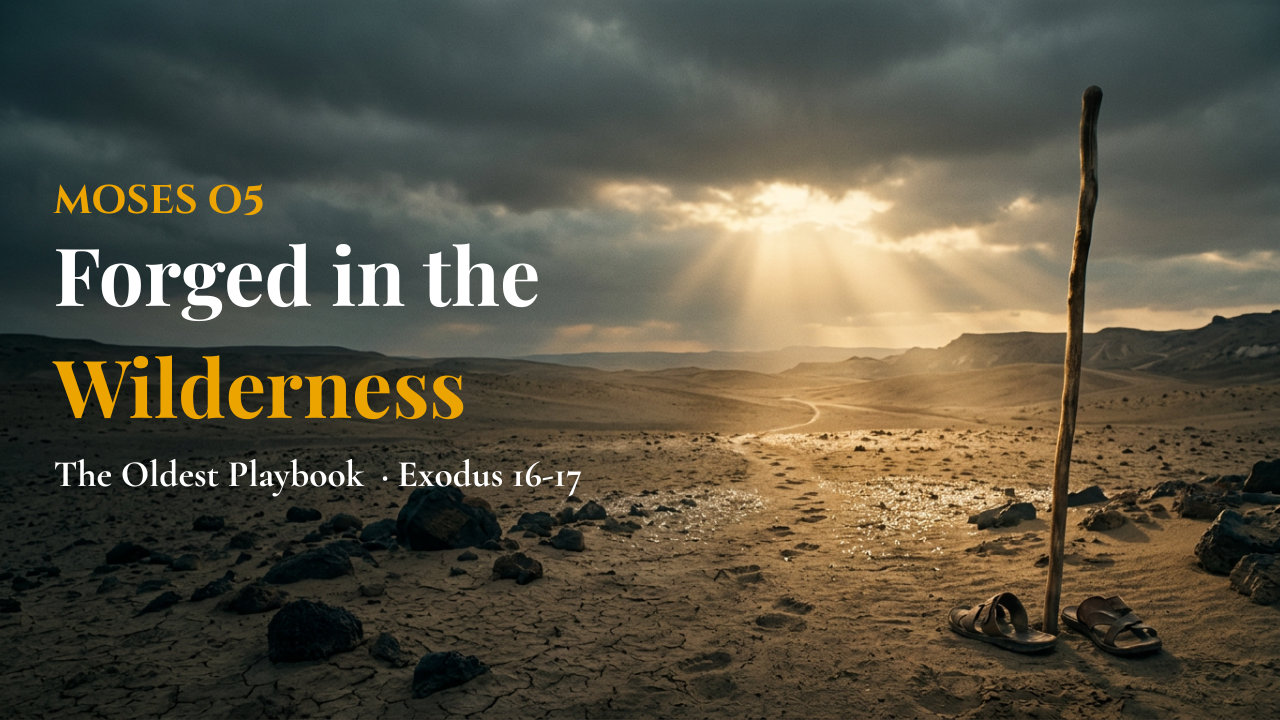
Moses 05: Forged in the Wilderness
Exodus 16-17 | The Oldest Playbook

We love the Red Sea. The walls of water standing up into two towering walls, a whole nation walking through on dry ground, and on the far side the greatest existential threat they had ever known — the entire army of Egypt — swallowed by the sea. Miriam on the shore with her tambourine, singing. It's the moment every movie is built around: the exit, the launch, the miracle. We're founders and builders. We love the emotional highs, the dramatic parting, the glorious thing you can write home about.
Here's what almost nobody notices. The Bible gives the Red Sea exactly one chapter. Then it gives us forty years in the wilderness. That ratio is not an accident. The ratio is the entire lesson.
The wilderness is not the boring part between the good parts. It's the main event — the place where leaders are actually forged. And almost nobody in Hollywood makes a movie about it, because it's long, unglamorous, and mostly about showing up again the next day. Think about the business leaders we celebrate — the ones in Fortune and The Economist, the tycoons we make look heroic. We fixate on the Red Sea moment of their lives and skip the long, arduous middle. But I'll make you a bet: for every successful leader you can name, there's a wilderness story in their biography — a stretch where they just had to show up again and again and again, where they had their loser moments, their near-deaths. Not literal death, usually. The death of a business. The death of their security. The death of their pride. Those transformative moments are what got them to the part we admire. Almost nobody arrives there overnight, like a genie granting a wish. The struggle is the real deal.
New here? This is The Oldest Playbook, where we read scripture — the oldest playbook in human history — the way you'd study a case at Harvard Business School or in law school: precedents, past examples, lessons extracted for the people building things today. Humans learn from history, from our mistakes and our victories, and there's no better way to learn than to reflect on what others, better or worse than us, have done. I've spent twenty-plus years as a founder and builder, and this book has shaped how I lead more than any title on my shelf. Tonight, case study number five: Moses, after the Red Sea.
The three moves, at a glance
- Read the complaint. It's data, not an attack. Don't crumble, don't crush.
- Don't solve the problem—build the rhythm. Daily dependence, forced rest, enough over more.
- Nobody holds their own arm up. Delegate, get held, and forge your successor in the valley.
Where we left off
Last week we watched the sea split, the nation cross, and Egypt sink. We heard Miriam's victory song. And then, almost immediately, the first shortage: the people got thirsty, hit bitter water, and — days removed from a life-or-death miracle — started complaining and reminiscing about Egypt. It was almost a test. Moses guided them, despite the bickering, to an oasis with plenty of water. That was last week: the victory song and the first crisis.
Tonight we walk further into the same desert. And here's the part people skip, because we love the rays and the parting and the exit: the weeks and months after the miracle. A good while later, deep in the wilderness, those same people who sang are angry all over again. This time it's not about water. It's about lunch.
First, the 430 years nobody talks about
Before the desert, there was Egypt — 430 years of it. Generations born into slavery, living in it, dying in it, having never seen anything else. If you'd been one of them, you'd have asked the only honest question there is: God, where are you? You promised our ancestor Abraham a nation, a land, a future. It's been four centuries. Have you forgotten us? Do you even see me? That was probably the prayer, over and over, for 430 years.
We have such a myopic view of time. We look at the stretch we're living through and magnify it, and we forget the far longer history we already came through. But this playbook lets us zoom out to a near-thousand-year perspective — and the answer it gives quietly changed how I read my own life.
Generations earlier, God had told Abraham exactly what would happen: your descendants will be strangers and slaves for four hundred years. And He gave a strange reason for the delay — the sin of the people already in the land "is not yet complete." Unpack that. The land they were headed for was full of violent, absorbing tribes. A single family of seventy people dropped into that world would have been swallowed whole — assimilated, raped into other nations, erased, gone before they ever became anything. So God hid them. He tucked them into a corner of Egypt called Goshen, kept deliberately separate — the text tells us the Egyptians couldn't stand shepherds, so Israel got quarantined off on its own.
And in that hidden place that felt like punishment, seventy people became a nation of millions. Slavery wasn't God forgetting them. Slavery was the incubator. Four hundred years that felt like abandonment were four hundred years of protection and growth in the dark — hidden, unseen, where no one could corrupt them or kill them off, including themselves.
Founders, sit on that for a second. The most common experience of building something real is not the parted sea. It's the 430 years — the long, hidden, unglamorous stretch where nothing you were promised is visible yet, where every feed is somebody else's miracle and you're still in Goshen making bricks. And the oldest playbook says something staggering about that stretch: it may be exactly where the most important work is happening, precisely because no one can see it. You are being formed in the dark into something strong enough to survive what's coming — before it's ready to be seen.
So here are three moves the wilderness will teach you. This is the playbook for the hardest phase of building anything: the messy middle, after the win, before the promised land. Zero to one is the easy part, honestly — I'm a zero-to-one guy; I could spin up a dozen companies in three months. But zero to one, one to a hundred, a hundred to a thousand, a thousand to a million, a million to hundreds of millions — that journey is what's hard. You can't do a dozen of those in a lifetime. That's what the wilderness is about, and it requires something else entirely.
Move 1: Read the complaint — don't take the bait
Open Exodus 16. The people are hungry, and listen to how they turn on Moses: "If only we had died in Egypt, where we sat around pots of meat and ate all the bread we wanted."
Stop right there. These people were slaves in Egypt. They were beaten by their masters. Their baby boys were thrown into the river. And here they are, weeks into freedom, describing Egypt like a brunch spot they miss — something to be longed for.
This is the first thing the wilderness reveals about us, and it's devastatingly relevant to anyone building anything: when the present gets uncertain, people romanticize the past — even a past that was killing them. Slavery at least was predictable. You knew what tomorrow looked like as a slave. Freedom is terrifying precisely because it's open, so the mind reaches backward and paints the cage gold — the golden handcuffs.
I've watched this happen to founders again and again. They romanticize their time in corporate America, the steady paycheck, college, high school when "things were amazing." Things weren't amazing back then; you had your problems, and when life was secure and predictable you probably weren't thriving either. But something about the uncertainty you're facing today repaints the past into gold. You'll watch it in your team when the strategy shifts and someone says, "wasn't it simpler back then, before we raised, before all these people?" You'll watch it in yourself at 2 a.m. — "I could've taken that safe job." The wilderness makes Egypt look good. Name it for what it is. It's not a memory. It's fear wearing memory in a golden cloth.
Now watch what Moses does — because this is the whole ball game. He doesn't get defensive. He doesn't quit. And he doesn't crush his people. He says something almost strange: "Your grumbling is not against us. It's against the Lord."
Do you see what he just did? He depersonalized it. The complaint was aimed right at his face — you brought us out here to die, Moses — and he understood something that takes most leaders a decade to learn: the complaint is almost never actually about the thing it's about, and it's almost never actually about you. The hunger wasn't really hunger. It was fear. The anger at Moses wasn't about Moses. It was terror that needed somewhere to land, and it landed on the easiest target — the person standing in front of them.
Founders, hear me. When criticism comes in the messy middle — and it will come, from your team, your users, your board, your own family — you have two immature options and one mature one. You can crumble: take every word to heart, conclude you're a fraud, lose your nerve. You can crush: treat every complaint as insubordination and go to war with your own people. Or you can do what Moses did — refuse to take it personally, refuse to dismiss it, and read it as data.
"The coffee is bad" often means "I'm scared we're going to miss the quarter." "Why did you change the roadmap?" often means "I don't know if I still belong here." When I was leading a company of about 150 engineers — and I'm not an engineer by training — every time a new CTO or senior engineer arrived, the other leaders would start a quiet power struggle and complain about the roadmap and the shift in direction. It was never really about the roadmap. It was a human issue every single time. The mature leader hears the fear under the complaint and speaks to the fear. That's not weakness. It's the single most important skill for surviving the wilderness with your people still following you — and it requires you to be solid enough, settled enough in your own place, not to need their approval to stay standing.
Move 2: Don't solve the problem — build the rhythm
Then God feeds them, and how He does it is the part everyone misses. He could have dropped a warehouse of food from the sky and solved the problem in one move — after all, this is God we're talking about. Instead He installs a system with rules. Every morning a bread-like substance called manna appears on the ground, and the instructions are oddly specific: gather only what you need for today. Don't hoard it — if you keep it overnight, it breeds worms and stinks. On the sixth day, gather double. On the seventh day, don't gather at all. Rest. That's the system.
Notice what He doesn't do. He doesn't drop a Costco in the middle of the desert and let everyone go at it. It makes me think of that rat experiment — give a colony unlimited food and abundance, and eventually the whole thing collapses. God doesn't flood them with abundance. He gives them a rhythm. And the text tells us out loud why: He's doing it this way to test them, to see whether they'll follow His instructions. So much of schooling, K through twelve, is really about learning to follow instructions — and there's wisdom in that. He's not solving a hunger problem. He's using hunger to build a culture. The daily bread is a daily curriculum. And there are three founder lessons baked into it.
You cannot hoard it. Last week, at the bitter water, we learned the painful half of this rule: the miracle you crossed on Monday does not sustain you by Thursday. This is God's response — and notice He doesn't answer with a bigger one-time miracle. He builds daily dependence into the design. Manna rots overnight, so the only way to eat tomorrow is to show up again tomorrow. He isn't being stingy; there's plenty, enough to fill your need for the day. He's simply giving people who are prone to forgetting Him a standing appointment every single morning. The lesson you failed last week, He just built into breakfast. That's smart leadership.
Rest is not optional — it's in the code. We worship hustle, especially in the founder and Silicon Valley scene. God builds Sabbath into the system by decree. One day in seven, the manna doesn't fall — and He tells them in advance so they can prepare. He is protecting these people from their own tendency to grind themselves to death. And notice: some of them go out on the seventh day anyway, looking for more, and find nothing. The lesson isn't subtle. There is provision you will only ever get by stopping. Cadence beats heroics. The leader who never installs rest — who treats rhythm as a luxury for people less committed, who says rest is for the lazy and the losers — will burn out, and the very organization they were trying to build will never get built. Rest here is not the opposite of the mission. Rest is part of the operating system.
Gather only what you need. Those who gathered much had nothing left over; those who gathered little had no lack. Everyone had enough. That's a quiet indictment of the scarcity mind — that frantic sense that there's never enough, that you'd better grab more than your share before someone else does. The wilderness is where you learn the difference between enough and more, and the builders who learn it early don't torch their health and their relationships climbing a ladder that's leaning against the wrong wall.
Let me put it plainly. What's the difference between a first-time founder and a fourth-time founder? The first-timer is unusually hustly, and we glorify it — investors reward it, everyone tells them it's the right way. Second- and third-time founders don't hustle like that. They know it's a marathon, and they've baked rest into the operating system. And the ones who succeeded that first time but never learned this? They tend to go back for company number two for one of two reasons: either the first exit wasn't big enough and they still don't have their freedom, or they got bored and figured they might as well do the thing they're best at. That's how a lot of serial entrepreneurship happens — people treating companies like scoreboards, like ego machines, like something to show off. But the founders who keep going and start thinking about legacy, calling, and meaning — how to run the marathon better — become wiser. You usually can't become that kind of leader without first being the first-timer who got it wrong. Yet if you're aware, even now, that there's a wilderness mode in here changing you into a more durable builder, that awareness alone makes you a different first-time founder. Those are the ones who build what I call a super-brand: not a company that's around for a season or a single territory, but one that transcends boundaries and stays relevant across centuries. Very few pull it off, because very few think that way — and I think that's an epidemic.
So don't just solve the problem in front of you. Ask the harder question: what rhythm can I build so that solving this problem trains us into the kind of team that can solve the next ten? Great leaders don't rush out to fish, and they don't even hand out fishing rods right away. They build the season — the daily and weekly rhythm that forms their people, and forms them. That's what God was doing with breakfast.
The same test, on a loop
One chapter later, at a place called Rephidim, the water runs out again, and the people turn on Moses again — this time ready to stone him. And if you're thinking, didn't we just do the water crisis last week? — yes, we did. That's exactly the point. The desert runs the same test on a loop until it finally forms you. The fear doesn't leave; it just changes outfits. Moses, worn thin, does the one thing that works: he doesn't argue with the mob, he takes it up the chain, and water comes from a rock. But the place keeps a scar for a name — Massah and Meribah, testing and quarreling. Hold that name. We'll come back to it.
Move 3: Nobody holds their own arm up
Then, out of nowhere, war. In Exodus 17 the Amalekites attack — a people who have never held a sword, never trained, never fought. This is a wilderness too: the crisis you didn't schedule, the competitor who shows up in the desert when you're tired and thirsty and in no way prepared. It always comes when you least expect it.
And Moses' strategy, on paper, is insane. He tells a young man named Joshua to take the fighters into the valley. And he says: I'll stand on top of that hill and hold up my staff. One man fights; the other stands on a hill holding a stick. Then the eerie part — while Moses holds his hands up, Israel prevails; when his hands drop, Amalek prevails. The battle in the valley is somehow tethered to the posture on the hill. Set aside for a moment whether you believe in the miracle; look at the pattern underneath. There are three lessons here, and they build on each other.
Sometimes the leader's job in the fight is not to be in the fight. Moses doesn't grab a sword and charge the front to look brave. He sends his best operator, Joshua, and takes the high ground, where he holds the vision, the resolve, the why of the whole thing. Some of you need to get off the front lines. Your instinct as a founder is to get into the weeds — go, go, go, micromanage everything, personally know where every fire is and put it out yourself. But if you're swinging a sword in the valley, nobody is holding the higher ground, and the whole army loses its center of gravity. Delegate. Trust. Hold the high ground.
Even the leader can't hold his own arm up. Moses gets tired — of course he does, he's human — and as his arms sink, the battle turns against Israel. So two men, Aaron and Hur, come and stand on either side of him and hold his arms up until the sun goes down. The most important person in the nation could not hold his own arms up. The myth of the lone founder dies right there on that hill. You've absorbed a story — from Hollywood, from social media — about a singular genius who wills it into existence alone. It's a lie, and it's ruining a lot of founders. I hear it from other investors too: we watch a brilliant lone operator grind away as the solo genius and never grow as a leader. If you've built a life where you are impressive, admired, and completely unheld, that's not strength — it's the most dangerous position there is. Notice why, as a culture, we've come to love the Avengers and the X-Men more than a lone Superman. There was a time Superman was the ideal, but we gravitate now toward the team. Something deep in us knows a lone hero is cool for a moment but never sustainable. Find your Aaron and your Hur.
Your successor is forged in the valley, not at the coronation. Notice who's fighting down there: Joshua. This is the first time we ever hear his name — and if you know the playbook, you know Joshua is the one who will eventually lead the whole nation into the promised land after Moses is gone. Where does he make his debut? Not at a ceremony, not on a stage. In an unscheduled battle, in the wilderness, with an untrained army, getting forged. You will find and form your successor in the trenches, not at the coronation. The next generation of leaders is grown in exactly the season you'd least choose. So if you care about your company being around for centuries, keep your eyes open in the valley. That's where your Joshua is.
Two names for the same desert
Two monuments get built in these chapters. At the place where they fought about the water, the name is Massah and Meribah — testing and quarreling. This is a place we doubted. And at the place of the battle, Moses builds an altar and names it The Lord Is My Banner. This is a place we were carried. Same wilderness, two names. That's the choice.
You are going to go through a wilderness. If you're building anything real, you're probably in one right now — you just left one, and there's another coming, because the wilderness is unending: event after event, nothing spectacular to write home about, just difficulty and the long, unpostable middle. When you come out the other side, you will name it. You'll either call it the place I doubted, the place that nearly broke me, the place I resent — the thing that made you ugly — or the place I was forged.
Because here's the secret the oldest playbook has been keeping for three thousand years. Read it as a founder would read a case study, and the wilderness is not the price you pay for the promised land. The wilderness is the training that makes you into someone who can actually lead once you get there. That's the pattern all through scripture. Everybody wants the Red Sea — the miracle, the glorious thing worth writing home about. Nobody wants the desert, and nobody talks about it. But the desert is where you become the person the story needs you to be. That's the real story of anyone's success — the one you'll actually end up telling about your journey.
Why I read this every morning
So don't despise the wilderness. Don't despise the boring, everyday work of just showing up and grinding — that is the work. Read the complaints instead of taking the bait. Build the rhythm instead of just solving the problem. Bake in rhythms of rest. Hold the vision and delegate, so that as the founder who began the whole thing you keep the higher ground instead of getting lost in the weeds. Find the people who hold your arms up. And go through the wilderness — because you must go through it. There will be days you feel lost.
People wonder why I spend so much time each morning meditating and reading scripture. It's because, like the Hebrews coming out of Egypt, I too am forgetful. I forget the vision. I drift from the center. I wander away from the miracles and the promises I've been given — the very things I'm building toward. As humans, we need to re-center ourselves again and again and again, because you cannot center others until you've centered yourself.
For me that's the oldest playbook, and I'd encourage you to spend time with it too, believer or not — it's a very powerful book that has shaped more leaders, in business and beyond, than almost any book alive. But whatever it is for you — the oldest playbook, meditation, going inward, a page of Stoic philosophy — take the moment to step back and re-center. That's the discipline underneath everything else. Otherwise you'll have nothing left to give the people following you into the desert.
There's one thing harder than surviving the wilderness yourself, and it's the question we'll end the whole series on next time — our sixth and final Moses case study, where we climb the mountain:
Can you build something that survives without you?
See you next week.

The Oldest Playbook Newsletter
Join the newsletter to receive the latest updates in your inbox.