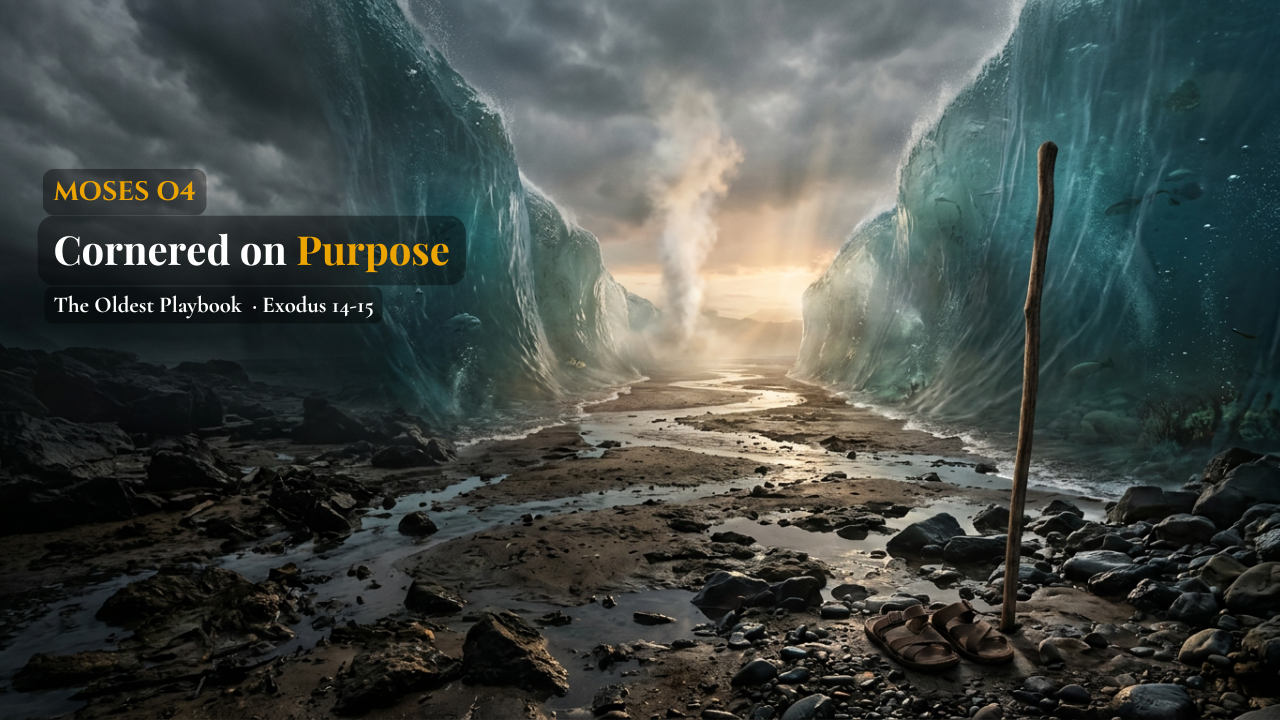
Moses 04: Cornered on Purpose
Exodus 14-15 | The Oldest Playbook

Last week we put two founders side by side: Moses and Pharaoh. The whole question was who they answered to. Pharaoh thought he had no boss, so the only voice he obeyed was his own heart—flippant, fickle—and it cost him everything, down to his firstborn son. Moses answered to God. Hold that thought, because tonight it comes back around.
This week I promised you we'd watch the Red Sea split. It does. But before a single wave moves, God gives the strangest instruction in the whole book of Exodus — an order no advisor, no board, no strategy consultant on earth would ever sign off on.
Here's the setup. The largest liberation in ancient history is underway. A whole nation walking out of 430 years of captivity under the superpower of its day. And in Exodus 14:2, God says: tell the Israelites to turn back and encamp by the sea. Turn back. Reverse course. Take 600,000 men plus women, children, and livestock — the slowest, most defenseless convoy ever assembled — and park them in a pocket with desert on one side, wilderness closing behind, and open water dead ahead.
Every founder knows that feeling. You look at the map and think, this route makes no sense. Tonight I want to show you why it made no sense for Israel — and why that was exactly the point. There are four movements.
Movement One: Sometimes you're not lost. You're bait.
Nobody wants to be bait. But read verses 3 and 4 — God narrates the strategy out loud, in advance. Pharaoh will look at Israel and see people wandering in confusion, hemmed in, trapped. And I will harden Pharaoh's heart, and he will pursue them, and I will gain glory over Pharaoh and all his army.
Do you see it? The confusion is a costume. Israel is deliberately positioned to look lost, weak, and disorganized — and that apparent weakness is the hook. The dead end is designed.
And Pharaoh bites, because of course he does. Look at verse 5: what have we done, letting Israel go from serving us? Ten plagues, a wrecked economy, dead firstborns in every house — and within days the whole catastrophe gets repriced in his mind as a labor supply problem. That's what pride does. It can't read its own losses honestly.
So he mobilizes the most advanced military machine on the planet: 600 chosen chariots, the special forces of the ancient world, plus all the chariots of Egypt, officers over every one. And who are they hunting? Brickmakers. Slaves for 430 years with no combat experience and no weapons training. It's a bazooka aimed at a mosquito. On paper this isn't a battle, it's a forced acquisition.
Which is precisely what God wanted. Remember the founding principle from the burning bush: God recruits at the moment of zero leverage, because it keeps the credit clean. The mismatch wasn't a bug in the plan. The mismatch was the plan.
Movement Two: Where you look determines whether you sink.
Verse 10. The people look up and see the dust cloud of the world's best army closing in. Sea in front, chariots behind. There's a Korean idiom for exactly this — jin-toe-yang-nan — no way forward, no way back.
And under that pressure Israel produces some of the most vicious sarcasm in the Bible: was it because there were no graves in Egypt that you brought us out here to die? Think about the joke — Egypt, land of pyramids, is the grave capital of the world. That's how bitter they were. Then they do something worse than sarcasm: they revise history. Better to have served the Egyptians than die in the desert. Slavery gets rebranded as job security.
Founders, mark this one. When the runway shrinks, your people will remember the old world as better than it ever was, and they'll blame you for the new one. Nostalgia is just fear wearing the past as a costume.
But here's what makes their panic so instructive. Lift your eyes off the text and look at what's actually standing in front of them: the pillar of cloud. The visible, miraculous presence of God, still glowing, still blocking the Egyptians. And they're panicking anyway — in front of foolproof.
So faith is not a possession. Faith is an attention strategy. The moment the chariots appeared, the pillar didn't disappear. It just stopped being looked at. It's Peter on the water: same lake, same Lord, same waves — the only variable that changed was where his eyes went. Eyes on Jesus, he walks. Eyes on the waves, he sinks.
You already know attention is your scarcest resource. But this passage makes it something sharper: your attention is your faith, operationalized. Show me the dashboard you actually stare at, the feed you refresh at 2 a.m., and I'll show you what you really believe about your future. I've had founders tell me “I believe in my company,” and then tell me they can't build it until they raise. The belief is in the words. The doubt is in the operations. Actions speak.
Movement Three: The miracle is a team sport.
This is my favorite movement. Watch the mechanics.
Moses gives the great crisis line — do not be afraid; stand firm; the Lord will fight for you; you need only be still. Frame that, put it on the wall. And then read the very next verse, one of the most sobering in scripture. God's response to that beautiful, holy speech is essentially: why are you crying out to me? Tell the people to move.
The praying phase of this project is complete. There is a moment — and wisdom is knowing it — when praying longer is just panicking slower. “Be still” and “move forward” sit four verses apart, and they don't contradict. Stillness is a posture of the heart, not a strategy of the feet. Quiet the panic; march anyway. And notice the sequence: the command is to move toward the water while the water is still. The sea doesn't part until the people step.
Then look at the org chart God builds. Could He have split the sea alone? He spoke oceans into existence — of course. But He won't. He tells Moses to raise the staff — the same shepherd's stick from the burning bush, a piece of wood with exactly zero sea-parting horsepower — and He waits for it. He waits for the leader's obedience. The east wind blows all night — even miracles have a build phase. And then 600,000 people have to do the terrifying part: walk onto the seabed with walls of water towering over them, children in their arms, for hours, held up by nothing you can see.
The full cap table: God's power, the leader's raised staff, and the rank-and-file's walking feet. Divine sovereignty and human participation, all the way down. If you're waiting for the version of breakthrough that requires nothing from you, the oldest playbook doesn't have one. It's always a dance between the divine and the human.
The Egyptians charge into someone else's miracle — the most catastrophic market entry ever attempted — and the same corridor that was a road for one people becomes a grave for the other. Same water, same walls, same hour. Egypt had all the technology; Israel had nothing but God. That was the whole difference.
Movement Four: The song, and the shortage.
Freed and safe, the first thing this nation does isn't a strategy meeting or a press release. They sing. Exodus 15 — the oldest recorded song in scripture, Miriam with her tambourine: the Lord is my strength and my song.
Now count the verbs. The Lord hurled, the Lord stretched, the Lord unleashed. Your right hand, O Lord. Who is like You, O Lord. Then count how many times Moses, the leader, appears in the song he himself wrote.
Zero.
The launch retrospective credits the leader with nothing, and the leader is the one holding the pen. That's the faceless leader, and it's the thing I want most as a founder. The modern instinct at every milestone is me—I did this, praise me. Real maturity knows the victory belongs to the concert, not to the general at the head of the army. If Moses had crossed on his own engineering, the song would be about him. He knew better.
And then — how long did the revival last? Three days. Verse 22: they hit bitter water in the wilderness and go straight back to grumbling. One of the shortest honeymoons in history. But before we laugh, be honest: you've done this. You pull off the impossible close in March and you're in despair by the second week of April. The text says the Lord tested them. And here's the detail that undoes me — a little wood turns the bitter water sweet, and then just ahead lies Elim: twelve springs for twelve tribes, seventy palm trees. An oasis prepared in advance. The bitter water was only a test standing between them and the abundance already waiting. If they'd held on without complaining, they'd have found it either way.
The one question to take home
So when we decode Exodus 14–15: when the route makes no sense, remember the map may be using you as bait, and the dead end may be designed. Remember the miracle is a team sport — the leader acts, the people act, God moves, all at once. And when the sea closes behind you, thank God for the boats He burned; sometimes the kindest thing He does with your exit is shut it so you can't go back.
Then the last question, the same one as last week. Pharaoh answered to himself. Moses answered to something greater. And when the sea splits — because in this life something always splits, and any honest founder knows their success was never pure skill — who gets the song? Is it all me? My luck? Or God?
Call it luck, call it coincidence, call it God — that part's up to you. But you can't call it all you. It takes an almost delusional person to believe every success was earned by making all the right calls. The most capable founders I know are the first to admit how much of it was grace they didn't manufacture.
Keep your hand on the staff. Watch the pillar. Guard your attention, because it's scarce and it's your faith made visible. Do that, and eventually — the sea splits.
See you next week, far off the far shore, where 600,000 hungry people are about to watch bread fall from the sky.

The Oldest Playbook Newsletter
Join the newsletter to receive the latest updates in your inbox.