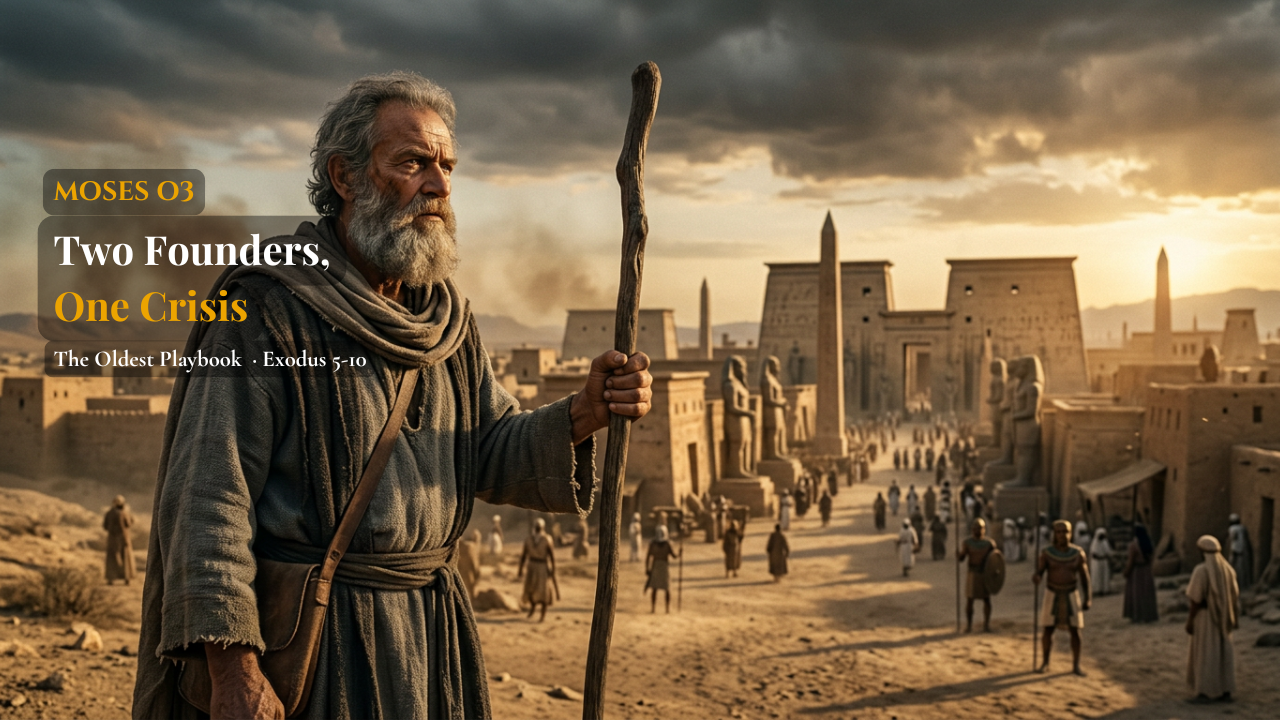
Moses 03: Two Founders, One Crisis
Exodus 5–10 — and the one question every builder has to answer

There's a lie we quietly believe about traction. We think that the moment we finally say yes to the hard thing (the right thing) the universe is supposed to reward us for it. The doors swing open. The graph ticks up and to the right. The team cheers. That's the deal, isn't it? You do the brave thing, you get the win.
Now let me show you what actually happened the day after the founder finally said yes.
This week on The Oldest Playbook, the venture launched. And I have to warn you up front: the launch goes terribly. Not "we missed our numbers a little" terribly. Spectacularly, catastrophically, everyone-turns-on-you terribly. If you've ever shipped the right thing into a market that punished you for it, this one is for you.
Where We Left Off
For the past few weeks we've been watching God recruit the worst résumé in the ancient world. Moses: eighty years old, a fugitive with a manslaughter charge behind him, forty years removed from anything resembling relevant experience, whose own self-assessment in the interview was, and I quote, "I have never been eloquent. I am slow of speech and tongue."
That's the founder God picks to run the largest exit in history: getting an entire nation out from under one of the great superpowers of the ancient world. In Exodus 3 and 4 we watched the Founder above all founders recruit him at a burning bush, answer all five of his objections, hand him a co-founder in Aaron, and send him off still trembling — but holding a staff.
That was the founding story. This week, the founder walks into the arena for the first time. And this is where most founder documentaries cut away.
The Part They Cut Out of the Documentary
If Exodus 3 and 4 were the founding story, Exodus 5 through 10 is the stretch no one puts on the highlight reel — the part where everything gets worse before it gets better. But buried in these six chapters is the sharpest leadership case study in the entire Bible. Because the text does something remarkable. It holds two leaders side by side and lets you watch them take the exact same pressure, in the same city, through the same events — and break in opposite directions.
One of them is criticized by his own people, doubted, cursed to his face — and he bends, again and again, in one direction only. The other is warned nine times, watches his entire country come apart in front of him, hears his own executive team beg him to change course — and he will not bend at all.
Moses and Pharaoh. Those are your two founders. And here's what I want you to notice before we go any further: the difference between them is not talent. It's not resources. It's not intelligence. Pharaoh has all of that in abundance. The difference comes down to a single question — a question every person reading this has to answer, whether you follow a higher calling or not, whether you'd call yourself religious or an atheist or nothing at all:
"Who do you answer to?"
Because you answer to something. We all do. So let me put it in language every builder understands. I'm going to call the thing you answer to the board. Every leader reports to something. Moses reports upward — to a God he argues with, complains to, yells at, and ultimately obeys. Pharaoh reports to a committee of one: his own heart. And these six chapters are simply what happens when those two org charts collide.
Let's decode it. Four movements today.
Movement One: The Dip Is the Curriculum, Not the Verdict
Moses and Aaron walk into the most powerful office on earth and deliver the message exactly as instructed: "Thus says the Lord, the God of Israel: Let my people go" (Exodus 5:1).
And Pharaoh gives one of the great lines in Scripture — because it's the thesis statement of his whole life: "Who is the Lord that I should obey him? I do not know the Lord, and I will not let Israel go" (Exodus 5:2).
Then he does something worse than saying no. He retaliates. That same day he orders his managers to stop supplying the Israelites with straw for their bricks — but keeps the brick quota exactly the same. Fewer inputs, same output. Every operator reading this knows that move. It's punitive resource starvation. And when the people inevitably miss quota, their own foremen beat them for it.
Now watch what happens to Moses' approval rating. At the end of chapter 4, the people believed him, bowed down, and worshiped. Days later, bleeding under the new quota, here's what they say to him: "May the Lord look on you and judge you. You have made us a stench to Pharaoh. You have put a sword in their hands to kill us" (Exodus 5:21).
Read that again. Moses did everything right. He obeyed the mandate precisely, exactly as he was told. And the immediate result was that the people he came to rescue suffered — and blamed him. Not Pharaoh, who was actually inflicting the punishment. Moses. The man carrying the message.
Here's the first line of tonight's playbook, and it's one nobody puts on the fundraising deck: doing the right thing can make the metrics worse before it makes anything better.
There's a dip on the far side of almost every real obedience, every real venture. And the dip is not evidence that you're wrong. Slow traction, no heat, no momentum in the early going — none of that means you made the wrong call. But the people around you will read the dip as failure. They'll start drafting the postmortem. Because pain makes people bad at attribution. When it hurts, we blame whoever is nearest and safest to blame — and the messenger is always nearer and safer than the king. So let me ask you, founder: when things go sideways, who do you lash out at? The co-founder? The staff? The silent co-founder — the spouse, the family — who never signed up for the cap table but pays for it anyway? If you've ever made a necessary hard call and watched your own team turn on you, you know exactly what Moses felt. The only real question is what you do with it.
Movement Two: When the Pain Comes, Route It Upward
Watch what Moses does with the worst performance review of his life.
He does not defend himself. He doesn't litigate it. He doesn't spin the narrative or call an all-hands to explain why, technically, this isn't his fault. He turns around and goes straight to the top: "O Lord, why have you brought trouble on this people? Why did you ever send me? Ever since I went to Pharaoh to speak in your name, he has brought trouble on this people, and you have not rescued them at all" (Exodus 5:22–23).
I love this prayer. It is not polite. It's earnest, it's raw, it's real — practically slamming open the boardroom doors and yelling at the chairman. And here's the distinction I need you to catch: Moses isn't venting. He's escalating. Venting goes sideways — you dump the pressure on the people around you and beneath you. Escalating goes up — you take it to the one actually able to do something about it. How many of us vent when we should escalate?
That's the pattern of Moses' entire leadership through these chapters. When people are furious with him, he goes up. He stays relentlessly accountable to the authority above him.
Now hold that next to Pharaoh. "Who is the Lord?" The king of Egypt looks to no one. No accountability, no escalation, nobody keeping him in check. He's absorbed in his own ego and deflects everything downward onto his people. For six chapters you watch him do it again and again.
Here's the principle, and I want you to sit with it, because half of you reading this run companies: the leaders who last are not the ones without a boss. They're the ones with the right one. Show me a founder accountable to nothing but their own reflection, and I'll show you a Pharaoh with better branding. It's only a matter of time and pressure. If the only thing you escalate to is you — your pride, your fear, your appetite, your greed — that's a terrible board and a terrible boss. The question was never whether you'll bend the knee. It's whether the thing you bend it to is worthy, and whether it actually loves the people you lead.
And that's the part we forget in the grind. We're so busy building that we lose sight of the fact that the whole thing is for people. Your company is itself a product — and as it grows, the people who come work for you have to be served and stewarded too. If you're so self-absorbed that there's no one you answer to, then congratulations: you're your own god. And that never ends well for the people downstream of you.
So notice what the real Board does when Moses escalates. He doesn't fire him for insubordination. He answers with the most important thing in the next six chapters: "I am the Lord. I have heard the groaning of the Israelites. I will take you as my own people, and I will be your God" (Exodus 6:2–7).
Notice what that answer is not. It's not tactics. It's not a revised timeline. Before God gives Moses a single next step, he re-anchors him in identity: who I am, and whose you are. Something no circumstance can touch.
And here's the detail that reframes the whole book. God explains why the exit will be slow and contested. Because if Pharaoh had caved in the first meeting, the story forever would have been "the king generously let them go." The credit would be ambiguous, and in their bones the people would still be Pharaoh's. The long fight is what transfers their identity. Plague by plague, a nation of slaves learns who actually holds the power and whose people they are. The delay wasn't the failure of the plan. The delay was the curriculum.
Some of you are in a season that feels like pure delay. You've been banging your head on a door that won't open, asking God — or the universe, or your journal, or whatever your board is — why. This text raises a possibility: that the season is doing something an open door never could. It's settling the question of who you are before you get to where you're going.
Movement Three: Substance Separates — But Not in Round One
Now let's talk about demos.
Moses goes back in, and chapters 7 through 10 become a study in escalation — nine plagues, each one turning up the pressure. But watch the early rounds, because there's a founder's lesson hidden in them.
Aaron throws down his staff and it becomes a serpent. Impressive — until Pharaoh's magicians throw theirs down and get serpents too. The Nile turns to blood; the magicians replicate it. Frogs cover the land; the magicians produce more frogs, which is the least helpful flex in history — Egypt is already drowning in frogs and your team's big move is additional frogs.
But the point stands, and every founder eventually learns it the hard way: in the early rounds, the counterfeits can keep up with the real thing. You ship something good — your first demo, your first feature, your first real result — and competitors will replicate it fast, especially if it's good. Your fire gets matched with their fireworks. And Pharaoh looks at the copycats and concludes exactly what a threatened incumbent concludes: "That's nothing. We can do that too."
Then comes the third plague — the gnats. The magicians try, and they fail. They walk into Pharaoh's office and, with resignation, admit: "This is the finger of God" (Exodus 8:19). The imitators tap out. And from the fourth plague on, God adds something no one can counterfeit: he starts to discriminate. The flies swarm the Egyptians but skip Goshen, where the Israelites live. Egyptian livestock die; Israelite herds are untouched. Pharaoh even sends people to verify it.
Substance separates imitation from the real thing. Always. Just not in a single round. Here it took three. So if what you're building is real, you don't need to panic when a competitor copies your feature or tries to outrun you. If you're building a trick, no amount of early parity will save you; the gap always shows eventually. But if you're building the real deal, your only job is to outlast — to keep showing up while the copycats fall apart. Round one is noisy. Give it time, and the substance tells.
Movement Four: The Anatomy of a Proud Heart
The final thing I want to decode is a diagnosis. Because Pharaoh is the most instructive bad leader in the Oldest Playbook — his failure is documented in exquisite detail. Nine plagues. Nine data points. And I want you to do what the text is daring you to do: as I walk through the symptoms, check yourself for them. I've had to. I've been Pharaoh more times in my own leadership than I'd like to admit.
Symptom one: he ignores data he himself commissioned. After the livestock plague, Pharaoh sends his own people to Goshen to check whether the Israelite herds really survived. The report comes back confirmed — not one animal dead (Exodus 9:7). He verifies the miracle with his own investigation, and hardens his heart anyway. That's the terrifying part. We assume the problem is always information — that if people just knew the truth, they'd change. Pharaoh knew. Pride is not a data problem. You cannot A/B test a man out of his own ego.
Symptom two: foxhole promises. Under the frogs, he begs Moses: pray for me and I'll let the people go. Moses prays, the frogs die, and the text gives us one of its quietly devastating lines: "But when Pharaoh saw that there was relief, he hardened his heart" (Exodus 8:15). He does it again with the flies. Again with the hail — where he even gets the words exactly right: "This time I have sinned; the Lord is in the right, and I and my people are in the wrong." A theologically perfect confession, retracted the moment the thunder stops. I've been this person. When it's desperate, you bargain; when the deal stops dying, you get amnesia — wait, when did I say that? A commitment that only exists under pressure was never a commitment at all.
Symptom three: he negotiates what isn't his to negotiate. As the pressure rises, Pharaoh starts offering deals. Fine — worship your God, but here inside Egypt. Fine — go, but only the men, leave the families. Fine — take the families, but leave the herds. Each offer sounds almost reasonable. Each one keeps a hook, collateral to guarantee they come back. And Moses' answer never moves: "All of us will go... not a hoof shall be left behind" (Exodus 10:9, 26). Watch both sides of that table, because you will sit at it. Compromise never shows up looking like surrender — it shows up looking reasonable, tired, and like 90% of what you wanted. Moses knew something Pharaoh's negotiators didn't: a mandate isn't yours to discount. There are things in your life and your company that should never make it to a negotiation table — and the mark of a leader is knowing which table to refuse.
Symptom four: he stops hearing his own team. By the eighth plague, Pharaoh's own officials break rank and say it to his face: "Let the people go... Do you not yet realize that Egypt is ruined?" (Exodus 10:7). That's the sound of an executive team watching their leader drive off a cliff. When the people closest to the problem are telling you the country is lost, and your response is to renegotiate the hostage terms, leadership has already stopped. It isn't about the mission anymore. It's about your pride. And investors can smell that red flag from across the room.
Now contrast every one of those with Moses. Criticized — he escalates to God instead of crushing the dissent. Vindicated plague after plague — and he takes zero credit. Not once in nine miracles does he claim a single one as his own. The humble leader runs Pharaoh's equation in reverse: he absorbs the criticism personally and routes the glory elsewhere — to the team, or in this case, to God.
And one honest, frightening detail, because the text is honest and so should we be. Early on, the narrator says Pharaoh hardened his own heart. Later, it says the Lord hardened Pharaoh's heart. People have wrestled with those verses for two thousand years, but at minimum the arc is telling you something true about how a heart works: say no long enough, and the no stops being a decision and becomes your character. Every refusal makes the next one cheaper. Nobody becomes Pharaoh on day one. You become Pharaoh one relieved, retracted promise at a time.
The Takeaway
So here's Exodus 5 through 10, decoded.
The right obedience can make things worse before it makes them better. The dip is the curriculum, not the verdict. When the pain comes, route it upward: complain to the one who sent you, not the people you lead. Anchor in identity, because tactics change and circumstances lie. Don't panic at counterfeits — substance separates over time. And watch for the four symptoms of a hardening heart: ignoring the data you asked for, promises that evaporate when the pressure eases, negotiating the non-negotiable, and going deaf to your own team. Because those are the early markers, and once a heart hardens enough times, it simply becomes who you are.
But under the whole passage is that one question, and I want to hand it to you plainly:
"Who do you answer to?"
Don't answer too fast.
- Because your calendar already knows. Show me how you spend your hours and I'll tell you who you report to.
- Your team knows. Let me interview them and they'll tell me.
- The person you become under pressure knows.
Everyone reports to something.
The only real choice you get is whether it's something big enough to be worth reporting to, and good enough to love the people downstream of you.
And here's the deeper thing I keep coming back to. Moses walked out of Pharaoh's palace that first day having made everything worse, cursed by his own people. He went and had it out with God — and then got up and went back in. Nine times. Because the venture was never his to abandon. It was his to steward. He knew he wasn't the owner.
I think we have to hold our businesses the same way. You come into this world naked and you leave it naked; you don't take anything you build with you, not even your company. So it was never really yours. You feel like you own it, but you're stewarding it. And honestly, that might be the greatest lesson in business, period. Even the most die-hard capitalist eventually learns it: you grind to unicorn status, you IPO, and the moment you do, there are shareholders, and the company is no longer yours. You're a steward to your shareholders and to the board they elect. Business turns out to be a strange, accurate mirror of our relationship to a higher power. It was never something you own and can do whatever you want with.
The sea hasn't parted yet. We'll get there. The Red Sea is coming, and when it does, there are more lessons waiting in it. But this is where we'll leave it for now.
Two leaders stood in the same storm. One answered upward, and it made him unshakable under criticism. The other answered to no one, and it made him a hostage to himself, and his whole nation paid the ransom.
Who do you answer to?
The Oldest Playbook is where we decode the Bible through the lens of a founder. If this stirred something, stay plugged in: we're walking through Exodus together, and next week the Red Sea parts.
See you at the next Concert.

The Oldest Playbook Newsletter
Join the newsletter to receive the latest updates in your inbox.