Moses 02: The Reluctant Founder
The Oldest Playbook — MOSES 02 | Exodus 3 & 4

There's a version of the founding story we've all rehearsed in our heads. The visionary steps onto the stage, fully formed, fully ready. The timing is perfect. The résumé is stacked. The confidence is radiating off him. That's the story we think we're supposed to be living.
Now let me hand you the actual founding document of the greatest logistics operation in the Old Testament — the relocation of an entire nation out from under a superpower. And the founder God picks for it would get screened out by any HR department on earth in about eight seconds.
This week on The Oldest Playbook we kept deep-diving into Moses, picking up in Exodus 3 and 4 — the burning bush. On the surface it's a call story. Read it again and it's something far more familiar to anyone who has ever tried to build anything. It's the founding of a venture. And it shows you how the Founder above all founders — God — recruits, equips, and launches a leader who wants nothing to do with the job.
Where We Left Off
A quick recap of the two weeks before. The Israelites had been in Egypt a long time, and the higher powers had forgotten Joseph and all his glories from Genesis. They looked at the Hebrews as pests — dirty, a threat — because the Hebrews were flourishing and multiplying. So Pharaoh commanded the midwives to murder the Hebrew babies. That's the world Moses is born into.
And notice who saves him. Not mighty men. It's the midwives, his mother, his sister, and Pharaoh's own daughter — people in the margins. Revolution comes from the fringes, not the center. Moses grows up a prince of Egypt but never forgets he's a Hebrew. When he sees an Egyptian beating a fellow Hebrew, he kills the man, becomes a fugitive, and flees. The last we saw of him, he'd married Zipporah, the daughter of a Midianite priest.
That's the man God is about to call.
The Candidate HR Would Reject
Picture Moses' application landing on your desk. Eighty years old. A criminal record — one count of manslaughter. Fled the jurisdiction. Forty years of no relevant experience. Last job: shepherd for his father-in-law. And when you ask him in the interview to name his greatest strength, he says — I'm quoting — "I have never been eloquent. I am slow of speech and tongue."
This is who God recruits to run the largest relocation project in the ancient world, right under the nose of one of history's great superpowers. Exodus 3 and 4 are on the surface a call story. But they're really the founding of a venture — and a masterclass in how the Founder of all founders builds his leader. There are about five movements here. Let's decode them.
Movement One: The Call Comes on an Ordinary Day
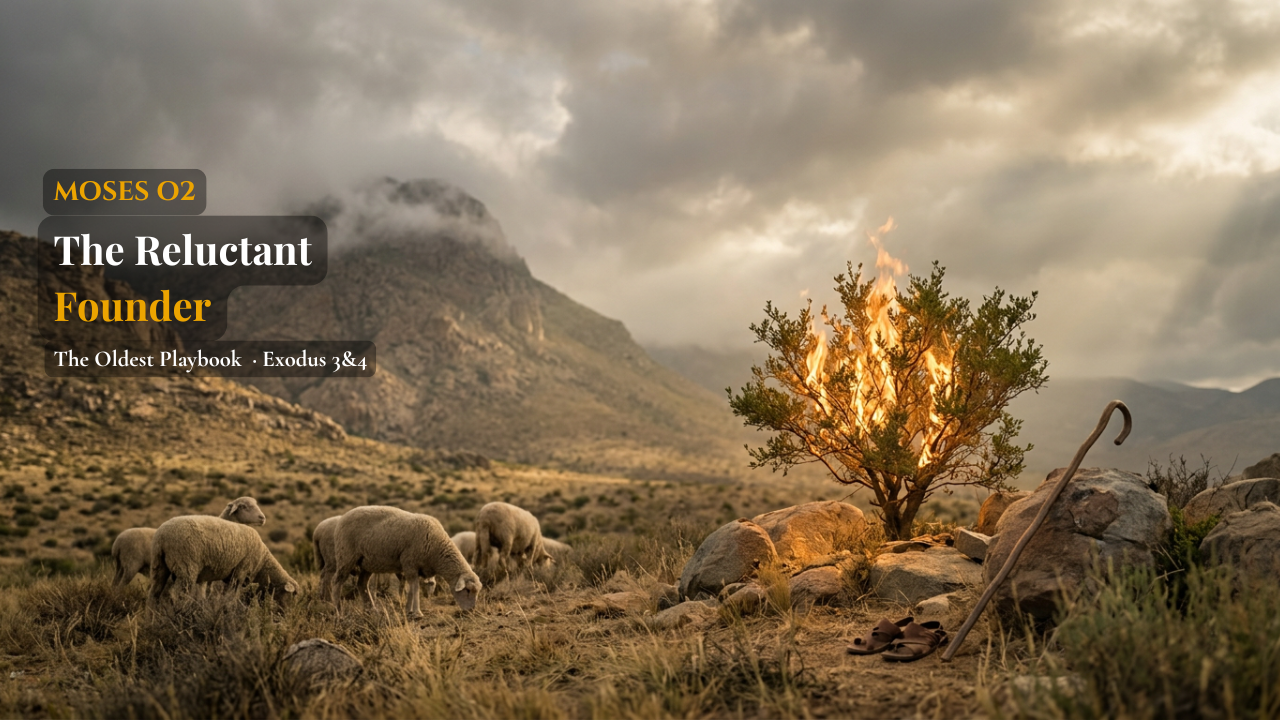
When the call comes, it doesn't come in a palace. Not at a majestic summit. Not when Moses was a prince with servants and access to Pharaoh's court. It happens on a completely ordinary day, in the middle of the wilderness, while he's doing the least glamorous job available — walking someone else's sheep to grass.
The text says he "led the flock past the wilderness and came to Horeb, the mountain of God" (Exodus 3:1). But Moses didn't know it was the mountain of God. To him it was just another Tuesday. The author knows something Moses doesn't.
So here's the first line of the playbook: the defining call of your life will almost certainly arrive disguised as an ordinary day. We keep waiting for the big stage, the launch event, the moment we've "arrived." And God keeps showing up in the commute, the routine, the unglamorous work we're tempted to phone in. Moses' passion for his people had cooled by this point. He'd shrunk his life down to feeding sheep and keeping his own household fed. And it's there — not on a mountaintop of achievement, but in the flat middle of an ordinary season — that the bush catches fire.
We imagine glorious Hollywood moments. But it's wake up, grind, sleep, repeat. Wake up, grind, sleep, repeat. And the takeaway is uncomfortable: if you are not faithful and awake in the ordinary, you will miss the extraordinary when it's standing right in front of you. Only the person paying attention to the daily gets recruited.
Movement Two: God's Timing Looks Like Bad Timing — On Purpose
If you were staffing this project — moving a whole nation out from under a superpower — when would you have hired Moses? Obviously forty years earlier, when he was a prince of Egypt with palace resources, political capital, and a standing invitation to Pharaoh's court. That Moses could get a meeting anytime. The Moses we meet at the bush is a fugitive shepherd with trembling hands who can't get near Pharaoh's desk.
And that is precisely the point. God waited until Moses had zero leverage — until, humanly speaking, there was nothing he could contribute on his own. Why? Because a founder who wants the credit to be unambiguous does not build a plan that could be mistaken for the founder's own genius.
Think like a founder for a second. You want your timing perfect so that when it works, you get the credit. God does the opposite — with the big-F Founder in mind. If Moses had pulled this off as a prince, every headline reads "Brilliant Egyptian Royal Frees Slaves," and there's no inspiration in it. Instead God engineers a situation so far beyond human capacity that when it works there's only one possible caption: God did this.
So here's the governing principle: God's optimal timing is not the same as our optimal timing, and the gap is often the whole point. We all carry a perfect schedule in our heads — millionaire by my twenties, that promotion this year, married by 28 or 35. We chase efficiency and grieve the window we think we missed. We hesitate at the assignment that arrives when we feel least ready. But the timing that makes us look impressive and the timing that makes the mission undeniable are rarely on the same clock. He calls you when you have nothing to bring to it. That's not a bug — that's the design. It keeps the glory clean and the leader humble.
Movement Three: Five Objections — A Masterclass in Developing Reluctant Talent
Have you ever tasked someone and gotten resistance instead of "yes"? Moses is the epitome. God lays out the vision — go to Pharaoh, bring my people out — and Moses spends the next chapter and a half saying no in five different ways. Every leader in the room has used at least three of these.
Objection one: identity.
"Who am I that I should go to Pharaoh?" (Exodus 3:11).
That's imposter syndrome — 3,500 years before we had a name for it. And notice: God never answers the question "Who are you?" He answers a better one — "I will be with you." He doesn't inflate Moses' self-esteem; he reframes the whole equation. The qualification was never Moses. The qualification is the presence behind Moses. The mission doesn't rest on the man. It rests on who's behind the man.
Objection two: the mandate.
"What is your name? What do I tell them?" (Exodus 3:13).
Moses wants authority to cite — a name to stand behind him. And God gives him the strongest mandate ever issued: "I AM WHO I AM." Not a committee, not a title. Every leader who's ever walked into a hostile boardroom knows the difference between "I think we should…" and "I've been sent here by…" Same as a kid quoting a teacher or a parent — "my mom and dad said." The authority isn't yours; it's borrowed from who stands behind you. God says: tell them I AM is behind you.
Objection three: credibility.
"What if they don't believe me?" (Exodus 4:1).
A fair point — so God hands him proof of concept. The staff becomes a snake. The hand turns leprous and is healed. Pilots, demonstrations, signs — evidence you can put on the table when the word alone doesn't carry. But watch the mechanics, because there's a kingdom principle hiding in the miracle. God tells Moses to throw down the staff, to grab the snake by the tail, to put his own hand in his cloak. God does the miracle — but Moses has to act. It's not black magic Moses performs. God does not work instead of you; God works with you. The sign required Moses' obedience as raw material. That's the whole operational model: divine power plus human participation. Even the Bible itself was written by men — God working through men. Nothing in life, business, spirituality, or science happens without a human taking action.
Objection four: the skills gap.
"I'm not a good speaker." And God's answer: "Who made the mouth?" (Exodus 4:10-11).
In other words — I'm aware of your limitations. I designed them. I am not deterred by the very weakness you're using as your exit.
Objection five: the flat-out no.
"Please send someone else" (Exodus 4:13).
This isn't an excuse anymore. It's a refusal. And the text says God gets angry. But look carefully at what his anger does. It doesn't fire Moses. It doesn't smite him. It doesn't go find a more confident candidate. It hands him a co-founder. Sit with that.
The reluctant hire — the one making excuses, the one God is genuinely angry with — God still doesn't replace. He develops him. He'd rather invest to the very end in the leader he chose than swap him for someone flashier. If you lead people, that's a miracle. Your most frustrating team member — the one whose confidence seems stuck in the same place month after month — is exactly the person the playbook tells you to be patient with. Coach them. Don't give up on them.
This one's hard for me. The modern, efficient MBA instinct says your team is not a family: if they don't perform, fire them. The Oldest Playbook says something else. Once you've committed to a co-founder, you don't swap them out — you develop them, you walk with them, you grow with them. And hesitation is not the same as unfaithfulness. Some people, like Abraham, hear once and go. Others, like Moses — like Gideon — have to argue it out until God names their fear, and then they go. Both are faithful. Faith isn't a finished product you either have or you don't. It's a process you mature through. So extend to others the grace you're hoping for in your own growth — and don't despise yourself for still being in the process either.
Movement Four: Build a Team, Not a Monument
Aaron deserves his own line in the playbook. He's Moses' co-founder.
Moses' fatal assumption — the one underneath every objection — is that this is a solo act. That he's the single point of genius, sent to do it all alone. But God's design for accomplishing his work is never the lone hero. God blesses unity; his work moves through people together.
This is the same truth the whole community keeps circling back to. Remember chapter 2 — it took a mother, a sister, a midwife, and a princess just to keep the leader alive. No one arrives at leadership by their own strength, and no one executes it alone either. If you're trying to do it all by yourself, you're not being faithful — you're being proud. When you run a company thinking "I'm the smartest person in the room and everyone else is here to stroke my ego," that's not right. You need to find your Aaron. We saw the same thing with King David — he had his Jonathan, he had his mighty men.
Movement Five: Fix Your Own House Before You Scale
Here's the strangest scene in the whole passage, and one of the hardest business lessons in it. Moses finally says yes. He packs the family, sets out obedient — and on the road, at a lodging place, "the Lord came to meet him and was about to kill him" (Exodus 4:24). God's own chosen leader, launched at last, nearly dies before the launch date. Over what?
Over an unaddressed obligation. Abraham's covenant with God was marked by circumcision — Abraham circumcised himself and Isaac, and it became the non-negotiable sign between God and his people. Moses knew this. And Moses had never circumcised his own son. So Zipporah grabs a flint knife and does it herself, and the crisis passes. To modern readers this scene looks bizarre. To anyone who knows the Old Testament, it makes complete sense: Moses had skipped the one covenant mark his ancestors had promised to keep.
Read that as a leader. You cannot ask people to live under a covenant you've quietly skipped yourself. The man about to demand that an entire nation follow God's word had an unresolved compliance failure at home. And before he could scale — before he could stand in front of anyone — his own house had to be put in order. How many of us tell our people to wake up early and work hard while we're out drinking and partying? That's the dissonance being named here. Integrity gaps don't disappear when you get promoted; they get more dangerous. The bigger the mission you're about to carry, the less you can afford the private thing you've been meaning to fix. Deal with the tent before you address the nation. Deal with your home before you address the vision.
And don't miss who fixed it. Not Moses. Not the Hebrew insider. It was Zipporah — a Midianite, an outsider, a woman who by every assumption shouldn't have known the importance of that mark at all. The solution came from the person nobody would have credited. Keep your eyes open: what your venture needs may come from the last person on your org chart you'd expect. And on the other side of that — it matters enormously who you marry. Warren Buffett has said the most important decision he ever made was who he married. Marry the right person and your business has an easier time flourishing. Not automatic — you still have to work — but the right partner changes everything.
The Takeaway
Chapters 3 and 4, decoded, are about founders — and mostly about HR. Talent acquisition, talent fostering, talent growth. Here's the whole arc:
You'll be called on an ordinary day, so stay alert. You'll be called when you have no leverage, when you feel least attractive in your own head — so stop waiting to be qualified. You will object, and the answer to "who am I?" is never you; it's who's behind you. You'll want to go it alone, but the mission needs a team, so build one. And you'll be tempted to skip the private things to chase the public ones — but fix your house first.
Moses walked away from the bush still afraid. The text is honest about that. He went trembling. But he went off holding a staff — an ordinary shepherd's stick that had become the symbol of a presence he couldn't manufacture and couldn't see. He didn't have confidence in himself. He had something better: the assurance that he wasn't going to build alone.
If you're building anything, sit on that. Entrepreneurship carries real risk, and there will be nights you wake up at 2am asking, "What did I just decide to do? I gave up a comfortable, well-paid job for this?" There will be days you're trembling even though you made the right call. The assurance the Oldest Playbook offers isn't that the fear goes away. It's that if you're in good terms with the one who called you, who sent you, who's behind you — then even trembling, you can move with confidence.
It was never about becoming impressive enough to deserve a call. We're all responding to a call. It's always about keeping your hand on the staff and taking the first step — even when you're scared.

The Oldest Playbook Newsletter
Join the newsletter to receive the latest updates in your inbox.