Moses 01: The Basket and the Throne
The Oldest Playbook — MOSES 01 | Exodus 1 & 2

We're starting something new this morning. A series on Moses.
But I'm not going to introduce you to Moses yet.
You'd expect Exodus to open with him. He wrote much of the Torah, he's revered across all three Abrahamic faiths. It doesn't. Scripture spends a whole chapter on the world he was born into before it ever lets him on stage. The people. The king. The threat. The fear.
You cannot understand the man until you understand the room he walked into. So this morning is about the room. And I promise you, by the end you'll see your own boardroom in it. Your own org chart. Your own leadership.
Because Exodus 1 is one of the sharpest leadership case studies ever written. And I'll be honest, I've read the Bible many times, and I skipped right past it. There's more there than meets the eye.
A People Who Wouldn't Stop Growing
Exodus opens by counting.
It's a list. Jacob's family, the household that came down to Egypt. On the surface it's a little boring: names, sons, a family. Easy to skim.
But if you pay attention you'll see verse 7 say:
"...[They] were fruitful and increased greatly, multiplied and grew exceedingly mighty..."
And if you know your Bible, that verse rings a bell. It harkens back to Genesis 1:28, where God gives mankind the mandate to be fruitful and multiply.
Two Hebrew words sit underneath it: Parah, to be fruitful, and Ravah, to multiply. The exact same two words from Genesis 1:28.
So if verse 7 made you think of the Garden, you're not crazy. It is the Garden language. Showing up in Egypt.
Which means Israel was being faithful to the culture mandate. In a foreign land, under pressure, far from home, they were multiplying. Having dominion. Flourishing. They kept building. They lived out the original assignment God ever gave a human being, and that is good.
And that faithfulness is exactly what made them a target.
The King Who Forgot
Verse 8. There arose a new king over Egypt, who did not know Joseph.
Did not know Joseph.
Joseph saved Egypt. Stored the grain, read the dreams, kept a whole civilization alive through famine. And a generation or two later, he's completely gone from the memory of the most powerful man in the world.
Favors get forgotten. Stories get edited. There's nothing permanent in your glory.
I asked one of the AIs the other day what the single biggest fear driving humanity is, and one answer was the fear of irrelevance. Fear of being forgotten. Which is ironic, because we will all be forgotten. That's exactly what happened to Joseph.
So it's worth asking, even in business:
"How important is the day-to-day of what I'm doing, really?"
But back to the king.
He's watching a people flourish. And what he says is:
"...[They] are more and mightier than we..."
He looks at growth and he doesn't see a blessing. He sees a threat.
And right there, that one sentence, is the whole sermon.
He doesn't see a blessing. He sees a threat.
Don't miss that. It's a huge lesson for anyone who does business.
Pharaoh Had a Choice
Pharaoh made the choice insecure leaders always make.
He tried to control what he could have stewarded.
Think about his position. Sitting inside his own borders is the most fruitful, fastest-growing people in the ancient world. That's not a threat. Seen another way, that's one of the greatest assets a leader could ask for.
A wise king could have thrown his arm around that and build with it:
"Look, there's something growing under my roof. Let's go further together."
That's an abundance mindset, and we have to nurture it, because most of us aren't born with it.
Most of us carry the opposite: a smallness, a scarcity. That's exactly what Pharaoh had. He looked at what could have been abundance, and he got scared.
And fear does what it always does. It reaches for control. He sets taskmasters over Israelites: more bricks, less straw.
And when oppression doesn't work, verse 12,
"....[T]he more they afflicted them, the more they multiplied and grew..."
So Pharaoh goes from labor to murder, killing the Hebrew baby boys, because he thinks that's how you control a population.
Now watch the pattern. Did the control work? It didn't. The oppression backfires.
But before we move on, let's have a mirror-in-front-of-your-face moment. Don't think Pharaoh is somebody else.
The Mirror
When a leader leads from fear, they start to experience other people's fruitfulness as competition.
How often have you felt that? Or seen it?
- The colleague who outperforms and suddenly gets frozen out of the meeting.
- The young founder who's clearly more gifted, who suddenly can't get the check, the intro, the green light.
- The employee whose talent makes the boss nervous, so instead of a promotion they get more work, less credit, a tighter leash.
- The brother whose light fills a room, so the room decides to dim him.
When someone begins to surpass us, the human default is not to celebrate them. It's to suppress them. To neg them. To hold them down just enough that they never pass us.
So the questions are simple:
What could Pharaoh have done differently?
And...
Am I being Pharaoh here?
If you feel that ugliness creep in when you see someone more successful than you, check it. You have the same opportunity Pharaoh had: to hold abundance, and practice anti-scarcity.
Because here's the iron law of Exodus 1:
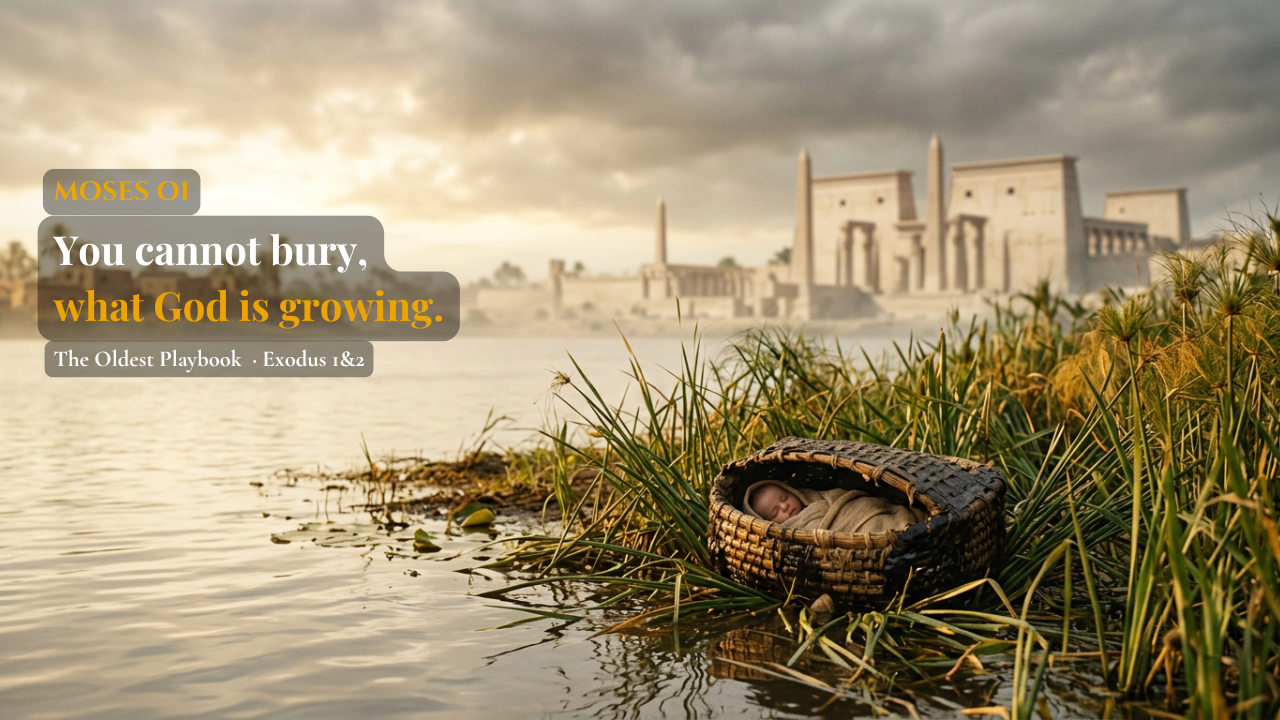
You cannot bury what God is growing.
Pressure didn't kill the mandate. Rather, it spread it. Every brick they were forced to make, the nation got stronger. The harder Pharaoh squeezed, the faster Israel multiplied.
And now sit with the deepest irony in the chapter. The child Pharaoh feared most, the Hebrew boy he passed a law to kill, gets pulled out of the river by Pharaoh's own daughter. Raised in his own house. The thing he feared most, he ended up sheltering at his own table.
Oppression often creates the very leader it was trying to prevent.
Remember that one. Insecure leaders try to control the threat. Wise leaders recognize what God is raising up. And they don't fight it.
Pharaoh reached for control, and in reaching for control, he built the conditions for his own collapse.
Empires are built by control. But movements are born through multiplication. And you cannot run a movement with a Pharaoh's heart.
So the uncomfortable question, because the Oldest Playbook always asks it:
When you watch the people under you flourish (e.g., the report, the hire, the rising partner, the kid who's clearly going to be better than you) what shows up in your heart? Joy? Or threat?
Power amplifies the condition of the heart. So check your heart. Look at the mirror. Let's be abundant people.
The Future Was in the Basket, Not the Boardroom
Now look where God was actually working while Pharaoh was busy with his ugliness.
Not at the throne. In the margins.
People in power overlook the margins. But change, innovation, revolution—those almost always come from the margins. And Exodus 1 shows it.
There are two midwives: Shiphrah and Puah. Notice what Scripture does. It remembers their names. The most powerful man in the world is just "Pharaoh." But these two midwives? Named and remembered.
Pharaoh commands Shiphrah and Puah to kill the Hebrew boys at delivery. But instead of blindly obeying, they quietly let the babies live because fear God more than the king.
From this backdrop, a mother hides her son. A sister watches from the reeds. A basket goes into the river, and Pharaoh's own daughter finds it.
That basket is worth a pause. The Hebrew word is tevah. It appears in one other place in the Bible: Genesis, for Noah's ark. The vessel that carried life through the waters of judgment.
So something poetic is happening. God is basically whispering: "I save through the flood. I carry the chosen through the very thing meant to destroy them."
The powerful leadership truth is that the future is usually being formed in the place powerful people overlook.
While Pharaoh obsessed over quotas and managed the visible threat, the actual future of the world was floating in a basket a few feet from his palace. Hidden. Vulnerable. Unfunded. Not in the boardroom, in the reeds.
Your world is the same. The next great company, leader, movement...it rarely begins where the powerful are looking. It begins in the basket. The unfunded founder. The overlooked hire. The idea nobody will back yet. And if God is preserving it, no VC, no monopoly, no empire kills it.
So don't despise the basket. That might be exactly where you are.
Just because you're not in Silicon Valley or on Wall Street doesn't mean you don't matter.
What's on the margin today can be the center tomorrow. If you're on the margins, find hope in that. If you're at the center, don't neglect the margins, and don't be scared of what's rising there.
Why This Particular Boy
Now let's come back to Moses. He's the protagonist. Why him? What made him the one?
Exodus barely introduces him. A man of the house of Levi. A baby under a death sentence, pulled from the water and raised Egyptian. Egyptian name, education, privilege. Pharaoh's daughter raises him as her own. Every door open. He could have lived and died in that palace, comfortable, fully assimilated, safe.
But then comes the twist. Exodus 2:11:
"He saw an Egyptian beating a Hebrew."
And here's the line that surprised me this time around.
He saw an Egyptian beating a Hebrew, one of his brethren.
One of his brethren.
One of his own people.
Stop there. This is the hinge of the whole man.
Moses was raised inside the dominant culture. Every incentive pointed one direction: forget where you came from. You're palace now. You're Egyptian now. Don't look at those slaves and call them yours. You're better than that.
That could easily have been the narrative in his head. But Moses refused it. He looked at a beaten slave and something in him said:
"That's mine. Those are my people. That's who I am."
Let me be honest and a little vulnerable about why this hit me.
I grew up watching so many people do the exact opposite. I'm Asian American. When you're raised between two worlds, there's enormous pressure to deny your roots and disappear into the dominant culture. Shave off the accent. Be more American.
That's why what Moses did made me pause. Palace life demanded he ignore his roots and take the role of privilege. He didn't. The privilege never erased the identity. And that refusal is what, I think, made him a deliverer. How can lead a people home if you've spent your whole life pretending you're not one of them?
That's the seed God was protecting in the basket. Not just a survivor—a man who would remember who he was when everything around him paid him to forget.
Though he gets it right in his heart, he is wrong in his hands. He kills the Egyptian, hides the body, and runs to Midian. And the irony follows him.
At a well he saves seven sisters from some bullies, and what do they call him? An Egyptian.
So to the Hebrews he's too Egyptian. To Egypt he's a fugitive. To the strangers he looks Egyptian. He belongs nowhere yet. And he could have leaned into the safe Egyptian identity. But he didn't.
And let me widen it, because this isn't really about ethnicity. The meta is bigger: it's about denying who you are for the convenience of fitting in.
How many of us do that in business, trying to fit in by denying who we are? That's a cheap trick.
The greatest founders I meet, a hundred percent of them, aren't fakers. They don't ask permission to be who they are. They bring their full selves forward and go at it. It may be painful at the start. But that's what made Moses great, and it's what will make you great.
Where Exodus Leaves Us
So here's where Exodus leaves us. No plagues. No sea. None of the miracles we know the book for. Just a flourishing people, a fearful king, and a baby in a basket destined for greatness.
And the whole thing is a leadership mirror. Three of them.
First: how do you handle other people's growth? Pharaoh shows you the cost of leading from fear. He treated fruitfulness as a threat, reached for control, and built his own collapse. Don't be that leader.
Second: if you feel hidden, e.g., unfunded, overlooked, stuck in the margins, remember the midwives. Remember the basket. The story doesn't happen in the center. The momentum comes from the margins, and once it's there, nothing stops it. You are not forgotten because you're not visible.
Third: if you're tempted to assimilate and bury your true self, don't. Moses's power wasn't that he made it into the palace. His power was that he never forgot who he really was. Don't erase your roots to win the room. The very thing you're tempted to hide may be the thing God plans to use.
Before the burning bush, before a single miracle, these three lessons are revealed to us in Exodus 1 and 2.
Go back and read them again after this. Next week, we move into chapter three and beyond.

The Oldest Playbook Newsletter
Join the newsletter to receive the latest updates in your inbox.