Esther 02: She Turned Down Half a Kingdom. Twice.
Esther 5-10 | The Oldest Playbook

Walking Back Into the Throne Room
Quick recap before we pick up where we left off, for anyone just joining. Esther is an orphan, an immigrant, and her ethnicity makes her a target in the empire she's now queen of. She got conscripted into a pageant she never volunteered for. Her cousin Mordecai refused to bow to a court official named Haman, Haman got furious, and he signed a decree to kill every Jew in the empire. Mordecai told Esther that saving their people was now, somehow, her job. She fasted three days and said the line everyone remembers: "If I perish, I perish."
That's where we left her. About to walk into the king's throne room uninvited, which is a legal death sentence unless he extends the golden scepter. Fifty-fifty odds, roughly, given how the last queen's story ended. Spoiler, since we're picking the story back up anyway: she wins. Completely. Total reversal of fortune, and Haman is the one who ends up dead.
But the mechanics of how she wins are where the actual business lessons live, and they're better than I remembered when I first read this as a kid in Sunday school. Four movements, chapters five through ten. Let's go.
Movement One: She Turns Down Half a Kingdom. Twice.
Chapter five, verse one. Third day of fasting. She puts on her royal robes and walks into the inner court. The king sees her, and here's the part that plays like an action movie: he extends the golden scepter. She lives. Probably the longest thirty seconds of her life, and then it's over, and he says, delighted, "What is it, Queen Esther? What is your request? It shall be given you, even to the half of my kingdom."
That is a blank check from the wealthiest, most powerful man alive. She has risked absolutely everything to get to this exact moment. Mordecai's entire pitch to her was save our people. So what does she ask for?
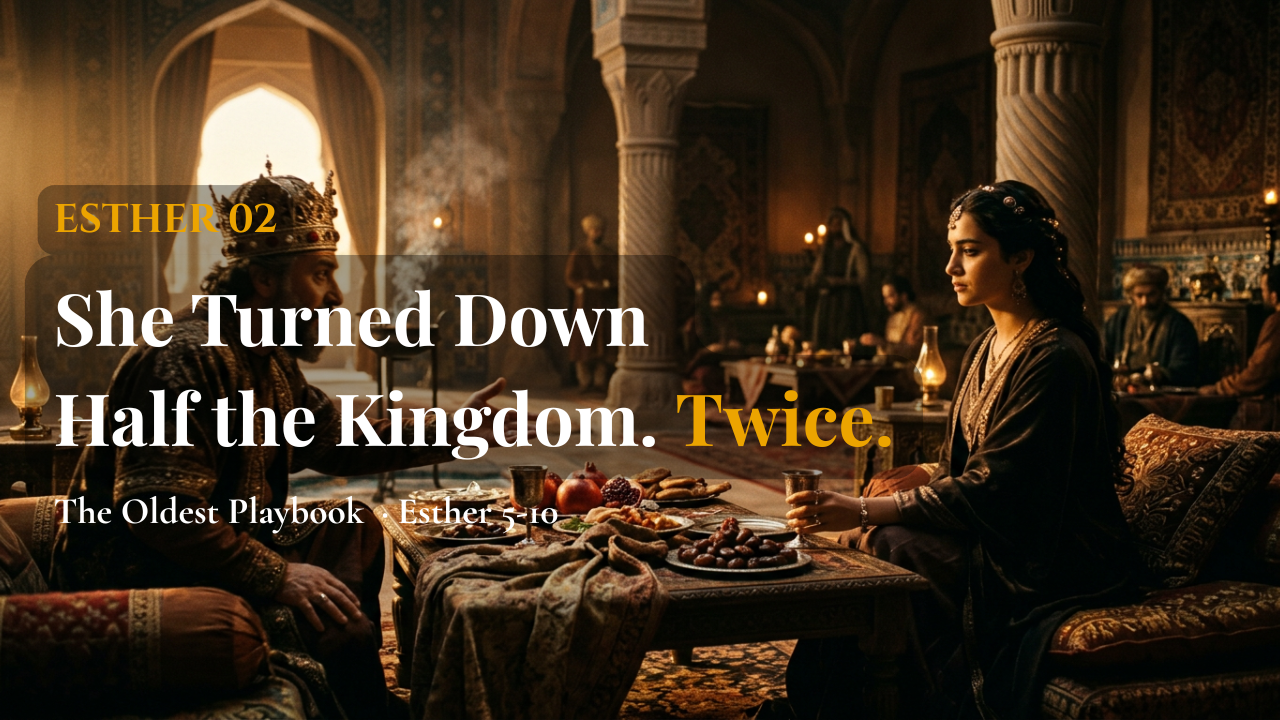
Dinner. She asks him to come to dinner. That's it. Verse four: come to the banquet today, you and Haman. Yes, she invites the man actively trying to exterminate her people to the dinner too. When he shows up, delighted, and offers again, up to half the kingdom, again, she says the same thing. Come to dinner again.
The most powerful man on earth offers her half an empire twice, and she books two dinner reservations.
I have to pause on this, because it reminds me of something. Warren Buffett is famous for auctioning off a meal with himself, lunch or dinner, and people pay hundreds of thousands, sometimes millions, of dollars for the privilege. I've never met a single person who paid that money and said it was a waste. People understand, instinctively, that a meal can be worth more than a check.
Esther wasn't just being polite. She had something better in mind than dinner as an end in itself. And here's the founder mistake this exposes. Most people don't fail to ask for what they want. They fail by asking the second someone gets excited. The investor says "this is amazing, send me the docs, I want in," and you take the yes right there, in the room, at the peak of their enthusiasm.
Enthusiasm is not authority. A yes given in a good mood gets relitigated the next morning. I've had it happen to me. I've caught myself doing it to other people, feeling genuinely excited about something in the moment, then sleeping on it and walking it back. It happens to founders constantly. Taking the yes the instant it's offered is, and I say this with love, kind of a noob move. Esther is not a noob.
Movement Two: She Wasn't Reading the Offer. She Was Reading the Man.
The blank check is undeniably attractive. She doesn't take it anyway, and here's why that matters more than the dinner itself.
The text never actually explains why she waited, which means anyone confidently telling you the exact reason is making it up. But here's a read worth considering. She wasn't evaluating the offer a second time. She was evaluating the person making it.
What does she actually know about this king? Chapter one already showed us: he throws a six-month party, gets drunk, summons his queen to show her off to his guests, she declines, his feelings get hurt in public, and he has her removed from court entirely. He's volatile. Emotionally reactive. The same instability that could get Esther killed on a bad day is the exact same instability that just offered her half an empire on a good one.
She's not trying to avoid his temperament. She's trying to time it.
Here's a read on the dinner specifically. This is a man who's been drinking for hours on an empty stomach, tired, hungry, and feeling unusually good about himself for being merciful. A promise extracted from someone in that state is worth exactly what it cost him. Which is nothing.
My dad once told me why traditionally men spend two or three months of salary on an engagement ring. It's not really about the ring. It's that the sacrifice, the saved-up, hard-earned cost of it, becomes a physical reminder of what the commitment is actually worth. You don't cheapen what you paid dearly for. There's obviously no real price on love between two people, but the principle transfers cleanly into business. If an offer cost someone nothing to make, don't be surprised when it costs them nothing to walk back.
Now, the part that matters most for basically everyone reading this. You all have a machine on your phone that gives you instant answers. AI. I use it constantly, to think out loud, to brainstorm, and I'm not here to tell you it's bad. But notice what it did to the market for answers. It made them cheap. Nearly free.
When answers get free, the whole game shifts to timing. You can prompt your way to a perfect email. You cannot prompt your way into knowing that it's Tuesday, he's exhausted, and he hasn't eaten since breakfast. That kind of knowing isn't information, it's judgment, and it can't be automated. Knowledge is something you acquire. Wisdom is something you have to become.
Esther had zero information advantage in that room. Haman knew the same facts. The eunuchs knew the same facts. Everyone in the palace had the same access to the same king. What she had instead was the willingness to read the person and the self-control to wait. That's also, incidentally, why plumbers and contractors are having a moment right now while anyone selling "instant" is racing to the bottom. When speed gets commoditized, time and judgment become the premium.
Movement Three: The Chapter Some Scholars Call a Joke
Some serious scholars, including Adele Berlin, who wrote the Jewish Publication Society commentary on Esther, actually describe chapter six as a farce, deliberately written to be funny, because it's almost comically well-timed to be believable. I don't think it's a joke. I think it's the whole point.
Here's what happens. That specific night, for no stated reason, the king can't sleep. He orders someone to read him the royal chronicles, basically the history of his own reign, presumably to bore himself to sleep. In the middle of this reading, he lands on the entry where Mordecai uncovered and stopped an assassination plot against him. And he realizes he never rewarded the guy.
At that exact hour, Haman happens to be walking through the outer court, on his way to ask the king's permission to hang Mordecai on a pole he's already built. The king spots him and calls him in. "What should be done for the man whom the king delights to honor?"
Haman, in a truly spectacular moment of self-regard, thinks to himself, who else would the king possibly want to honor besides me? So he goes big. Parade the man through the streets in royal robes, on the king's own horse, with a noble shouting his praises ahead of him.
The king loves the idea. And then hands Mordecai the parade Haman just designed for himself.
This all happens between the second and third dinners. Esther could not have engineered this. There is, again, no mention of God anywhere in this book, the only book in the Hebrew Bible where that's true. But the setup is so airtight it's hard not to notice.
There's a law professor I studied under, David Strauss at the University of Chicago, who once said something I still think about: you'd be surprised how much of your life's success comes down to luck and fortune, no matter how well you prepare or how perfect your decisions are. Esther didn't cause the king's insomnia. She couldn't have. But her patience meant that when the door opened, Mordecai was already exactly where he needed to be, freshly restored to royal favor, right as she made her actual ask.
Had she asked before chapter six happened, the timing would have been off, and Mordecai wouldn't have had the standing he needed for what comes next. She waited. The universe, or something, filled in the rest.
Movement Four: The Third Dinner
Third time the king asks what she wants, she finally answers. "Let my life be granted me, and my people, for we have been sold, I and my people, to be destroyed." The king erupts. Who did this? Who would dare?
Meanwhile, right before this dinner, Haman's wife Zeresh, his silent co-founder in all of this, along with his advisors, tells him something true for once. Chapter six, verse thirteen: "If Mordecai, before whom you have begun to fall, is of the Jewish people, you will not overcome him, but will surely fall before him." This is the same woman who talked him into building a seventy-five-foot pole to hang Mordecai on. Now she's telling him to be careful. He doesn't get time to sit with the warning before he's rushed off to the dinner.
At dinner, the king storms out to the garden to cool off. Haman, realizing his life is in immediate danger, throws himself down on Esther's couch to beg for mercy. The king walks back in and sees him there, and decides it looks like an assault on the queen. Whether that's actually what he believed or just the excuse he wanted, we don't know. But it's enough. Somebody in the room mentions there's a conveniently available seventy-five-foot pole nearby.
Haman is hanged on the exact structure he built for his enemy. He dug his own grave and then, somehow, also built the gallows.
The Restraint Nobody Talks About
Power transfers immediately. The king gives Mordecai Haman's signet ring, meaning he can now write law.
Here's the part I think matters most for founders. Chapter eight, verse eleven: Mordecai writes a law allowing Jews to defend themselves against anyone who attacks them, and to plunder the goods of their attackers. Let's be straight about this instead of sanding it down. That's a war-like statement. Thousands of people die. The book doesn't flinch about it. The Jews, once defenseless, are attacked and they defend themselves, and their attackers, Haman's allies, are killed.
But then, chapter nine, verses ten, fifteen, and sixteen, the narrative deliberately stops to report one specific detail, three separate times: they laid no hand on the plunder.
Here's why that repetition matters. Six hundred years earlier, Saul, from the same tribe as Mordecai, the Benjaminites, was commanded to defeat the Amalekites. He won. And then he took the spoils. That decision cost him his kingdom. He didn't just win, he went further than he needed to.
Six centuries later, same family line, same test. They win. They don't touch the spoils.
Setting morality aside for a second, here's why this matters for anyone building something. The real test isn't the fight. It's the ninety days after you win. What you do with leverage once the other side can no longer hurt you. The employee who burned you. The investor who passed on you rudely and now needs into your next round. This will happen to every one of you.
The extractive mindset says you hurt me, so now I hurt you back, harder, because that's strength. I've heard plenty of business people wear that like a badge. You hit me once, I'll come back with a thousand lashes. But revenge doesn't actually end with you. It's short-sighted in a way people rarely clock in the moment. When you take more than the win requires, you're not settling a score, you're just handing the counterclaim down a generation. Your kids inherit the bill you thought you were the one paying.
We tend to think our venture, our lifetime, our particular fight is the whole story. It isn't. We're a speck on a much longer timeline. Karma, whether or not you personally buy into the framework, is essentially what Mordecai is demonstrating here, whether he meant to or not. Forgiveness doesn't mean letting people destroy you, the text never says that. It says justice comes from somewhere else. You don't have to be the one who delivers it.
The book ends with Mordecai seeking the welfare of his people and speaking peace to all of them. That's the exit line for the most powerful Jew in the ancient Persian world. They invented a holiday, Purim, in his honor, and it's still celebrated today.
Two Questions to Actually Sit With
First: what are you about to ask for while the room is still excited? Next time an investor or a client lights up in a meeting, notice what you're tempted to ask for right then. Read the person, not the room. Sometimes the answer is "come to dinner" instead of "sign here."
Second, the one worth actually writing down: when you win, and you will, not if, what are you not going to take? There will be scars on the way to any real win. Will you take revenge when you have the leverage to take it? Will you go an eye for an eye simply because you can?
Some of the best businesspeople I know don't operate from an exploitative mindset. They operate from an abundant one. That's the whole lesson today, if you only take one thing from it.

The Oldest Playbook Newsletter
Join the newsletter to receive the latest updates in your inbox.