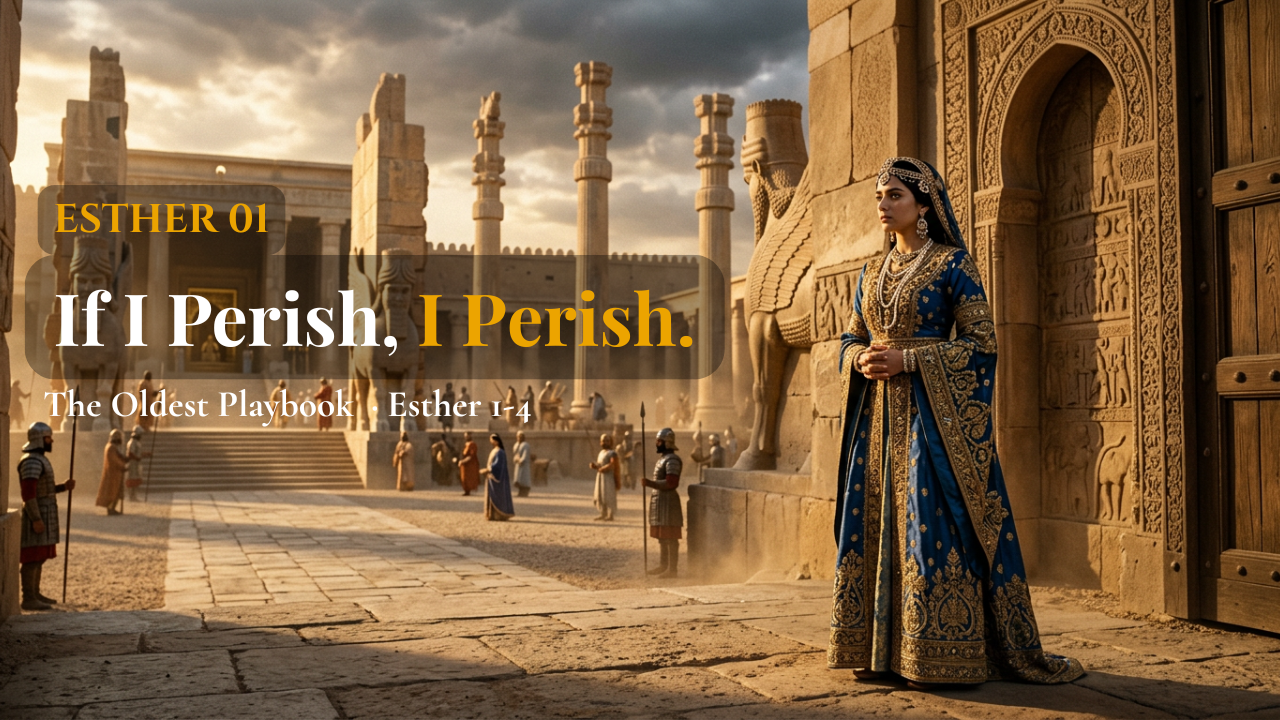
Esther 01: "If I Perish, I Perish"
Esther 1-4 | The Oldest Playbook

A Princess Story With No Princess In It
Before we open the text, one disclosure. I go by "the VC who hates most VCs." It's a joke, mostly. I don't actually hate many people. I just spend a lot of time telling founders things they don't want to hear, and eventually somebody turned that into a moniker and it stuck.
What authority do I have to decode a 2,500-year-old text for founders? Honestly, not much. I've been in business for over 20 years. I'm a trained lawyer. I'm a student at Fuller Theological Seminary, which means I get to read this stuff in the original languages instead of just squinting at an English translation. Mostly I just really like old books, and I like taking them apart to see what's still load-bearing.
Today's character is Esther. First female lead we've covered at the Concert. And before we go any further, let's kill the version of this story you already have in your head.
Esther is not a story about a princess. Yes, she becomes queen, technically. But that's not the book. The book is a case study in what a person does with a position they did not choose, inside a system they did not control, on a deadline they did not set.
The Only Honest Book in the Bible
Here's a detail that should make every skeptic in the room lean in. God is never mentioned in the Book of Esther. Not once. No divine name appears anywhere in the Hebrew text. It's the only book in the Hebrew Bible you can say that about.
Which, weirdly, makes it the most honest book about how life actually feels. Nobody's narrating. There's no voice from the sky confirming you're on the right track. There's just a sequence of decisions and actions that only make sense in hindsight, which, if you've built anything, is exactly how every version of your own story reads too.
So, before we open Esther, one question for you. How much of your situation did you actually choose? Your company, your title, your market, the city you're building in. Think hard, because most founders carry two origin stories. There's the one on the website, the insight, the leap, the decision on the pitch deck. Then there's the real one. You got laid off. Your co-founder left. Your passport picked the country you build in. Your father's business was the only industry you ever saw from the inside.
The deck version is a choice. The real version is usually a set of conditions that happened to you.
Three Ways Into the Room
The Bible gives us three people carried into a foreign court, and they all got there differently. Joseph, Daniel, and Esther.
Joseph was sold in. His brothers threw him in a pit and took the cash. He has a villain and a date.
Daniel was carried in. An army showed up, took the smartest kids in the kingdom, and marched them to Babylon. He has a scene you can point at.
Esther was born into it. Nobody deported her. There's no origin trauma with a timestamp. She woke up in Susa, inside an empire that ran from India to Ethiopia, and that was simply the water she was always swimming in.
Founders ride all three currents. Sold in, and you've got a Goliath to blame. Carried in, and you've got a door-opened story to tell. Born into it, and you have nothing. No villain, no scene, just years of quietly relitigating your own starting conditions. Why this industry. Why this country. Why am I even here.
That third category is the hardest to make peace with, especially now, when independence and self-agency are basically a religion of their own. Esther's book doesn't bother explaining her backstory. It's completely uninterested in why she's there. It only cares what she does now that she is.
Lesson one, and I want you to actually write this down: stop auditing the entry. Start working the position.
Her Resume Was Terrible
We've beautified this book into something inspirational. Let's not.
Esther was an orphan. Chapter two, verse seven: no father, no mother. Mordecai, her older cousin, raised her as his own daughter. She's an ethnic minority, and she's hiding it, because Mordecai told her to conceal it and she just did.
And she's entering a court where the previous queen was "removed" by royal decree for declining an invitation. Removed is the polite word. She was murdered.
Here's the part that gets sanded down the most, and I'm going to mispronounce this word on purpose because I keep doing it by accident. We call this a "prutified," no, "petrified," no, I mean "pritified." Beautified. We beautify this story. But look at the actual grammar in chapter two, verse eight. The young women "were gathered." Esther "was taken." Both passive. Royal officers were sent to collect candidates. She wasn't recruited. She was collected.
There's a version of this talk where I tell you hardship is secretly a gift. I don't believe that. Her conditions were bad. Genuinely bad. Every immigrant family in this room will recognize the shape of it. People look at the second generation and say, wow, these kids are sharp, they're doing so well. Nobody sees what the parents paid to make that true.
So the honest claim isn't that bad conditions are secretly good. It's that bad conditions aren't disqualifying. They're just the material you're handed.
Favor Is Not Beauty (This One's for the Fundraisers)
Here's the most useful idea in the whole book if you raise money, sell into the enterprise, or hire senior people. The text says Esther was beautiful. Fine. But read carefully. Every single woman gathered into that building was beautiful. Beauty was the entry requirement. It was not the differentiator.
So what actually happened? Chapter two, verse nine: "the young woman pleased him and won his favor." Him is Hagai. Not the king. Not the gatekeeper. A eunuch, the man who ran the women's quarters. Hagai favored Esther, and that's the hinge of the entire chapter.
Watch what she does with it. Chapter two, verse fifteen: when her turn came, she asked for nothing except what Hagai advised.
She had a blank check. Any jewelry in the treasury, any perfume, total creative control over her own pitch to the most powerful man on earth. And she used none of it. She asked the one person who actually knew the room what to walk in with, and she went with that.
How many founders in this room could have done that? Say someone who actually knows the room tells you, contrary to everything you think, don't pitch AI, don't even bring a deck, just walk in and ask three questions. Could you have listened?
Here's the translation for the rest of you. Early on you get judged on your numbers. Growth, margin, retention. Real, and you should be great at it. But past a certain stage, everybody's numbers start to blur, because nobody makes it to the final round with bad metrics. At that point the only question left in the room is do I want to be in a foxhole with this person for ten years. That's favor. There is no playbook where step four is "obtain favor." You cannot manufacture it.
Proof it wasn't about her face: jump to chapter five, verse two, years later, pageant long over. She walks into the inner court uninvited, which by law is a death sentence. The king extends the golden scepter anyway. If this had been about beauty, it would have run out by then.
One more thing about favor, since a lot of you are parents. You love all your kids equally. But there are seasons where one particular kid has your favor more than the others. Ask yourself why. It's rarely about talent. It's almost always about relationship, obedience, and how teachable they are in that season. Same mechanism.
Mordecai Is the One I Can't Stop Thinking About
Esther's name is on the book. Mordecai is the character most of you actually are.
He does three things, spread out over years. First, he raises an orphaned cousin with no upside and no exit in a foreign empire, where she's frankly a liability to him. He raises her anyway.
Second, he protects her from a position of zero power. Chapter two, verse eleven: every single day Mordecai paced in front of the court of the women's quarters to learn how Esther was doing. He has no authority in that building. None. All he has is presence outside the wall. If you've ever promoted someone into a bigger role than you have access to, and then had to sit outside the room while they were in the meeting that mattered, this verse is about you.
Third, he names her. Calls out the moment, loudly, when it counts. Chapter four, verse fourteen, and I want you to actually sit with this one, in both translations. NKJV: "For if you remain completely silent at this time, relief and deliverance will arise for the Jews from another place, but you and your father's house will perish. Yet who knows whether you have come to the kingdom for such a time as this?" ESV says roughly the same thing with slightly different scaffolding.
Read that cold. It's brutal. Mordecai is telling his own foster daughter to go do the thing that will probably kill her, and if she doesn't, she'll die anyway, and it won't even matter because someone else will do it if she doesn't.
Who talks to their daughter like that? Here's the answer, and it's the entire lesson. You can only say a sentence like that to someone whose trust you've been funding for twenty years. Go back to chapter two. He told her to hide her identity, and she just did it, no debate, no negotiation. Verse twenty: she kept following his instructions the way she had when he was raising her. That's the account balance. The withdrawal in chapter four is only possible because of two decades of deposits nobody saw.
A scholar I was talking to about this gave me the image that reframed the whole book for me. She said this is Moses' mother putting the baby in a basket, pushing it into the river, and watching from a distance. You send the one you love most into the room you cannot enter. That's what sponsorship actually costs. Not a warm intro. Watching from outside the wall.
Operator question for you. How hard a conversation can you actually have with your key people right now? That's not a communication style problem. It's an accounting problem. How much have you actually deposited.
Bad Versus Worse
Now the actual decision in chapter four, because we sanitize this one too.
Option A: walk into the inner court uninvited. One law, death, unless the king extends the scepter. And here's a detail easy to skim past: "I have not been called to come in to see the king these thirty days." Thirty days of silence from the most powerful man on earth, and she's about to bet her life on his mood. This king, by the way, is essentially a boy who throws tantrums. Unpredictable.
Option B: stay quiet. Which might also mean death, just slower, and for everyone.
This is not a choice between a good option and a bad one. It's bad versus worse. Most of the decisions that actually define your company are shaped exactly like this. Layoffs versus running out of runway. Firing the exec who's failing versus six more months of damage while you're being nice about it. The question people ask, "what's the right call," is usually the wrong question, because there isn't one. The real question is which risk you're willing to own.
The Ego Tax
Back up to chapter three, verses one through six. Why did Mordecai refuse to bow to Haman? The text doesn't say. It just states that he didn't.
Haman is the powerful, corrupt court official. Functionally, what he wanted was closer to a greeting than an act of worship. An ego tax. Mordecai wouldn't pay it. The bill came to his entire people. Every Jew in 127 provinces got a death sentence because one man wouldn't nod at the gate.
This should stay uncomfortable. If you lead anything, this will happen to you. You'll hold a line on a term, a customer, a hire you won't make, and you'll be right, and other people will pay for it. Your team, your family, your investors. A leader's conviction is not supposed to be compromised, but a leader's conviction always has a bill, and somebody else usually gets handed the invoice. If that thought has never woken you up at three in the morning, you probably haven't held a real line yet. And if you're the kind of leader who's flexible like bamboo on every value the second it gets expensive, you should question that too.
The Piece I'd Never Seen Until Now
Here's the thing underneath the whole book that took me longest to notice. Ask why these Jews were in Persia in the first place.
Quick history. Cyrus issues the decree letting the Jews go home in 538 BC. First group leaves that year. The temple is finished in 516 BC. Esther happens under Xerxes, roughly 483 to 473 BC. Do the math: the door had been open for more than fifty years.
These people, Esther, Mordecai, are descendants of the ones who did not walk through that door. I'm reading between the lines here, because the text never says why they stayed. Maybe business was good. Maybe they had no family left to go back to. Maybe they'd married into different households, had kids who only spoke Persian, grandparents buried in Persian ground. By that point, Persia was home. Going back to the motherland might have felt like emigrating to a foreign country.
By the strict reading, that's the compromise crowd. The heroes went home. The ones who stayed took the comfortable option.
I want to be careful here, because this isn't permission to compromise. But if you're running the tape on a decision you're not proud of, you took the money, you stayed at the job, you optimized for your family instead of the calling, this book has something to say to you. The rescue in your story might show up on the far side of a decision you'll never put in the deck.
It's honestly encouraging to me as a second-generation Korean American. If you've ever had a moment where America is unambiguously home, but the "return" to your ancestral country would feel more foreign than staying, this isn't the same situation Esther's in, but it rhymes.
If I Perish, I Perish
So here's where we land for part one. Esther is terrified. Three days of fasting. Then the flattest, most honest line in Scripture: "If I perish, I perish."
Notice what does not happen. The odds don't improve. Nobody guarantees her anything. The law doesn't change. The scepter is still a coin flip depending on the king's mood. What changes is that the assignment gets clear.
That's the actual mechanism, and it's the inverse of what most founders believe. Fear does not leave when the risk drops. Fear leaves when the calling gets clear. And when the vision stays fuzzy, that's exactly when you start compromising.
The verse I want you to leave with, chapter four, verse fourteen again: "If you remain silent, deliverance will come from another place." You are not indispensable. That should be a relief, not an insult. The work was never fully dependent on you. You're invited. Not required.
A lot of founders carry a quiet hero complex, the "if not me, who" posture. It's not wrong to have it. But there's a deeper humility underneath it, the understanding that if you don't do this, someone else eventually will. That should put a fire under you, not take one out.
And here's the closing irony I have to point out. When you're facing a genuinely hard decision, the instinct is to go talk to more people, get more opinions, maybe open up ChatGPT or Claude and ask it to help you think. What Esther does instead is sit in silence for three days and get clarity through fasting and stillness. Not more inputs. Less noise. When you actually understand why you're here in the first place, the decision gets easier, and no amount of outsourcing that will get you there faster.
Next week, part two: what happens after the brave decision. Timing, sequencing, and discovery. Turns out the most courageous person in this book is also its most patient strategist.

The Oldest Playbook Newsletter
Join the newsletter to receive the latest updates in your inbox.