David 05: What He Didn't Confront, He Grieved
The Oldest Playbook — DAVID 05 | 2 Samuel 13 to 18

There's a saying I've heard in different forms all over the world, and I think it's one of the truest things ever observed about success.
The hardest thing for a wealthy or powerful person is not to build a company. It's not to build another company. It's to raise a strong child.
You meet them everywhere. Brilliant founders. Titans of industry. People who built empires from nothing, who can will an organization into existence, who solve problems that would break ordinary people. And then you look at their family, and something has gone quietly wrong at the dinner table. Children who are lost, entitled, angry, adrift. The very people who conquered every external battle could not win the one happening under their own roof.
I saw this up close before I ever built anything. In my twenties I funded my way through college and graduate school by tutoring, and my clients were exactly these families — real estate tycoons, bankers, masters of the universe. To this day I cannot think of a single family I tutored that didn't fit the pattern. Extraordinary parents. Drifting kids.
Why? Why does the thing we are most capable of in the boardroom fail so often at the dinner table?
There is no better case study than the most successful man in the Old Testament. A man who defeated giants, united a nation, wrote songs we still sing three thousand years later. The man called "after God's own heart."
What happened inside his household is one of the most devastating accounts of family collapse ever written. And it did not happen because David was evil. It happened because in the place where it mattered most, David would not do the hardest thing a leader and a parent ever has to do.
He would not confront the people he loved.
And everything he refused to confront, he eventually had to grieve.
The Wound No One Would Treat
The story opens with an act of violence against a young woman. Her name is Tamar, David's daughter. I want to handle her story with the seriousness it deserves — I won't dwell on the details of the violence, but I will not skip past her either. Because what happened to Tamar, and what did not happen afterward, is the seed of everything that follows.
Amnon, David's eldest son and heir apparent, becomes fixated on his half-sister. With the help of a calculating cousin, he lures her into his quarters under the pretense of illness and assaults her. The next thing the text records is chilling. 2 Samuel 13:15:
"Then Amnon hated her with intense hatred. In fact, he hated her more than he had loved her."
He discards her. Tamar tears her robe, puts ashes on her head, and weeps. Her honor is publicly stripped away.
And here is the verse the whole tragedy turns on. 2 Samuel 13:21:
"When King David heard all this, he was furious."
That's it. That is the entire record of David's response. Keep reading and the verse simply ends with his fury. He doesn't confront Amnon. He renders no judgment. He does nothing to protect, restore, or even publicly acknowledge his daughter.
He felt the appropriate emotion. He did not take the corresponding action.
Say it as plainly as it can be said: anger without action is not justice. It's the appearance of caring without the cost of acting.
David got to feel like a good father — the outrage, the grief on his daughter's behalf — without ever paying the price of real fatherhood. The uncomfortable conversation. The demanded consequence. He should have. He didn't.
And other people paid the price.
How many leaders do you know who simply will not have the difficult conversation? Are we those leaders? Because that's David in this verse. Watch what the unaddressed wound does over time.
Two Years of Silence
Tamar's full brother, Absalom, takes his devastated sister into his home. And then, 2 Samuel 13:22: Absalom never said a word to Amnon, either good or bad, because he hated him for what he had done to his sister.
For two years, Absalom said nothing. Two years of watching his sister live in desolation. Two years of watching his father do nothing. Two years of a wound no one would treat, growing quietly into something lethal.
Sit on that number. Two years is a long time. Whole businesses are made or broken in two years. You can imagine what was happening inside him — hoping his father would deliver justice, maybe even trying to make peace with it, and then seeing his sister's face and burning all over again.
Then Absalom invites all the king's sons to a feast. And at that feast, he has Amnon murdered. Cold. Premeditated. Two years in the making.
Moral Debt
Here is one of the most important principles I can give you as someone who builds organizations and families:
An unaddressed problem does not stay the same size. It compounds.
Engineers have a term for this: technical debt. You take shortcuts, you skip the hard fixes, the system keeps running and looks fine. But the cost doesn't disappear. It accrues interest. And one day the bill comes due, far larger than the original fix.
I've lived this. At one of my startups — I'm not a technical founder — we had a team of 150 engineers, and we spent a year and a half unraveling technical debt. A hundred and fifty salaries, eighteen months, just cleaning up what had been deferred. That's what shortcuts actually cost.
David's house was carrying moral debt. The interest compounded the entire time Amnon's crime went unpunished. Absalom's hatred festered, untreated, until it burst into murder. And the murder set in motion an exile, and the exile set in motion a rebellion, and the rebellion became a civil war.
All of it traceable to one problem left small and unaddressed.
The Half-Measure
After the murder, Absalom flees into exile for three years. Eventually David allows him back — under one condition. Absalom must go to his own house and "must not see my face."
Think about what that is. It's not reconciliation. It's not justice. It's the worst of both. Absalom is brought close enough to feel the rejection, but kept far enough that nothing is ever resolved. Home, but not received. Present, but not forgiven. For two more years.
This is what avoidance looks like when it finally moves. It produces gestures that satisfy no one and resolve nothing. David could not bring himself to fully punish his son, and he could not bring himself to fully embrace him. So he did the hollow, halfway thing.
A clear no would have been survivable. Painful at first, but everyone survives, and there is no civil war. A full yes could have been redemptive. David's answer was quiet, silent, halfway. And Absalom's resentment hardened into rebellion.
Why Did He Freeze?
David is not a fool. He is a very good king — good enough that warriors and wise men followed him for decades. So we have to ask the question the whole passage is built around.
Why did this man freeze?
This is the same man who ran at Goliath while an entire army stood paralyzed. The same man who spared Saul's life twice while Saul was hunting his. A man of almost unnatural composure when life is chaos around him. And he cannot have one hard conversation with his own sons.
Here's the answer, and it's uncomfortable. David's love for his children disabled his judgment about his children. The very closeness that should have made him a better father made him a worse one. He could not bear to cause pain to the people he loved most — so he chose the short-term comfort of avoiding pain over what was actually good for them.
We tend to believe love and confrontation are opposites. That if we really love someone, we let them off easy. That accountability is the opposite of grace. David's story says the reverse. His failure to confront was not love. It was the absence of courage — which love requires. It was avoidance dressed up as tenderness.
And this runs straight through business. When sales isn't working, it's easier to ignore than confront. When your co-founder, your head engineer, your marketing lead has clearly done something that's hurting the company, it's easier to let it go. And it creates debt — moral debt and company debt at once.
So here's the sentence I want you to carry:
Overlooking and excusing things because of relationships is never beneficial. Not in family. Not in companies. Not in partnerships. Not anywhere.
The closer the relationship, the more tempting it is to look the other way. We excuse the people we love most. But that's not grace, and that's not what love does. If you truly love someone, you look out for their benefit in spite of the pain of confronting.
I'll be honest — this is a hard one for me to teach. I have two boys. I think constantly about how to raise them into good men, and it is hard not to let things slide. When your kids are fighting and it's not clear who's at fault, how do you discipline fairly? You don't get time to think. You just have to act. Maybe I overthink it. I know I overthink it. But the collapse of a household — or a company — always begins from these small cracks of inaction. If we have the authority to address something while it's small and we don't, it can ruin the entire house.
The Gate
Absalom's rebellion comes. He steals the people's hearts, raises an army against his own father, and David flees Jerusalem. And it ends the way unaddressed things tend to end.
In the forest of Ephraim, Absalom's army is defeated. Fleeing on a mule, his head catches in the branches of an oak, and he's left hanging there. David had given one order: be gentle with my son. Joab — the same Joab from last week — takes three javelins and drives them into Absalom's heart.
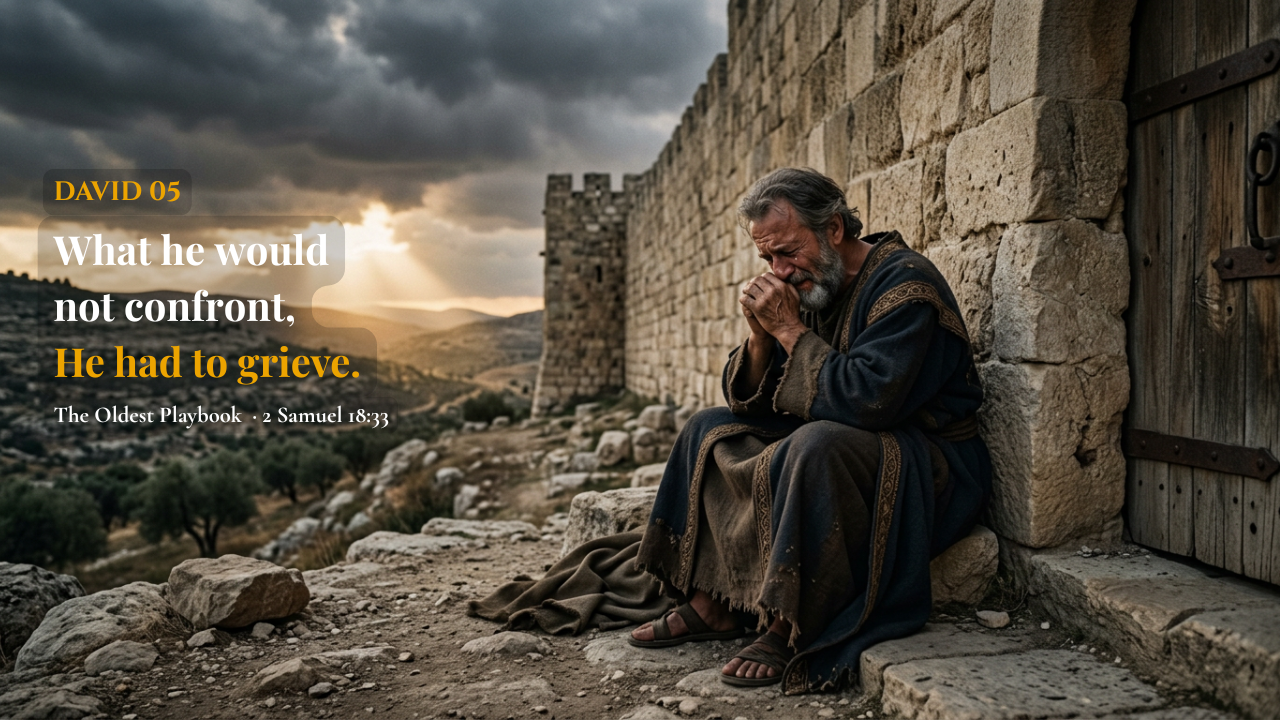
When the news reaches David, the most successful man in the Old Testament breaks. 2 Samuel 18:33:
"The king was shaken. He went up to the room over the gateway and wept. As he went, he said: O my son Absalom! My son, my son Absalom! If only I had died instead of you."
Five times he calls out my son. The repetition of a man who has nothing left but grief. By this point he has lost Amnon, lost Tamar, lost Absalom.
And here is the unbearable thing. Every tear David cried at the gate was for a confrontation he did not have years earlier. He's grieving because he avoided. He would not have the hard conversation when it could have healed — so he held a funeral instead.
What he would not confront, he had to grieve.
That is the whole story in a single sentence.
What Are You Raising?
Let me bring this home — to children, to succession, to business, all of it.
Every one of us is raising something that will outlive us. For some of you, that's literally your children. For others, it's a company, a team, a movement, the people you're mentoring and forming. How we treat the ones who come after us is one of the most important questions of a life.
And the lesson of David is this: the most loving thing you can do for the people coming after you is not to shield them from every hardship. It's to have the courage to tell them the truth, to hold them to a real standard, and to confront what needs confronting — while it's still small enough to heal.
Why is raising a strong child the hardest thing for a successful person? Because success buys the ability to avoid discomfort. A parent who can afford to avoid every hard conversation usually will. The wealth and power that conquered the outside world become, at home, the means of dodging the very friction that builds strength.
Strength is built through confronted difficulty, not avoided difficulty. A child who is never told no, never held accountable, never allowed to face a real consequence does not grow strong. They grow into Amnon. They grow into Absalom.
The kindest inheritance you can give is not protection. It's formation — the kind that only comes from facing hardships, with you beside them. Not thrown into deep water with the sharks. Beside them. But through it.
Two Questions for This Week
I usually leave you with three. Today, just two.
One. Where in your life are you furious yet frozen? David felt the right thing about Tamar and did nothing. Where are you feeling the right emotion yet taking no action? What is the conversation you keep not having — with a child, a partner, an employee, a friend — because the relationship makes it too painful? That unaddressed thing is not staying the same size. It's compounding. And the bill will come due.
Two. What are you raising — and do you love it enough to confront it? Your children, your company, your team, the people you're forming. The people coming after you do not need you to be comfortable. They need you to be courageous. They need you to do the hard thing while it's still small.
The Place to Save Absalom
David sat at the gate weeping, wishing he could have died instead of his son.
But the place to save Absalom was never at the gate. It was years earlier, in a room somewhere — lovingly, but courageously, having the hard conversation. David could not bring himself to do it.
So here is the wisdom we extract from the oldest playbook today, for you and for me:
Have the conversation. Confront while it's still small.
Do it while it can still heal.

The Oldest Playbook Newsletter
Join the newsletter to receive the latest updates in your inbox.