David 04: Dangerous Season of Your Life
The Oldest Playbook — DAVID 04 | 2 Samuel 11

There's a question I ask almost every founder I meet. Thirty a week, sometimes fifty.
What's your exit plan?
It sounds like a money question. It is. But what I'm really asking is simpler and more personal: how will you know what winning looks like? What's the number, the outcome, the moment you get to say I did it?
Most founders can answer that instantly. They have a number. They can see the exit.
So I ask the second question. And this one catches almost everyone off guard.
"What will you do after?"
And the room goes quiet. Most say some version of:
"I'll figure it out when I get there. Right now I keep my head down and build."
Here's what I've found, almost without exception. We spend ten years, twenty years, climbing toward a summit. Climbing, climbing, climbing. And we've given almost no thought to what happens when we actually reach it.
We assume the top is the safe place. The reward. The rest.
I want to tell you the thing almost nobody tells you, because it's counterintuitive and frankly uncomfortable. The most dangerous season of your life is not the climb.
It's what comes after you've already won.
And there is no better case study for this in all of human literature than the man we're looking at today. Because he already won. Everything. And what he did next nearly destroyed who he was.
The Story Doesn't Start Where You Think
David and Bathsheba. You know the scandal. There are songs written about it. And almost everyone remembers it starting on a rooftop — a woman bathing, a king watching from above.
That's not where it starts.
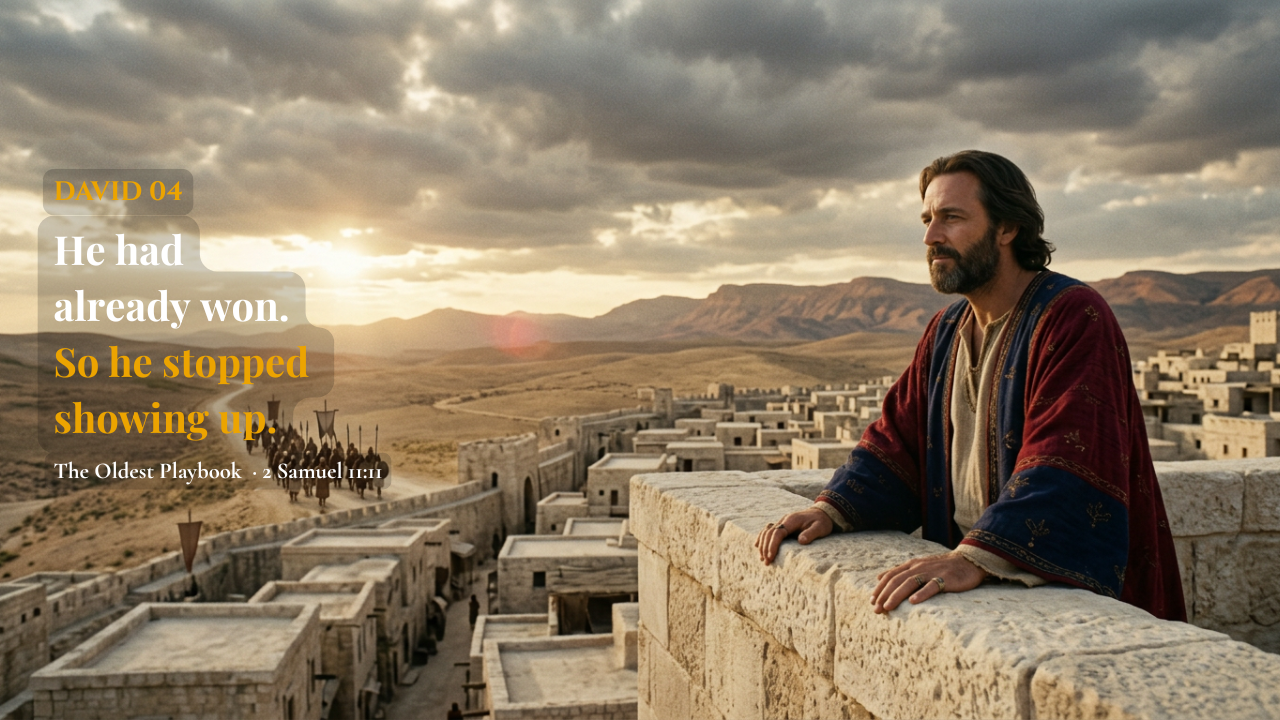
Read the first verse. 2 Samuel 11:1. "In the spring, at the time when kings go off to war, David sent Joab out with his men… But David remained in Jerusalem."
Sit on that last line. David remained in Jerusalem.
That's where the story actually begins. Not with a woman. Rather with a man who already won. Throne secured. Enemies defeated. Kingdom established. Wealth and power beyond anything a shepherd boy could have imagined.
David was living the exact post-exit reality every founder I talk to is chasing. The "F-you" money. The chill. The parties. The imagined version of rest.
And the very first thing scripture records about him in that comfort is that he stopped showing up.
He'd won so many battles he no longer wanted to go to them. He could send others and stay home. So he did.
The rooftop wasn't the cause. The rooftop was a consequence — of a man who had reached the summit and decided he no longer had to climb.
Two Men in the Room
What happens to a leader after they win and success removes the friction that was keeping them honest?
You can read the whole answer in two men standing next to David. Their names are Uriah and Joab. Hold both of them, because between them they tell you almost everything about who's actually in your room after you make it.
Uriah: the mirror
Uriah the Hittite was not some background soldier. He's listed among David's thirty elite — the mighty men. He'd fought beside David through the wilderness years, the wars, the long road to the throne. Loyal. Decorated. Trusted.
He was also Bathsheba's husband.
When David learns she's pregnant, his first instinct isn't repentance. It's cover-up. Bring Uriah home from the front, give him a good dinner, send him to his wife. Problem disappears. Nobody needs to know.
But Uriah won't go home. Here's what he says, in 2 Samuel 11:11: the Ark is in a tent, his commander and his comrades are camped in open fields — how could he go home to eat, drink, and lie with his wife? As surely as the king lives, he will not do such a thing.
Here's what makes it devastating. Uriah has no idea what David has done. He isn't making a speech. He isn't staging a protest. He isn't accusing anyone of anything.
He's just being who he always was. A man of honor who doesn't clock out because the king handed him a night off.
And every word is a mirror held up to David's face. Because what Uriah is describing — refusing ease while others carry the weight — is exactly who David used to be. The man who ran at Goliath while everyone cowered. The man who refused Saul's armor. The man who wouldn't drink the water his soldiers risked their lives to bring him, because to him it was as precious as their blood.
Uriah was being the old David. And the new David couldn't stand to look at it.
Note this: Uriah refused twice. David tried again, even got him drunk. Twice the mirror came up. And rather than let the mirror do its work — rather than break — David decided to remove the mirror entirely.
He wrote a letter. Sent Uriah to the front. Pull back the troops. Let him die.
The man whose integrity was the loudest sermon David ever received — a man who never spoke a single accusing word — died because of his goodness. Because he was inconvenient.
That's what unchecked power does. It doesn't just corrupt. It eliminates what convicts you.
Joab: the loyal one who wasn't protecting him
Now the other man. Joab — David's commander-in-chief, his most decorated general, with him longer than almost anyone. He'd fought David's wars, guarded his throne, executed his strategy for decades. Inner circle of the inner circle.
David sends Joab the letter. And Joab carries it out. No questions.
Here's where I want to be honest with you about my own first reaction. When I read this, I thought:
"That's a good soldier. Who defies a king? You want people like that working for you."
And that reaction tells me something about myself I don't love.
Because Joab was a yes man. He wouldn't have called it cowardice — in his own mind he was being loyal, discreet, the operator who could be trusted with anything. He was protecting his king, the throne, the mission they'd built together.
That self-justification is the most dangerous insider you can have. The most effective one.
The longer you win together, the harder it becomes for the people around you to tell you you're wrong. The relationship itself becomes an obstacle to honesty. Joab had everything invested in David — the army, the rank, the legacy, the wars they'd fought side by side. So when the moment came to say no, to absorb the cost to the relationship in order to protect the man, he couldn't do it.
He chose the relationship over the man. And the man paid for it.
Read that again. Protecting you and protecting the relationship with you are not the same thing. The most dangerous person in your circle isn't the enemy outside. It's the trusted insider who has learned that agreeing with you is how to stay close.
Same Old Pattern
Don't file this under faith and walk away.
Watch any K-drama and you'll see the arc: the brilliant prosecutor who becomes the corrupt politician. The idealist founder who becomes the man his younger self would have despised. Korean storytelling has this pattern deep in the bone. So does Greek tragedy. So does Shakespeare. So does nearly every political biography ever written.
The higher the climb, the further the fall. The person most unrecognizable at the bottom.
Companies, dynasties, movements, marriages. Humanity has been telling this story for as long as there have been stories. Which means the question was never really about power. Power is coming. The question is what you build around yourself before it arrives.
How It Actually Began
We picture abuse of power as something dramatic. Tyrants. Dictators. Corruption at grand scale.
David's began with something almost boring.
He stayed home.
That's it. That's where it started. The man removed every natural source of friction in his life. Out in the cave, hunted and outnumbered, every single day was a check against him — he couldn't afford to stop asking God what to do. But by 2 Samuel 11, he had enough victories to skip the war. Enough power that no one in the court would tell him no. Enough comfort to always have it within reach. And he had Joab to execute whatever he asked.
The check was gone. And so was he.
The chapter ends on one sentence. 2 Samuel 11:27.
"But the thing David had done displeased the Lord."
No thunderclap. No immediate consequence. Just a quiet verdict on the man after God's own heart — the one who killed Goliath, wept with Jonathan, rose from shepherd to king. The same man.
Three Questions for Your Room Right Now
Let me get knuckle-practical. Three questions.
One. Who in your circle is Uriah? Not someone who challenges you directly — someone whose simple, consistent integrity makes your compromises harder to sustain. Do you still have people like that close? Or have you quietly moved them to the margins because their presence got inconvenient?
Two. Who in your circle is Joab? Loyal, capable, willing to execute almost anything — and unwilling to push back. Not your enemy. But not protecting you either. They're protecting the relationship and their position. Those are not the same thing.
Three. Do you have a Nathan? Nathan is the prophet who finally confronts David — but he doesn't show up until chapter 12. By then Uriah is dead, the sin is committed, the damage is permanent. The Nathan in your life has to be in the room before the letter gets written, not after. Someone whose access comes from integrity, not utility. Someone who can walk in and say you are not being the person you said you'd be — and you would actually listen.
Accountability Is Architecture
Here's the lesson. The question is not whether you'll reach a moment of disproportionate power, comfort, or temptation. You will. If you're building something, the summit is coming.
The lesson is that accountability is architecture. You build it before the moment, deliberately, or you repeat the oldest tragedy there is.
Three concrete ways to start:
Name your Nathan before the crisis. Don't wait to discover who'll tell you the truth in the moment you most need it. Choose them now, while things are calm, and tell them explicitly: I'm giving you standing permission to confront me, and I want you to use it. A truth-teller with no mandate stays silent when it counts. Give them the mandate in advance. Put it in writing if you have to.
Build friction into your own decisions. David's downfall was the removal of every check. So engineer them back in. A co-founder who has to sign off. A board that sees the ugly numbers. A cooling-off period before big, irreversible moves. This isn't bureaucracy and it isn't about slowing everything down — it's about denying yourself the ability to go from impulse to irreversible action with nothing standing in between. Yes, friction can cost you speed. As your power grows, you want some anyway.
Audit who you've moved to the margins. The higher you rise, the more tempting it becomes to quietly distance yourself from the people whose integrity makes you slightly uncomfortable. Notice who you've stopped inviting into the room. That discomfort is often the exact thing you can't afford to lose. Pull them back in on purpose.
Rest. But Don't Rest.
So when you reach that apex — and I hope you do — here's the strange thing I'll leave you with.
"Rest, but don't rest."
You're allowed to rest. What you're not allowed to do is slip into the passive belief that you've made it — and let arrogance and ego quietly change who you are.
The white-collar criminal on the front page wasn't corrupt on day one. It started small. It started with someone who stayed in Jerusalem, who stopped taking his original mission as seriously as he used to.
That tiny slip is what eventually crushes everything around you — and then your own soul.
This is the difference between a leader who lasts and one who becomes a cautionary tale.
Don't be the one who only thinks about the summit and then doesn't know how to live there once he arrives.
Build the architecture now. Name your Nathan. Keep your Uriah close. And don't let winning be the thing that finally undoes you.
Let's not make the mistake David made.

The Oldest Playbook Newsletter
Join the newsletter to receive the latest updates in your inbox.