David 03: Everyone Wants a Jonathan
The Oldest Playbook — DAVID 03 | 1 Samuel 23:17

The Rarest Person in the Room
There's a question we all ask without saying it out loud.
Who's in my corner? Who do I trust? Who's my mentor, my advisor, the one person who'd take my call at 2am?
Good questions. Honest ones. But notice what they have in common. They're all about you. What you're getting. What you're receiving. Who's positioned to serve your rise.
I've asked those questions my whole life. I still catch myself doing it. I go around saying "I'm still looking for my Jonathan." Always David in my own head. Always the one looking to be backed.
Today I want to flip it.
Not: do you have a Jonathan?
Are you one?
Because that's the harder question. And almost nobody asks it.
The Man Who Should Have Hated David
Let's go to 1 Samuel 18:1.
"Jonathan became one in spirit with David, and he loved him as himself."
To understand what that sentence costs, you have to understand who Jonathan was. He was the firstborn son of Saul, the first king of Israel. In the ancient world, that's not a biographical footnote. That's destiny. The firstborn son of a king inherits the throne. Every general, every elder, every court official knew it. When Saul's reign ended, Jonathan was king. Not by ambition. By birthright. By law. By the expectation of everyone in the room.
That's the baseline. Hold it.
Then David arrives. David kills Goliath. The crowds go wild. The women are singing in the streets: Saul has slain his thousands, David his tens of thousands. And Jonathan is standing in the court watching all of it.
He understands exactly what he's looking at. David isn't just a rising star. David is a replacement. The threat is to him, specifically, to his throne, his inheritance, his future.
Here's where the Hollywood version writes itself. The prince watches the commoner get worshipped by his people. Pride takes over. Jonathan starts scheming to eliminate the threat.
Now read what actually happened.
He Gave Away His Own Throne
1 Samuel 18:3-4. "Jonathan took off the robe he was wearing and gave it to David, along with his tunic, and even his sword, his bow and his belt."
He stripped himself and handed it all over. On the day they met.
The robe matters most. In the ancient world a royal robe was not clothing. It was identity made visible. It was your position in the order of things. When a king gave someone his robe, it was a declaration: this person stands where I stand. This person carries what I carry.
Jonathan took the symbol of his own inheritance and put it on the man who was going to take that inheritance from him.
Voluntary. Immediate. Open-handed. Day one.
And here's the part most people miss, because there's a moment later in the story that changes how you read this one.
Flash forward to 1 Samuel 23. David is a fugitive now, hunted, hiding in the wilderness with a band of men. Saul wants him dead. And Jonathan finds him out there. No palace. No state dinner. No witnesses. The Hollywood script says this is exactly where Jonathan finally does it, where the prince eliminates the rival with nobody watching.
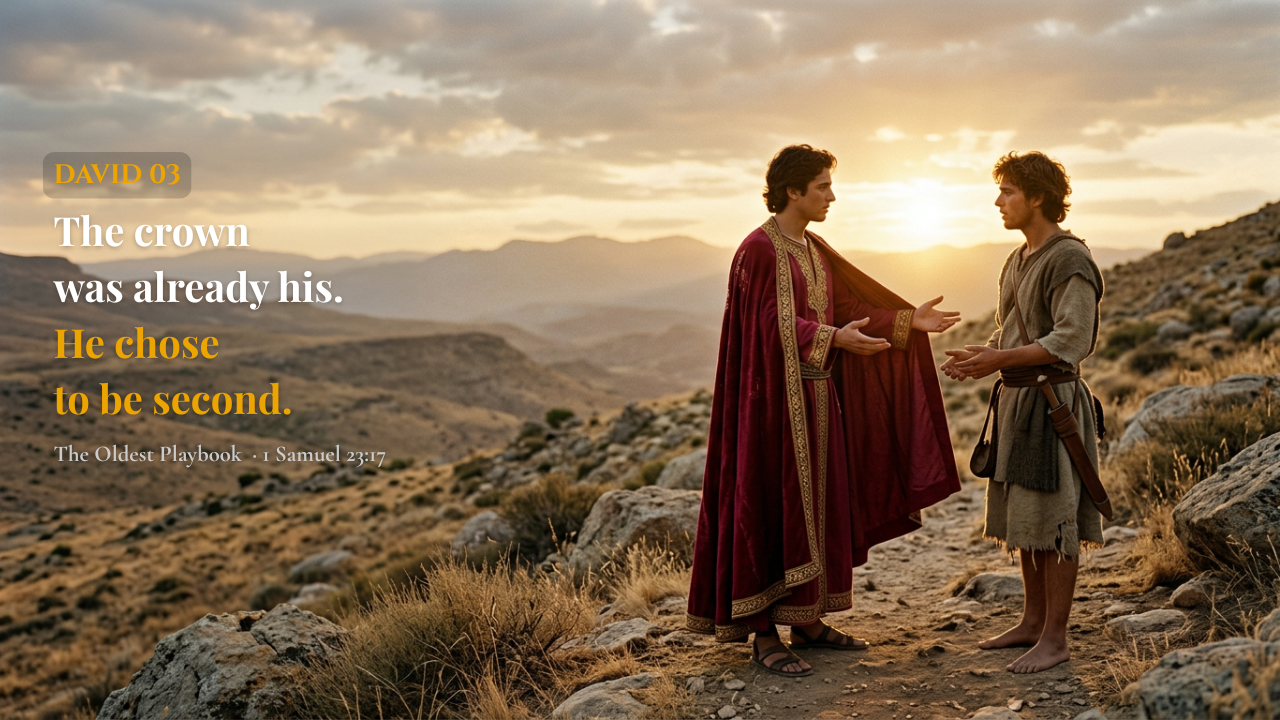
Instead, Jonathan says this: "Don't be afraid. My father Saul will not lay a hand on you. You will be king over Israel, and I will be second to you. Even my father knows this." (1 Samuel 23:17)
Sit with all three movements of that sentence.
You will be king. Not a guess. Not comfort for a scared friend. A declaration about the future.
And I will be second to you. He's owning his own demotion. The heir, calling his own descent the correct order of things. No bitterness. No negotiation.
Even my father knows this. This is the line that stops the room. Saul has spent the whole story trying to kill David, and Jonathan names the reason out loud: Saul isn't in denial. Saul knows David is going to be king. He's just trying to prevent the inevitable. The court knew. The son knew. The only open question was whether anyone around David could make peace with it.
Jonathan made peace with it. Out loud. In the wilderness. At the lowest point.
So go back to chapter 18. That robe was not an impulse. It wasn't a nice guy being affectionate, the beta to David's alpha, the kind of thing the macho executive reads and dismisses as weakness. Chapter 23 tells us what chapter 18 really was. Jonathan had looked at the full picture, asked himself the hard question, and said yes from the very beginning. The robe wasn't sentiment. It was a decision. Made with eyes completely open, repeatedly, at cost to himself.
That's the rarest thing in the room.
In forty years of watching people build things, companies, partnerships, movements, I can count on one hand the people I've seen do what Jonathan did. To look at someone rising and say "yes, that's right, I'll be second, I'll be third" and truly mean it. It almost never happens among founders. Almost never among partners. The default is Saul: get jealous, get angry, hold on hard to what's yours.
Three Markers of a Relationship Worth Building On
These aren't three steps to find a Jonathan. They're three signs you're becoming one.
One. You're for their mission, not just for them.
Jonathan wasn't rooting for David to have a nice career. He understood David carried something larger than either of them, larger than their friendship, larger than the whole country. His loyalty wasn't to personal affection. It was to a shared orientation toward a purpose that exceeded them both.
Run that through a partnership. Everyone says "we're all here for the vision." Fine. But here's the real test: are you for the vision when the vision doesn't put you on top? Can you go after something bigger than yourself even when bigger-than-yourself means you're not the one wearing the robe? Jonathan could. He had the throne in hand and he let it go for a vision that demoted him.
Two. You tell them the truth.
In chapter 20, when Jonathan confirms his father genuinely intends to kill David, he doesn't soften it. He builds an operation to deliver it, the famous arrows, a signal worked out in advance so David would know the truth even from a distance. He could have stayed quiet and let Saul do the work for him. He didn't. He gave David exactly what David needed to make the right decision, even though the truth would separate them.
The most dangerous dynamic in a close professional relationship isn't conflict. Conflict is a normal Tuesday. The dangerous thing is managed conflict, where both people protect the warmth of the relationship by never saying the hard thing. That's just a polite word for lying to each other. A relationship like that feels safe right up until the moment it has to carry real weight. Then it collapses.
We do this most with the people we're closest to. We patronize our partners and our co-founders to protect them. Jonathan refused. He told David when the spear was coming. Don't we all want that person watching our back? Then the question turns around: why aren't we being that person?
Three. The relationship survives the end of the arrangement.
After the arrows, David and Jonathan separate. The text doesn't say they teared up. It says they wept, the kind of weeping that breaks a person. Then David went his way and Jonathan walked back into his father's court, back into danger, with no guarantee of his own safety.
The relationship didn't need proximity to stay real. It didn't need shared upside to hold. It wasn't contingent on the deal continuing, the company surviving, or the circumstances staying convenient.
So here's the diagnostic, and it isn't rhetorical: how many of your professional relationships would survive the end of the business?
The answer tells you what you've actually been building. And who you've actually been being.
This Isn't a Religious Thing
Don't file this under faith and set it aside.
Think about the PayPal mafia. Early on, it's Elon's company. Then Peter Thiel comes in, and through the turns of that story Elon ends up giving up the top seat, dropping to second or third in the thing he started. He could have gone nuclear. The upside wasn't tilted his way anymore. By every normal incentive, that's where the relationship ends.
He took the Jonathan posture instead. In interviews he's talked about how he thought it through and landed on the same question Jonathan answered: what's actually better for everyone here? And the answer was the vision, not his seat at the table. He swallowed the pride and the self-interest for the bigger thing.
Elon isn't running a Bible study. He just behaved like a rational, whole human being who could see past his own position.
That's the whole point. This is older than any one faith and more practical than it sounds. It's a marker of a quality person.
The Question to Carry Out
So I'll leave you with the one question I wanted you holding from the start.
Not: who's in my corner?
Not: do I have a Jonathan?
Are you a Jonathan to someone?
Is there a person whose rise you're genuinely backing, even when it doesn't crown you? Someone you tell the hard truth to, even when it might cost you the relationship? Someone you'd still be loyal to if the deal fell apart tomorrow?
If there is, that's the rarest thing you've got. Protect it.
If there isn't, that's the work.

The Oldest Playbook Newsletter
Join the newsletter to receive the latest updates in your inbox.