David 02: Why David Kept Winning
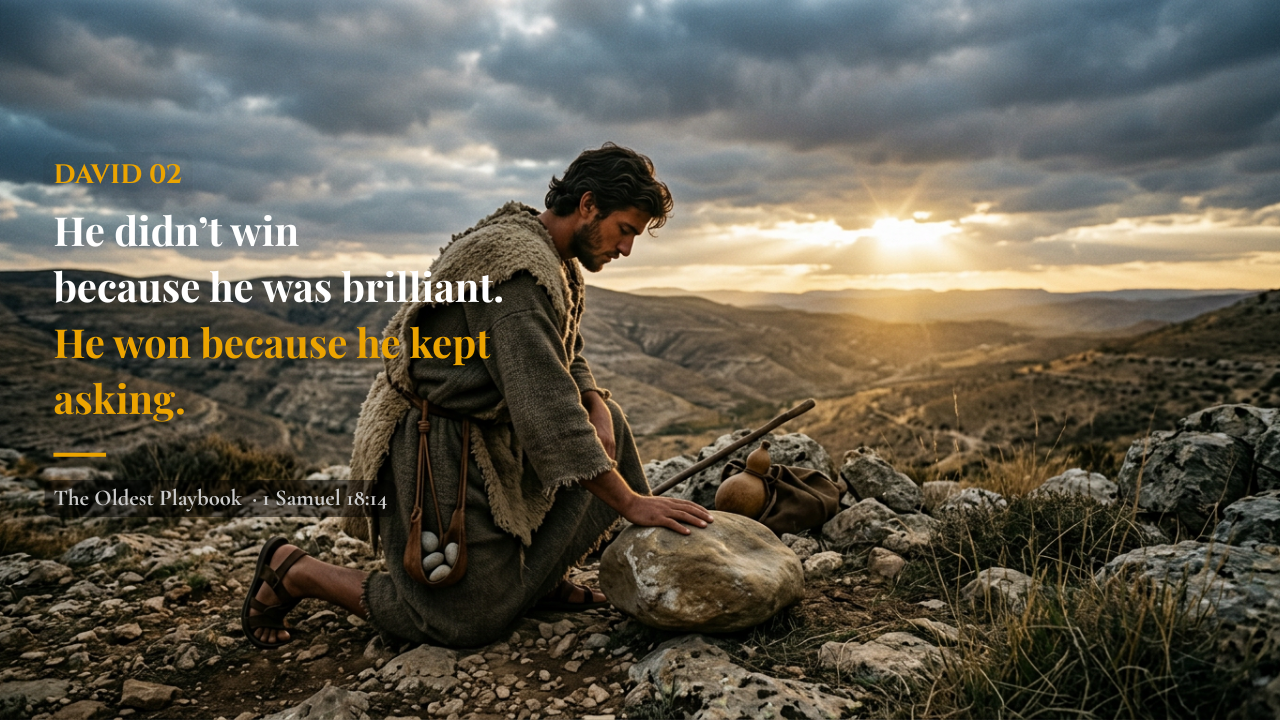
The Oldest Playbook — DAVID 02 | 1 Samuel 18:14

There is a person in every room who just keeps winning.
Same market. Same resources. Sometimes less. And they keep winning.
You've watched them. You've wondered about them. Some of us have tried to copy them—their habits, their frameworks, their morning routines. We buy their books. We listen to their podcasts. We try to apply their methods. There's no shortage of gurus on LinkedIn and social media telling us what works.
And still. The gap is there.
The question most of us are too proud to say out loud is this:
What do they have that I don't?
That's a human question. A genuine one. And it's not new — people have been asking it as long as humans have gathered in society.
Today, I want to find the answer from a text that is 3,000 years old. Because the question is that old. And so is the answer.
The One Sentence That Changes Everything
Let's go to 1 Samuel 18:14.
David has just killed Goliath. King Saul has recruited him and put him in charge of an entire army. And Scripture gives us one single summary sentence about David's entire tenure:
"In everything he did he had great success, because the Lord was with him."
Read that slowly. Not in some things. Not often. In everything he did.
Military campaigns. Personal decisions. Political relationships. Negotiations with enemies and allies. Everything. Consistent. Repeatable. Across domains.
Now, here's what the people around David saw.
His soldiers saw a military genius. A tactician who read battlefields better than anyone alive.
His enemies saw luck. A young man who caught a giant on a bad day and rode the reputation for years.
The people of Israel saw charisma. A man who could inspire soldiers to die for a cause and make them feel honored to do it.
These are reasonable observations. They are also all wrong about the cause.
The text does not say David succeeded because he was brilliant. It does not say he succeeded because he was charismatic. It does not even say he succeeded because he worked harder than everyone else.
It says: because the Lord was with him.
We live in an era that turns success into a formula. Every business book, every podcast, every conference keynote is hunting for the repeatable inputs that produce the desirable outputs. So when we see someone like David, someone who just keeps winning, we do what analysts do. We audit the visible mechanics.
How early does he wake up? What's his hiring philosophy? What frameworks does he use? What does he eat for breakfast?
Sometimes those things are worth learning. I'm not against frameworks.
But we make a category error when we assume the visible mechanics are the actual variable. We're modeling the shadow and missing the source.
The most important variable in David's success was invisible to every observer in the room. And it is invisible to most of the people studying the winners in your industry right now.
Presence Is Not a Status. It's a Practice.
I want to be careful here, because "God was with him" can become a bumper sticker fast.
Okay, great. What do I do with that on Monday morning?
Let me show you what it actually looked like in David's life.
Turn to 1 Samuel 23. David is a fugitive, hiding in the wilderness. A town called Keilah is under attack by the Philistines. And before David does anything (before he rallies his men, before he draws up a battle plan) he asks.
"David inquired of the Lord, saying, 'Shall I go and attack these Philistines?'" — 1 Samuel 23:2
His men push back. These are strong, reasonable men, his mighty warriors, his co-founders and business partners, effectively. They say: we're already in danger here, why would we go looking for a fight?
David does not override them with confidence. He doesn't bulldoze. But he doesn't capitulate either.
He goes back and asks again.
"Once again David inquired of the Lord, and the Lord answered him." — 1 Samuel 23:4
Notice what triggered the second inquiry. It wasn't doubt. It wasn't confusion. It was social pressure. His men pushed back, and instead of using their fear as permission to stand down, or using his own confidence to steamroll the room, he returned to presence. He went back to the source.
Most operators in a room of frightened lieutenants will do one of two things: override the room, or give in to it. David did neither. He used the pressure as a signal to re-inquire.
That is a specific skill. And most people don't have it.
Ask yourself: when your team challenges your read, what does that trigger in you? More analysis? Defensiveness? Capitulation? Or do you have a structure — a practice — that you return to before you call the play?
Here's the thing about presence: it is not a mystical condition that lands on you from the sky. It is the output of a practice.
It's not a status. It's not luck. It is the result of a repeated practice of orientation — of consistently turning toward something larger than yourself before you move.
Whether you frame that as prayer, as epistemic humility, or as a decision-making architecture, the evidence for it runs thousands of years deep. You see it in Scripture. You see it in Harvard Business Review. You see it in the 200-year-old companies that are still standing while the average publicly traded company today lasts 18 years.
The most dangerous operator in the room is the one who trusts only his own read of a situation. The best operators I've seen, worked with, and respect, they have built-in mechanisms for input that exceeds their own perspective.
David had that. Structurally. Habitually. As a non-negotiable.
And the text tells us exactly what happened when he used it: in everything he did, he had great success.
You do not acquire presence once. You return to it daily.
The Sauline Trap
There is a man standing right next to David in this story. His name is Saul.
Same country. Same enemies. Same battlefield. Same era.
While verse 14 says the Lord was with David, we already know from chapter 16 that the Lord had departed from Saul.
Same throne. Opposite trajectories.
Saul started well. Read 1 Samuel 10. He is anointed, the Spirit of God comes on him, he prophesies, he wins battles. His early metrics are outstanding. As an investor, that's exactly who you want to back.
But slowly, quietly, over time — Saul stopped asking. He stopped orienting. He started trusting his own read of situations. His fear. His judgment. His political instincts.
In 1 Samuel 13, the Philistines are massing. His army is deserting. And instead of waiting for Samuel (instead of returning to the practice that connected him to the source of his wins) Saul just reacts. He trusts his own timing. He moves.
Samuel arrives right after and says: because of this, your kingdom will not endure.
Not because one battle went badly. Not because of one failed campaign. Because of one decision to trust himself over the orientation practice that made him who he was.
The question for you is not: How do I win more? That is Saul's question. The wrong question.
The question is: What am I doing that makes me someone worth being with?
Saul's problem was not strategic. It was not military. It was not relational. The presence had left. And without presence, every tactic eventually fails.
Every business will eventually face a version of 1 Samuel 13. The army is deserting. The enemy is massing. The temptation to trust your own head is overwhelming.
The operators who last are the ones who built something underneath the strategy (a consistent practice of orientation) that holds even when the pressure is highest.
The Engine Underneath
Last Concert, we talked about the Five Stones. Building for 500 years, not five. Thinking in generations, not quarters.
Today's text gives you the engine underneath that thinking.
The companies that get chosen again across cycles, across generations, across borders are not the most efficient. Not the most innovative. Not always the best-funded. The average publicly traded company today is 18 years old. But there are businesses 200-plus years old, still standing across market conditions no one could have predicted. Something underneath those companies outlasts any single founder, any single product, any single era.
That something is what David had. And what Saul lost.
The businesses that last are the ones where the founders stayed oriented to something larger than their own ambition. Where they kept asking before they moved. Where they built the practice into the DNA of the organization, not just their personal routine.
Three Practices. Pick at Least One.
I'm not interested in leaving you with questions you can't answer.
1. The pre-decision pause. Before any decision you cannot reverse (before any major negotiation) your first instinct should not be to gather more data. And it should not be to open ChatGPT and ask it a million and one questions until you're paralyzed by analysis. That's not what David did. What David did was inquire before the battle, not after. The sequence matters. Build the pause into your system before you call the play.
2. The accountability structure. Someone in your life — and this cannot be a yes-person, and it probably shouldn't be your employee, because your employee is incentivized to agree with you. That's Saul's posture. He had yes-men around him. You need people who are empowered to reorient you. Who can say: wake up, focus, no. People with explicit permission to keep you accountable.
3. The return practice. Not perfection. Return. When you catch yourself operating from fear (when you notice you've gone back to your old ways) you need to know what reorientation looks like specifically for you.
For me, the thermometer is my family. When I'm in a fluster, I get agitated by everything around me. I snap at my kids. I'm short with my wife. That's when I know I've drifted. My family's response to me is one of the most reliable metrics I have for whether I've returned to the right practice.
Find your thermometer. Name it. Use it.
You don't need all three today. You need at least one. Institute it. Protect it like the most valuable asset in your portfolio.
Because it is.
The Close
David was not a man who never failed.
Consistently successful does not mean he never got it wrong. He was a man who always returned. The practice is not what earns the presence. The practice is what makes you someone who knows the direction home, so that when the pressure spikes and you move on instinct and you get it wrong, you're not lost. You're just temporarily off-axis. And you know how to reorient.
Saul never built that. When he drifted, he had no way back. The fear filled the space. He kept looking over his shoulder. He grew jealous of someone younger, someone he should have been mentoring, someone like his own son. That's a very sad ending. And it's an ending none of us want.
The difference between David and Saul was not performance. It was orientation.
So here is the question I want to leave you with today.
Not, what is your strategy?
Not, what is your funding plan?
Not, what is your market thesis?
What is your practice of presence?
What do you do (consistently, structurally, before major decisions) that keeps you oriented to something larger than your own read of a situation?
If you have one, protect it.
If you don't have one yet, that's what we're here for.

The Oldest Playbook Newsletter
Join the newsletter to receive the latest updates in your inbox.