David 01: The Difference Between Winning and Lasting
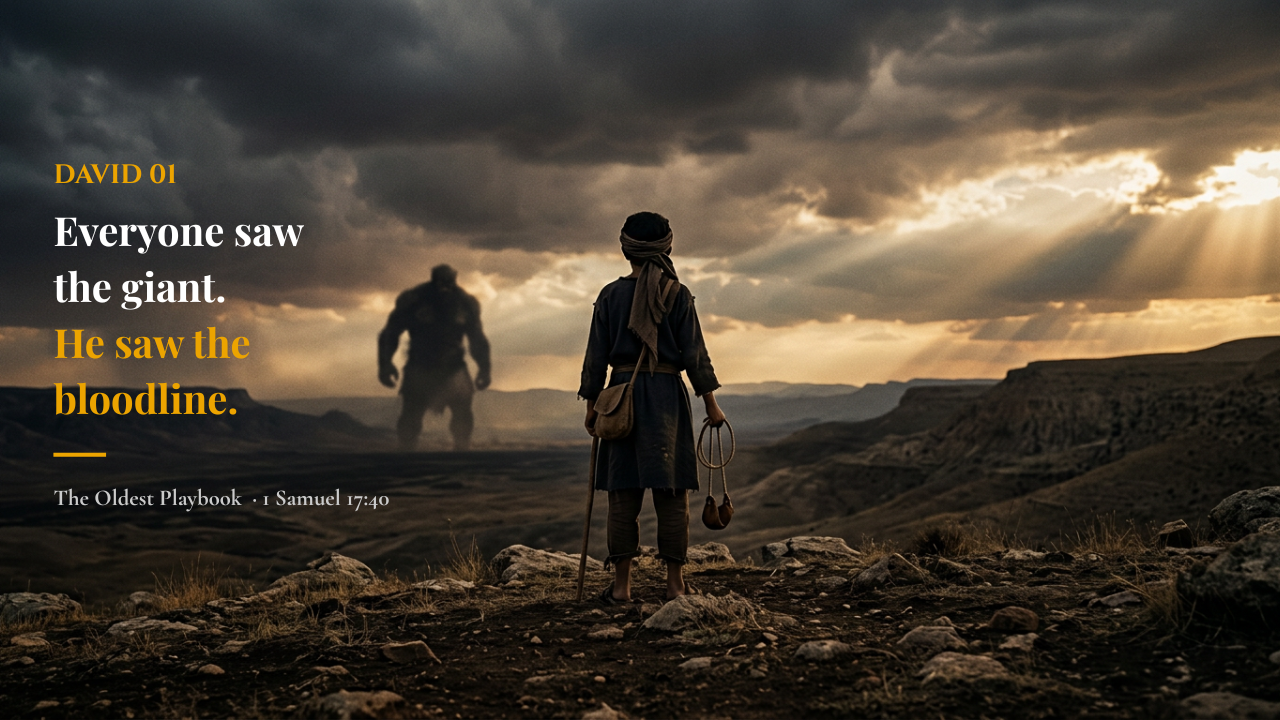
The Oldest Playbook — DAVID 01 | 1 Samuel 17:40

Why Did He Pick Five Stones?
Everyone knows the story of David and Goliath.
Boy fights giant. Boy wins. Faith beats force.
We've told that story so many times it's become wallpaper. And the moment a story becomes wallpaper, you stop reading it. You stop hearing what it's actually saying.
Here's what most people miss: David picked up five stones.
He only needed one. He used one. But the text says he chose five. And the Bible isn't random. Every detail is load-bearing.
1 Samuel 17:40 — "Then he took his staff in his hand, chose five smooth stones from the stream, put them in the pouch of his shepherd's bag, and with his sling in his hand approached the Philistine."
Twelve seconds of action. One verse. But between an army hiding in the trenches and a giant laughing at a boy, David does one thing.
He counts to five.
Five Is Not a Faith Number. It's a Planning Number.
In Jewish, Muslim, or Christian tradition, five has no special theological significance. The text isn't signaling mysticism. It's signaling foresight.
Fast forward twenty-odd chapters. David is now king. He's old and tired. And in 2 Samuel 21, four more giants come out of the same city—Gath. Goliath's hometown. The text even gives us their names: Ishbi-Benob, Saph, Lahmi (the brother of Goliath, carrying the same spear), and an unnamed giant with six fingers on each hand and six toes on each foot.
Four giants. Four battles. All descendants of Rapha. All from the same bloodline.
Now go back to the brook.
One Goliath in front of him. Four brothers waiting in Gath.
Five stones.
The text knew exactly what it was doing. The teenager at that brook knew exactly what he was doing. He wasn't loading up out of doubt. He was loading up out of foresight.
David didn't fight a giant. David fought a household.
The first stone takes the giant. The next four take the lineage.
Every Win Has a Family of Consequences.
You're not fighting Philistines. You're building companies, closing rounds, negotiating deals, managing launches.
But the structure is identical.
Most operators sling the stone, kill the giant, and stop counting. The win feels complete. It isn't.
When you sell a company, you forget that selling means integration risk, talent flight, brand transition, and founder identity collapse. That's four more giants from the same household.
When you IPO, you forget that public means quarterly. And quarterly means abandoning the long-game operating philosophy that got you there in the first place. Again, one giant killed, four more born.
The five-stone operator counts the family before throwing the first stone. That's not caution. That's planning. That's the job.
Why Don't Most Operators Count to Five?
The average S&P 500 company today is 18 years old. In the 1960s, the average was 60. Thousands of companies that existed decades ago are gone. A handful, many of them over 100 years old, concentrated in Japan and Germany, are still standing.
The ones that survived didn't outlast the rest because they were smarter. Plenty of smart companies died at 18.
They outlasted because they operated as if the kingdom mattered more than the king. The company mattered more than the founder. That's a five-stone move.
You can only think in five stones if you believe time is going somewhere. If this life is all there is, one stone makes perfect sense. Swing, win, exit, collect. That's rational.
But if there's a sovereign plan, if your name will be spoken by someone you'll never meet, then five stones is the only rational number.
Multi-generational thinking isn't a tactic. It's a metaphysics. You either believe time is meaningful past your own lifespan or you don't. The way you build betrays which one you actually believe.
The Move This Week
Name your current fight. That's one stone.
Then sit with it and ask:
"When I win this, what are the four giants that show up next?"
If you can name two or three, you're ahead of most. If you can't name any, you're rushing. You're a one-stone operator pretending to be a five-stone operator. Stop. Count again.
Don't think of this as homework. It's a discipline. A framework.
Pick up your five before you swing your one.
One Last Thing
When David walked to that brook, Samuel had already anointed him king. He knew he was going to be king. But I suspect he didn't know the faces of the giants he'd face. He didn't know their names. He didn't know how hard the fights would be, or when they'd come.
He didn't know that thousands of years later, people would still be talking about him.
But he still counted to five, picked up his stones, and walked forward.
That's the whole job.
Count. Pick up. Walk forward.
Your kingdom is bigger than the fight in front of you. The bloodline is bigger than the giant. And the playbook is older than any of us.
The Concert, hosted by The Oldest Playbook, is a weekly gathering for business operators who want to build something that lasts. Live and free, every week. Join us at OldestPlaybook.com.

The Oldest Playbook Newsletter
Join the newsletter to receive the latest updates in your inbox.