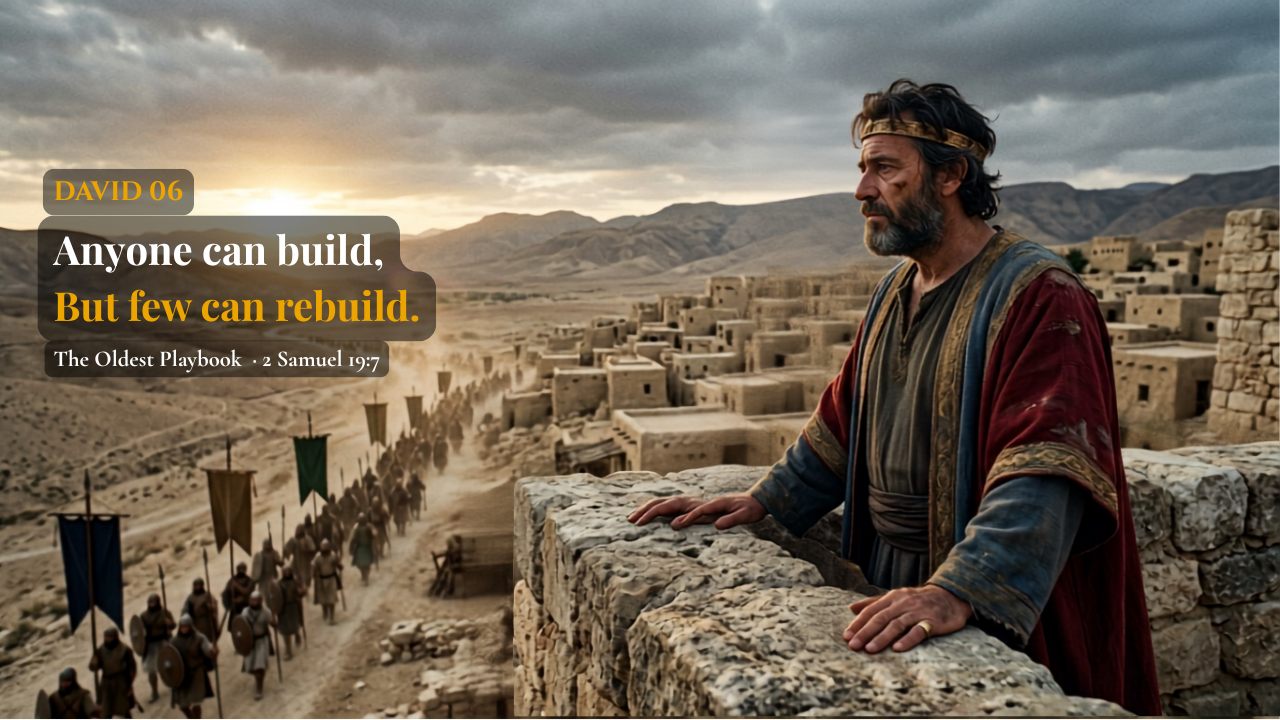
David 06: Anyone Can Build, But Few Can Rebuild

There's a saying in the startup world that the riskiest moment isn't the launch. It's the comeback. Anyone can start something. Almost no one can rebuild it after it breaks.
I see this every week. I get pitched by 30-50 founders, and almost all of them are good at the same thing: starting. The blank page, the open road, the momentum of something new.
Starting has its own energy, and ambitious people are wired for it. It's hard, but it's exhilarating, and most of them can do it.
Rebuilding is a completely different skill. Rebuilding is what you do after the thing you started has crashed. After the failure. The betrayal. The scandal. After the trust is gone, the team has scattered, and the story everyone tells about you is the story of your worst moment.
And here is the brutal asymmetry at the center of it. Collapse is instant. Restoration is slow. A reputation built over twenty years can fall in a second. A trust established over a decade can break in a single sentence. But rebuilding what was lost in that instant takes years, and sometimes it never fully becomes whole again.
Anyone can build. Few can rebuild.
For five weeks we've watched the most successful man in the Old Testament. We watched him rise, watched him win, watched him sin. We watched his family collapse under the weight of what he would not confront. Last week we left him at the gate, weeping for a son whose death traced straight back to his own failure.
Today is the last concert in the arc of King David. And it's about the hardest thing he ever did. Harder than Goliath. Harder than the wilderness years. Harder than building the kingdom the first time. Today is about how David rebuilt what his own sin had torn down, and about the God who specializes in rebuilding ruins.
A Leader Does Not Get to Stay in Grief
When we left David, he was crying out at the gate.
"O my son Absalom. My son, my son."
His grief was real. It was earned. In a sense it was righteous...a father had lost a son.
But watch what that grief does to everyone around him.
David's army had just fought a civil war to save his life and his throne. They risked everything. They came back from the battlefield victorious, but instead of a king who honored their sacrifice, they found a king so consumed by mourning that the whole army crept back into the city in shame. 2 Samuel 19:3:
"The men stole into the city that day as men steal in who are ashamed when they flee from battle."
The people who saved him were made to feel like criminals. The victory felt like a defeat.
And then a familiar figure walks back into the story. Joab.
The same Joab we've wrestled with across this whole series: David's commander, the man capable of cold and terrible things, the one who killed Absalom against David's explicit order. And here Joab does what no one else in the kingdom is willing to do. He walks into the presence of a grieving king and tells him the truth. 2 Samuel 19:6–7:
"You have made it clear today that the commanders and their men mean nothing to you. Now go out and encourage your men. If you don't, not a man will be left with you by nightfall."
Harsh. Brutal. And exactly true. Exactly what David needed to hear.
Here's the principle, and it's one of the hardest truths of leadership:
A leader does not get to stay in grief.
Not because the grief isn't real. Not because it doesn't matter. Not because the leader isn't a human being. But because the people who depend on you cannot survive your indefinite collapse.
This is one of the loneliest things about carrying responsibility. Everyone else gets to fall apart. Your team can grieve a failed product, a lost client, a layoff, and then they go home.
BUT you? The owner, the executive, the leader. You have to feel all of it, and then stand up in front of the room the next morning and give people a reason to keep going. Your private grief is real. Your public responsibility does not pause to accommodate it.
This is not a call to suppress your grief. David's grief was holy, and yours is too. It's a call to recognize that there's a season for it, and that the people you lead are watching to see whether you will eventually rise. 2 Samuel 19:8 tells us David got up and took his seat in the gateway, the seat of governance. He returned to his post. The grief was honored, and the king went back to work.
Three Moves of Restoration
So David rises, and now he faces the real work: rebuilding a kingdom his own family's collapse had torn in two. And the way he does it is deeply instructive, because it runs against the very instinct a wounded person has.
When you've been betrayed—when people turned against you, followed your rival, celebrated your downfall—the instinct is to come back with a blacklist. A hit list. A reckoning.
"Now that I have my power back, here's what happens to everyone who stabbed me in the back."
David, however, does the opposite. And he does three things worth naming.
1. Reach for your own first.
David's first move is not to punish the rebels. It's to reach out to Judah, his own kinsmen, the people closest to him who had nonetheless gone over to Absalom. 2 Samuel 19:12:
"Why should you be the last to bring the king back? You are my own flesh and blood."
He doesn't lead with grievance. He leads with belonging. He reminds the people who betrayed him that they are still his...that the door back is open, that restoration, not retribution, is the goal. Rebuilding starts quietly, with the costly rewinning of the hearts nearest to you. The ones whose betrayal hurt the most.
2. Choose mercy over the reckoning.
Then comes Shimei, the man who, when David was fleeing for his life, walked alongside him throwing stones and curses, calling him a murderer, kicking him while he was down. Now David is back in power, and here is Shimei, suddenly repentant, begging for his life. David's general says the obvious thing: let me kill him, he cursed God's anointed, he deserves it. And David refuses. 2 Samuel 19:22:
"Should anyone be put to death in Israel today? Don't I know that today I am king over Israel?"
David understood something about the moment of restoration. The day you regain your power is exactly the wrong day to use it for vengeance. A restoration built on a bloodbath is not a restoration, it's just the next cycle of the same violence. He chose to absorb the insult rather than avenge it, because he was trying to rebuild a kingdom, not win an argument.
Anyone who's married understands this. Whatever the teardown between you and your spouse, when there's a chance for peace, your goal isn't to be right. Your goal is to rebuild.
3. Never forget who stood with you when it was costly.
In the middle of all this, David pauses to honor Barzillai, an old man who provisioned him during the fight, when supporting David was dangerous and unpopular. In the chaos of rebuilding, David stops to remember and repay the one who was faithful when faithfulness cost something.
Reach for your own first. Choose mercy over the reckoning. Never forget those who stood with you when it was costly.
The Part the Comeback Story Always Leaves Out
Now I have to tell you the honest part. The part the polished comeback story always edits out.
David does all of this. He rises from his grief. He reaches for his kin. He chooses mercy. He honors the faithful. He does the work of restoration with wisdom and grace.
And it still wasn't clean. It still wasn't finished.
The very next thing that happens, immediately after all that careful rebuilding, is that the old fractures crack open again. Israel and Judah fall into bitter argument over who owns the king. And out of that argument, a man named Sheba launches a fresh rebellion. 2 Samuel 20:1:
"We have no share in David, no part in Jesse's son. Every man to his tent."
David gets his body back to Jerusalem, back to the throne. But the unity is not restored. The wounds are not healed. One rebellion ends, and another begins almost the same day.
Here's what I want you to take from this, especially if you're carrying the weight of something you're trying to restore right now.
Restoration is not clean. It's not a Hollywood arc. Often it's partial. Often it's slow. Often you fix one fracture and another opens. Often you will not live to see the thing fully healed, and you have to do it anyway.
The mark of a real leader is not that they restore things perfectly. It's that they keep doing the work of restoration even when it's incomplete, even when it's unglamorous, even when they know they may never see it finished. David spent the rest of his life with a kingdom never quite as unified as it had been before his sin. The consequences didn't disappear. But he kept governing. He kept rebuilding.
This is what it means to steward something across a long horizon. You are not promised completion. You are responsible for faithfulness.
We live in a generation built on the heroic arc: I act, the victory is won, I reap the reward. But the real shape of restoration is different. You do the seeding. The harvest may belong to the next generation.
And the question every business person has to ask is this:
"Could you build something you might never reap the full benefit of, but the next generation will? Is a business like that worth building? Or would you rather forget it and start all over?"
The God Who Rebuilds Ruins
Step back and look at the whole arc one more time.
Six weeks with this man. King David rose from a shepherd's field to a throne. He defeated giants. He united a nation. And then, at the height of his success, he committed adultery and murder. He watched his family disintegrate: the assault of his daughter, murder between his children, the rebellion of his son. He was driven from his own city in flight. He wept at a gate for a child whose death he had set in motion.
By any honest accounting, David fell about as far as a human being can fall. And he did it after he had everything.
He is not the story of a man who never failed. He is the story of a man who failed catastrophically, in exactly the ways that should have ended him.
And yet the story does not end in his ruins...because the God David served is not a God who leaves fallen pieces fallen. Isaiah 61:4:
"They will rebuild the ancient ruins and restore the places long devastated. They will renew the ruined cities that have been devastated for generations."
This is who God is. Not a God who only works with the unbroken and the perfect. Not a God who only builds on clean ground. A God who walks into the rubble of a life (a life ruined by its own choices) and begins to rebuild.
From the wreckage of David's house, through the very marriage that began in his worst sin, came Solomon. The wisest king. And through that line, generations later, came the one the whole story was pointing toward: Jesus.
God took the most ruined chapter of David's life and built a redemption story directly through it.
That is the God who rebuilds ruins. And that is the hope at the center of this entire arc.
So here's what I want to leave you with.
Some of you are in a season of building, and it's going well. I'm glad for you. Praise God. But carry the warnings of David with you. The most dangerous season is the one after you win. The things you will not confront will eventually have to be grieved.
But some of you are not building right now. Some of you are in the rubble. Something has collapsed: a company, a marriage, a reputation, a relationship, a version of yourself you can no longer get back. And the story everyone is telling about you (maybe the story you're telling about yourself) is the story of your worst moment.
To you, the word of this entire series is one thing:
Collapse is instant. Restoration is slow. But it's real.
The God who rebuilds ancient ruins is not finished with you.
No matter how far the fall, no matter how much of it was your own doing, David's life teaches us that you can fail as badly as a person can fail...and still get up, still do the slow work, still be used for something good and great.
The fall is not the end of the story. The rubble is not the end of the story, as long as there is a true turning, a real repentance, an honest return. There is a God who rebuilds.
Anyone can build. Few can rebuild. But the God we serve rebuilds ruins.
So get up, and walk the slow road home.
Two Questions for This Week
I usually leave you with three. Today, just two.
- Where are you stuck in grief the people around you need you to rise from? Not to suppress it. David's grief was holy, and yours is too. But who is depending on you to eventually stand up, take your seat at the gate, and go back to work? Honor the grief. Then rise.
- What are you rebuilding that you may never see finished, and are you willing to do it anyway? Restoration is rarely clean and rarely complete. You are not promised the harvest. You are responsible for the faithfulness. What is the slow, unglamorous work of rebuilding in front of you right now, and will you keep doing it even if the only thing you're guaranteed is that it's the right thing to do?

The Oldest Playbook Newsletter
Join the newsletter to receive the latest updates in your inbox.